The first thing Alejandro remembered after surgery was the sound of machines.
Not voices.
Not pain.
Machines.
A steady beep beside his bed. The soft hiss of air. Wheels passing in the hallway. Someone speaking behind a curtain in a low voice. His mouth tasted like metal and medicine, and when he tried to move, his entire lower body answered with a pain so large it seemed to have its own heartbeat.
He opened his eyes slowly.
A nurse noticed immediately.
“Mr. Aguilar? You’re awake.”
He tried to speak, but his throat was dry.
The nurse lifted a small cup with a straw. “Tiny sip.”
He drank, swallowed, and winced.
“My legs,” he whispered.
The nurse’s face softened in the way medical workers soften when the truth is too heavy to drop all at once.
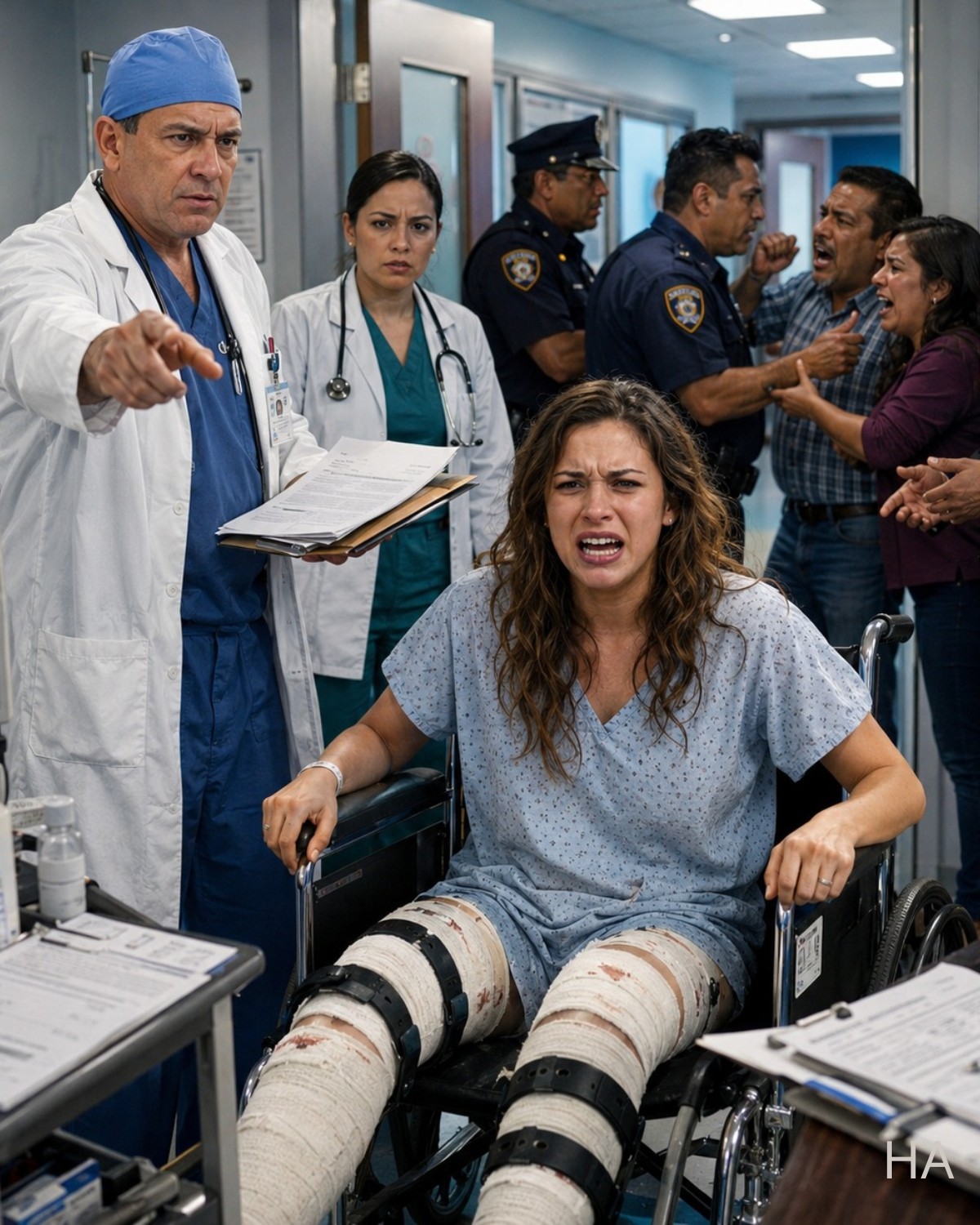
“You’re out of surgery. The orthopedic team repaired both tibias. You have rods and screws stabilizing the fractures. You’re going to be monitored closely.”
Alejandro stared at the ceiling.
Both tibias.
Rods.
Screws.
His father’s crowbar had become part of his bones.
A few minutes later, Dr. Harris came in. She was the trauma surgeon who had spoken to him before surgery, calm, direct, with silver glasses and eyes that missed nothing. She stood beside his bed holding a tablet.
“You did well,” she said. “The surgery was difficult, but successful.”
“How bad?”
She did not pretend.
“Severe. Your right leg had an open tibial fracture with soft tissue damage. Your left leg had multiple fractures but no open wound. You’ll need physical therapy, wound care, and likely at least one additional procedure later. You won’t put weight on either leg for some time.”
Alejandro closed his eyes.
He thought of his job site. Steel beams. Concrete schedules. Blueprints. Stairs. Ladders. Mud. Work boots.
Now he could not even sit up without help.
Dr. Harris lowered her voice. “The police are waiting to take a statement when you’re ready.”
“Is my father still arrested?”
“Yes.”
“My family?”
“No one has been allowed into your room yet.”
Yet.
That word made Alejandro’s stomach tighten.
Dr. Harris noticed.
“Do you want visitors?”
He did not answer quickly.
For thirty-four years, the word family had been treated like a law in the Aguilar house. Family comes first. Family forgives. Family does not call police. Family does not put blood in jail. Family does not let outsiders know what happens inside.
But his father had stood over him with a crowbar and said every day he would remember what happened when he refused to pay.
Alejandro opened his eyes.
“No,” he said. “No visitors.”
Dr. Harris nodded once, like she had been hoping he would choose himself.
“I’ll put it in your chart.”
Two hours later, his mother tried anyway.
Alejandro heard her before he saw her.
Maria Aguilar’s voice carried down hospital hallways the same way it carried through family parties, church kitchens, and every room where she believed tears could force a door open.
“I am his mother. You cannot keep me from my son.”
A security guard answered quietly.
Alejandro could not make out the words.
Then Maria cried louder.
“He needs his family.”
The word hit Alejandro like another blow.
His hands gripped the blanket.
A nurse stepped inside. “Mr. Aguilar, your mother is asking to see you. You said no visitors. Do you want to keep that order?”
His chest tightened.
Old guilt rose fast.
She’s your mother.
She’s scared.
She didn’t swing the crowbar.
Then he remembered something else.
All the years she had said, “Your father is just worried.”
All the times Martín failed and Alejandro paid.
All the times Maria called him selfish for having boundaries and responsible for having money.
He looked at the nurse.
“No visitors.”
The nurse nodded. “Understood.”
Outside, Maria began sobbing.
Alejandro turned his face toward the window and let her cry without rescuing her.
That was the first act of recovery.
Not walking.
Not standing.
Refusing to open the door.
The police took his statement that evening.
Detective Rachel Moore sat beside his hospital bed with a recorder, a notebook, and the quiet patience of someone trained not to rush injured people. Her partner stood near the door.
Alejandro told them everything.
The text from his father. The blocked truck. The missing boxes. The chair in the middle of the garage. The demand for $4,000 a month. The crowbar. The first strike. The second. The words afterward.
“Every day you’ll remember what happens when one doesn’t help his family.”
Detective Moore wrote that sentence down exactly.
Then she asked, “Did your father threaten you before the first strike?”
“Yes.”
“Did you attempt to leave?”
“Yes.”
“Was the exit blocked?”
“Yes. His truck was parked across the driveway.”
“Had he ever been violent with you before?”
Alejandro hesitated.
The easy answer was no.
The true answer was more complicated.
“He never broke bones before,” he said.
Detective Moore looked up.
“That’s not what I asked.”
Alejandro swallowed.
His father had slapped him once when he was sixteen for saying Martín should clean his own mess. He had shoved him into a wall at twenty-two when Alejandro refused to co-sign a loan. He had grabbed the back of his neck at twenty-nine and called him useless because he would not pay Martín’s gambling debt.
None of those had seemed like violence at the time.
They had seemed like Roberto Aguilar being Roberto Aguilar.
Alejandro told her.
Detective Moore listened without surprise.
When he finished, she said, “Your medical records and the scene evidence support your statement. There were no boxes in the garage. The chair placement and vehicle position were documented. The crowbar was recovered.”
Alejandro exhaled shakily.
He had not realized until then that part of him feared nobody would believe him.
Even with broken legs.
Even with blood on concrete.
That was what family abuse did. It trained the victim to prepare a defense against reality.
Detective Moore closed her notebook.
“Mr. Aguilar, your father is currently being held on charges including aggravated assault with a deadly weapon. Depending on the prosecutor’s review, additional charges may be filed.”
“My mother will say I’m destroying the family.”
Detective Moore’s expression did not change.
“Your father did that when he attacked you.”
The sentence was simple.
It sounded impossible.
For the next week, Alejandro’s hospital room became a battlefield without his family inside it.
Messages came through cousins, aunts, old neighbors, church friends, and people who had not spoken to him in years but suddenly felt qualified to advise him about mercy.
“Your dad lost control for one second.”
“You know how stressed he’s been about Martín.”
“Prison will kill your mother.”
“Families handle things privately.”
“Think about your nephew.”
Then came Martín’s message.
“Bro, this is insane. Dad didn’t mean to hurt you that bad. You know he’s old school. Can you just tell the cops it was an accident? Mateo needs his grandfather.”
Alejandro stared at the screen from his hospital bed.
Mateo needs his grandfather.
Not: I’m sorry Dad broke your legs because of my debts.
Not: I’ll take responsibility.
Not: Are you in pain?
Alejandro typed with shaking fingers.
“Mateo needs adults who don’t use him as a weapon.”
Then he blocked Martín.
His mother called from unknown numbers until Detective Moore helped him file a no-contact request through the hospital. His employer sent flowers, then a visit from his supervisor, Carla, who stood by his bed and looked at the external bandaging with tears in her eyes.
“You don’t need to worry about work right now,” she said.
Alejandro almost laughed.
Work was one of the few things he understood.
“I have projects.”
“You have two broken legs.”
“The Patterson site schedule—”
“Alejandro,” Carla said sharply.
He stopped.
She softened. “Your job is safe. Your insurance is active. We’ll coordinate leave. Don’t make me fight you while you’re full of pain medication.”
He looked away, embarrassed.
“I don’t know how not to be useful.”
Carla’s face changed.
“That sounds like something to work on while you’re healing.”
She was right.
He hated that.
After twelve days, Alejandro was transferred to an inpatient rehabilitation unit.
Learning to live without using either leg was humiliating in ways he had not imagined. Nurses helped him move. Therapists taught him how to transfer from bed to wheelchair. A shower became a military operation. Pain came in waves, especially at night, when the room grew quiet and memory returned with the smell of oil, concrete, and his father’s breath.
His physical therapist was named Marcus Lee.
Marcus was cheerful in the aggressive way of people who made suffering measurable.
“Today we practice wheelchair transfers,” Marcus said on the first morning.
“I’d rather fight a bear.”
“Great. After transfers, we’ll discuss bear strategy.”
Alejandro glared at him.
Marcus smiled. “Use the board. Shift your weight. Don’t rush.”
“I’m an engineer. I understand mechanics.”
“Wonderful. Then apply them to your body before you fall on your face.”
Alejandro almost liked him.
Almost.
Therapy was brutal.
Not only because of pain, but because he had to ask for help. He had to admit limits. He had to sit in a wheelchair while other people walked past. He had to be patient with a body that had become evidence.
At night, he replayed Dr. Harris’s words.
Bones tell things people try to deny.
His family denied everything.
His bones did not.
Three weeks after the attack, the prosecutor requested a meeting.
Assistant District Attorney Elaine Porter came to the rehab facility with Detective Moore. She had a neat gray suit, a soft voice, and a file thick enough to make Alejandro’s stomach tighten.
“We’re moving forward,” she said.
“With what charges?”
“Aggravated assault with a deadly weapon, unlawful restraint, and attempted coercion. We’re also reviewing whether the pre-planned setup supports enhanced sentencing arguments.”
Alejandro looked at the file.
“Pre-planned.”
“Yes. The blocked exit. The false message about boxes. The chair placement. The demand. The weapon hidden behind the mower. This was not a spontaneous fight.”
He swallowed hard.
He knew that.
But hearing the legal language made it more real.
“My family will say he was angry. That it got out of hand.”
Porter nodded. “They can say that. The evidence says otherwise.”
She opened the file and showed him photographs.
His father’s truck blocking the driveway.
The empty garage.
The chair in the center.
Blood on the concrete.
The crowbar.
Then the X-rays.
Black-and-white proof.
Lines through bone.
Destruction mapped in silence.
Porter tapped the images gently. “These injury patterns matter. Repeated directed blows to the lower legs. Not one accidental strike. Not a fall. Not a struggle where both people were moving wildly. These are targeted impacts.”
Alejandro looked away.
Targeted.
His father had not lost control.
He had aimed.
That night, Alejandro dreamed of being back in the garage.
In the dream, he could run, but the door kept moving farther away. His father stood between him and sunlight. Martín sat in the folding chair, holding Mateo, saying, “Just pay. It’s easier.”
Alejandro woke up shaking.
For the first time, he asked for the trauma counselor.
Her name was Dr. Nina Patel.
She sat beside his bed the next afternoon and did not ask him to describe the attack immediately.
Instead, she asked, “What do you feel most guilty about?”
Alejandro laughed bitterly. “That’s the first question?”
“It’s usually where families hide the knife.”
He stared at her.
Then he said the thing he had not said aloud.
“I feel guilty that my father is in jail.”
Dr. Patel nodded. “Even though he attacked you?”
“Yes.”
“Even though he planned it?”
Alejandro closed his eyes. “Yes.”
“Even though if a stranger had done the same thing, you would want him prosecuted?”
His jaw tightened.
“Yes.”
She let that sit.
Then she said, “That guilt was installed. We can uninstall it.”
For the first time in weeks, Alejandro smiled.
A little.
“Sounds expensive.”
“Very.”
He kept seeing her.
Slowly, therapy gave names to things he had lived with his whole life. Parentification. Enmeshment. Coercion. Scapegoating. Golden child. Financial abuse. Emotional blackmail. The words felt clinical at first, too clean for the dirty mess of family. But then they became tools.
And Alejandro understood tools.
A tool did not remove the work.
It made the work possible.
Two months after the attack, Alejandro was discharged to his apartment.
Carla had arranged for a ramp and temporary remote work. His coworkers donated vacation days. A neighbor he barely knew set up a meal train. His best friend, Daniel, moved furniture so the wheelchair could pass through the living room.
Alejandro cried the first night alone.
Not from pain.
From the sight of his own apartment changed to fit his broken body.
The bed lower. The bathroom bars installed. The rug removed so the wheelchair would not catch. His life redesigned around damage.
But in the quiet, there was also something else.
No mother crying outside the door.
No father ordering.
No brother asking.
No family emergency waiting.
Just him.
Alive.
At the preliminary hearing, Alejandro saw his father for the first time since the ambulance.
Roberto Aguilar entered the courtroom in an orange jumpsuit, hands cuffed, hair grayer than Alejandro remembered. He looked smaller without his garage, his tools, his authority, his command over everyone’s breathing.
Maria sat behind him, holding a tissue.
Martín sat beside her, looking angry.
Alejandro arrived in a wheelchair.
The courtroom went silent when he entered.
Maria covered her mouth and began crying.
Martín looked away.
Roberto looked directly at Alejandro.
No apology.
No shame.
Just disappointment.
As if Alejandro had failed him by surviving publicly.
The prosecutor presented enough evidence for the case to proceed. The defense argued Roberto had been under extreme emotional distress because his younger son was facing homelessness and separation from his child. They claimed Alejandro had provoked him with cruel words. They suggested the crowbar had been picked up impulsively during a heated argument.
Then Dr. Harris testified.
She explained the injuries with clinical precision.
Repeated direct blunt-force trauma.
Both legs targeted.
Force consistent with a metal pry bar.
No injuries on Roberto indicating a mutual fight.
No pattern consistent with an accidental fall.
The judge looked at the X-rays for a long time.
Alejandro watched his mother.
She had stopped crying.
Because the pictures did not care about her performance.
After the hearing, Maria approached him in the hallway despite the prosecutor’s warning.
Daniel moved to block her, but Alejandro raised a hand.
His mother stood before him, eyes red, hair perfectly styled, rosary wrapped around her fingers.
“Mijo,” she whispered. “Look what has happened to us.”
Alejandro looked up at her from the wheelchair.
“To us?”
She flinched. “Your father is sick with regret.”
“Did he say that?”
Her mouth tightened.
“He doesn’t know how to express things.”
“He knew how to express consequences.”
Tears filled her eyes again.
“Please. If this goes to trial, he could spend years in prison.”
“Yes.”
“He is your father.”
“I know.”
“And Martín is your brother. Mateo needs help.”
Alejandro almost laughed.
There it was.
Even here.
Even after surgery, X-rays, court, wheelchairs, and a crowbar.
Mateo needs help.
Alejandro leaned back.
“Mom, do you know what my legs need?”
She stared at him.
“What?”
“Another surgery. Months of rehab. Nerve pain medication. A shower chair. A ramp. Physical therapy. A lawyer. Sleep without nightmares.”
Her face crumpled.
“But you didn’t ask that,” Alejandro said. “Not once.”
Maria cried silently.
For the first time, he did not feel responsible for the tears.
“You can contact me through the prosecutor’s office,” he said. “Do not approach me again.”
He wheeled past her.
His hands shook for the next hour.
But he did not turn back.
The trial began nine months after the attack.
By then, Alejandro could stand briefly with braces and a walker. His right leg had a long scar down the front. His left knee ached in cold weather. He had learned to measure progress in inches: bending, lifting, shifting weight, one step between parallel bars, two steps, five.
He had also learned that healing made some people angry.
Martín sent messages from new numbers.
“You’re ruining Dad’s life.”
“Hope you’re happy with your revenge.”
“You think you’re better than us because you have a fancy job.”
“Mateo asks about you. Guess you don’t care.”
The last one hurt.
Alejandro missed Mateo.
He missed the little boy who ran into his arms and said “Tío Ale” like it was one word. He missed dinosaur pajamas and sticky hands and the way Mateo fell asleep against his shoulder during cartoons.
But missing a child did not mean funding the adults who used him as bait.
Alejandro began sending birthday gifts through Martín’s ex, Paola, who had left him months earlier. Paola wrote back once.
“Thank you. Mateo loves the books. For what it’s worth, I’m sorry. Martín told us all you were selfish. I know now he was lying.”
That message mattered more than she probably knew.
On the first day of trial, Roberto refused a plea deal.
His attorney argued pride disguised as innocence.
The courtroom filled with relatives.
Most sat behind Roberto.
Daniel sat behind Alejandro.
Carla came.
Dr. Patel came.
Paola came quietly with a folder of documents showing Martín’s unpaid rent, gambling apps, and years of borrowed money. She did not testify, but her presence made Martín avoid looking at anyone.
The prosecutor opened simply.
“This case is not about a family argument. It is about a man who planned to trap his adult son, demand money, and break his legs when he refused.”
The defense tried to make Roberto human.
Hardworking father.
Worried grandfather.
Old-fashioned values.
Family pressure.
A moment of rage.
Then the prosecutor showed the garage photos.
The empty floor.
The chair.
The blocked truck.
The hidden crowbar.
The blood.
Then the X-rays.
The courtroom changed every time the X-rays appeared.
People could debate words.
They could twist family history.
They could say Alejandro was cold, selfish, ungrateful, Americanized, too independent, not loyal enough.
But the bones refused to lie.
Dr. Harris testified again.
Then the paramedic.
Then Detective Moore.
Then Alejandro.
He walked to the stand with a walker.
Slowly.
Painfully.
Every step was its own testimony.
The jury watched.
So did his father.
Alejandro sat, adjusted carefully, and took the oath.
The prosecutor asked him to describe the day.
He did.
He told the story without shouting. The message. The arrival. The truck. The chair. The demand. The refusal. The crowbar. The strikes. The words after.
When he said, “He left me on the floor,” Maria sobbed loudly.
The judge warned the courtroom.
Alejandro did not look at her.
The defense attorney stood for cross-examination.
“Mr. Aguilar, you had argued with your father about money before, correct?”
“Yes.”
“You sometimes refused to help your brother?”
“I refused to finance his life.”
The attorney paused.
“You make a good salary as a construction engineer.”
“I make a salary I work for.”
“Your brother has a young child.”
“Yes.”
“And you told your father that child was not your responsibility.”
“Yes.”
The attorney approached slightly. “Do you regret saying that?”
Alejandro looked at the jury.
Then at his father.
Then back at the attorney.
“No.”
A murmur moved through the courtroom.
The attorney seemed pleased, thinking he had found cruelty.
Alejandro continued before the prosecutor could object.
“I love my nephew. I have bought him clothes, books, food, medicine, and birthday gifts. But loving a child does not mean handing money to adults who refuse accountability. My father did not break my legs because I hated my nephew. He broke them because I would not obey.”
The courtroom went silent.
The attorney shifted.
“You’re angry at your father.”
“Yes.”
“So your testimony may be influenced by resentment.”
Alejandro almost smiled.
“My testimony is influenced by memory, medical records, photographs, police reports, and titanium rods.”
The jury heard that.
So did his father.
Two days later, Roberto Aguilar was found guilty.
Maria collapsed into Martín’s arms.
Roberto stood still.
When sentencing came, the judge spoke for nearly ten minutes. She described the attack as deliberate, coercive, and especially cruel because it exploited family trust. She noted that Roberto had shown no meaningful remorse and that the injuries had permanently altered Alejandro’s life.
Roberto was sentenced to prison.
Not forever.
Long enough.
As deputies led him away, he finally looked at Alejandro.
For a second, Alejandro thought his father might say something human.
Instead, Roberto said, “You chose this.”
Alejandro looked at him calmly.
“No,” he said. “I survived it.”
The doors closed behind his father.
And just like that, the man who had ruled his family through fear became a prisoner of the truth he thought he could bury.
After the trial, Alejandro did not feel free immediately.
That disappointed him.
He had imagined the verdict like a door opening, sunlight pouring in, music swelling. Instead, he went home exhausted, took pain medication, elevated his legs, and slept for fourteen hours.
Freedom, he learned, was not dramatic.
It was a calendar with no court dates.
A phone that did not ring with demands.
A bank account no one else had access to.
A Sunday morning where he made coffee and did not feel guilty for drinking it alone.
His recovery continued.
Some days were humiliating. Some days were triumphant. The first time he walked from the bedroom to the kitchen with a cane, Daniel cheered like a stadium crowd. The first time he drove again, he sat in the car afterward and cried with both hands on the wheel. The first time he returned to a construction site, he wore boots over braces and stood for only twenty minutes before needing to sit down.
Carla did not rush him.
“You’re not proving anything to us,” she said.
“I’m proving it to me.”
“That’s allowed.”
He returned part-time, then full-time in a modified role. He became the person who reviewed site safety with a level of seriousness that made younger workers nervous and older workers grateful. He noticed blocked exits. Poorly stored tools. Trip hazards. Improvised shortcuts. Men who thought safety rules were optional because nothing bad had happened yet.
Alejandro knew what hidden danger looked like.
Sometimes it looked like a crowbar behind a mower.
Sometimes it looked like a family sentence repeated for decades.
Two years after the attack, Alejandro received a letter from prison.
The handwriting was Roberto’s.
He left it unopened for three days.
Then he brought it to Dr. Patel’s office and opened it there.
It was not an apology.
It was a sermon.
Roberto wrote about family loyalty, shame, prison suffering, and how sons should forgive fathers before it was too late. He said Martín was struggling. He said Maria was sick from sadness. He said Alejandro’s stubbornness had destroyed the Aguilar name.
Alejandro read the whole thing.
Then he looked at Dr. Patel.
“I don’t feel anything.”
She nodded. “That’s information.”
“Is that bad?”
“No. Sometimes numbness is your nervous system refusing to re-enter a burning house.”
He folded the letter.
“What should I do with it?”
“What do you want to do?”
He thought about it.
Then he tore it in half.
And then again.
And again.
Dr. Patel handed him the trash can.
That was another act of recovery.
Three years after the attack, Mateo turned six.
Paola invited Alejandro to his birthday party.
Not through Martín. Martín had moved out of state after failing to keep a job and exhausting nearly every relative willing to give him money. He called Mateo inconsistently and blamed everyone else for it.
Paola had built a quieter life for her son.
Alejandro arrived with a wrapped set of dinosaur encyclopedias and a remote-control excavator. He walked with a cane now. Stairs still hurt. Cold weather still punished him. But he walked.
Mateo saw him and screamed, “Tío Ale!”
The boy ran across the yard and hugged him around the waist.
Alejandro nearly fell.
Paola rushed forward, alarmed, but Alejandro waved her off, laughing through tears.
“I got him,” he said.
Mateo looked up. “Mom said your legs got hurt.”
“They did.”
“Do they still hurt?”
“Sometimes.”
“Can you still build stuff?”
Alejandro smiled. “Yes.”
“Good. My excavator needs a road.”
So they built one in the dirt.
That afternoon, sitting in a folding chair under a maple tree, Alejandro watched Mateo play with other children and understood something that lifted years of guilt from his chest.
He could love his nephew without saving his brother.
He could be family without being sacrificed.
Those were not the same thing.
Maria died five years after Roberto went to prison.
Alejandro had not seen her since the sentencing.
Paola called to tell him because Martín refused.
The news landed strangely.
Maria had not attacked him with the crowbar. She had also never protected him from the man who did. She had made excuses, carried messages, weaponized tears, and treated his broken bones as an obstacle to family reputation.
Still, she was his mother.
Grief came, but not cleanly.
He attended the funeral.
He sat in the back.
Martín glared at him from the front pew but did not approach. Cousins whispered. An aunt nodded stiffly. The priest spoke of forgiveness, sacrifice, and maternal love in broad, safe sentences that did not know the woman who had cried outside a hospital room demanding access to the son she had never asked about.
After the service, Alejandro stood by Maria’s grave.
He did not cry at first.
Then he remembered her singing while cooking when he was little. Her hand on his forehead during fever. The way she kept every school certificate in a drawer. The way she had also failed him so completely that love and harm could no longer be separated.
Tears came then.
Not forgiveness.
Not hatred.
Grief for the mother she had sometimes been, and the one she had never become.
Daniel stood nearby and said nothing.
That was friendship.
Roberto died in prison two years later.
Alejandro did not attend that funeral.
He sent no flowers.
He felt no guilt.
That surprised him less than he expected.
By then, Alejandro had built a new life.
Not perfect. His legs still hurt. He used a cane on bad days. He kept medical appointments. He still woke sometimes smelling oil and concrete. But the nightmares came less often. The guilt grew quieter. The silence in his apartment became peace instead of punishment.
He bought a small house outside Austin with a workshop in the back.
For months, he avoided the workshop.
Then one Saturday, he opened the door.
The smell of wood and metal hit him first. His body stiffened. His hand tightened around the cane. For a second, he was back in his father’s garage, trapped between a blocked exit and a man holding a crowbar.
Then the wind moved through the open door.
Sunlight fell across the floor.
No truck blocked the exit.
No chair waited in the center.
No one stood between him and leaving.
Alejandro stepped inside.
He stayed for five minutes the first day.
Ten the second.
An hour by the end of the month.
Eventually, he built a workbench.
Then a bookshelf.
Then a small wooden dinosaur ramp for Mateo’s toy trucks.
On the wall, he hung a framed copy of one X-ray.
Not the worst one.
Just enough.
People thought it was strange when they saw it.
Daniel asked once, “Why keep that?”
Alejandro looked at the pale lines of bone and metal.
“Because my family spent years telling me my pain wasn’t real unless they approved it,” he said. “This reminds me I don’t need their permission.”
Daniel nodded.
“Also,” Alejandro added, “it makes a hell of a safety poster.”
Daniel laughed.
Years later, Alejandro began speaking at workplace safety conferences.
At first, only about physical hazards. Blocked exits. Tool storage. Violence prevention policies. Site security. But slowly, his talks expanded. He spoke about coercion, family-owned businesses, workers pressured by relatives, and how danger often arrives wearing familiar voices.
His most requested presentation was titled:
The X-Rays Don’t Lie: What Evidence Reveals When People Deny Harm
He never turned his story into inspiration too neatly.
He hated that.
Instead, he told the truth.
“My father broke my legs because I refused to fund my brother’s life. My family called it a fight. My X-rays called it four directed blows with a metal bar. Evidence matters because abusers count on confusion. They count on love. They count on shame. Evidence gives reality a backbone.”
People listened.
Some cried.
Some came up afterward and whispered stories about fathers, brothers, spouses, bosses, people who demanded loyalty while causing harm.
Alejandro always said the same thing.
“You are allowed to protect yourself from people who use the word family like a weapon.”
On Mateo’s tenth birthday, the boy asked about Roberto.
Paola had warned Alejandro it might happen.
They were in Alejandro’s workshop, sanding a small birdhouse for a school project. Mateo was older now, all elbows and curiosity.
“Was Grandpa Roberto a bad man?” he asked.
Alejandro set down the sandpaper.
He could have lied.
He could have softened it.
He could have said complicated things that made adults comfortable and children confused.
Instead, he chose careful truth.
“He did bad things,” Alejandro said. “Very bad things. He hurt me because he wanted control.”
Mateo looked at his uncle’s cane leaning against the bench.
“Did he hurt your legs?”
“Yes.”
Mateo’s eyes filled. “Because of my dad?”
Alejandro’s chest tightened.
“No,” he said firmly. “Because of his choices. Not yours. Never yours.”
Mateo swallowed. “Dad says you hate him.”
“I don’t hate him.”
“Do you hate my dad?”
Alejandro thought about Martín. The messages. The blame. The years of demands. The way he had used his own child as emotional currency.
“No,” Alejandro said. “But I don’t trust him.”
Mateo nodded slowly, as if filing that away.
“Can you love people and not trust them?”
Alejandro looked at the boy.
“Yes,” he said. “And sometimes that’s the safest way to love them.”
Mateo returned to sanding.
After a minute, he said, “I trust you.”
Alejandro had to step outside for a moment.
The boy pretended not to notice.
That kindness was Paola’s doing.
At fifty, Alejandro walked without a cane most days.
Not because the damage vanished, but because his body adapted and stubbornness found better uses. He never married, though he loved once, deeply, with a woman named Elise who understood boundaries better than romance novels did. They built a quiet life together with dogs, nephews, friends, and Sunday breakfasts that no one was required to earn.
One June afternoon, sixteen years after the attack, Alejandro returned to the old Aguilar house.
Not because he missed it.
Because it was being sold.
Martín had inherited what little remained after debts, legal fees, and decay. He wanted Alejandro to sign something related to property cleanup costs. Alejandro refused through an attorney. Eventually the house went to sale without his involvement.
But before the new owners took possession, Paola called.
“The workshop is still full of your father’s tools,” she said. “Some of them were yours once. Do you want anything?”
Alejandro almost said no.
Then he drove there.
The street looked smaller.
The heat rising off the pavement felt familiar. The smell of cut grass, oil, and old dust waited like a memory with teeth. The garage door was open.
For a moment, his body remembered everything.
The chair.
The blocked truck.
The crowbar.
The floor.
He stood at the threshold, breathing slowly.
Then Elise took his hand.
“You don’t have to go in,” she said.
“I know.”
That was why he could.
Inside, the garage was cluttered, neglected, stripped of Roberto’s old order. Tools hung crooked. Boxes sagged. Dust covered the workbench. The crowbar was gone, taken as evidence years earlier, but Alejandro could still see where it had once leaned behind the mower.
He walked to the center of the room.
The place where he had fallen.
For years, he had imagined this spot as the place where his life broke.
Standing there now, he understood it differently.
This was the place where the lie broke.
The lie that obedience was love.
The lie that his brother’s failures were his responsibility.
The lie that his father’s violence was discipline.
The lie that his mother’s tears were proof of innocence.
The lie that family had the right to destroy him and call it need.
Alejandro turned slowly, looking at the garage one last time.
Then he picked up only one thing.
A small measuring tape that had belonged to him as a teenager.
Blue casing. Scratched edge. His initials written in faded marker.
Elise smiled. “That’s all?”
“That’s mine.”
They left the rest.
The house sold two weeks later.
Alejandro never drove down that street again.
On the anniversary of the attack, he no longer counted years with dread. He took Mateo fishing. Every year. It had started accidentally when Mateo was seven and Alejandro needed distraction. Then it became tradition.
At twenty-one, Mateo still came.
He was studying civil engineering, partly because of Alejandro and partly because he loved bridges. He had grown into a thoughtful young man who called Paola every Sunday and visited Martín when he could without letting guilt run his life.
On the lake dock, Mateo cast his line badly and swore softly.
Alejandro laughed. “Your technique remains offensive.”
“You taught me.”
“I taught you correctly. You rebelled.”
Mateo smiled.
Then he grew serious. “Tío Ale?”
“Yeah?”
“Do you ever wish you had just paid?”
Alejandro watched the water move under the late afternoon light.
There was a time when that question would have hurt.
Now it only asked for truth.
“No,” he said.
“Even with everything that happened?”
Alejandro looked down at his legs. The scars. The ache. The history.
“Especially with everything that happened.”
Mateo nodded.
After a while, Alejandro added, “If I had paid, maybe I would have kept my legs whole for a little longer. But I would have lost myself piece by piece. Your grandfather made the violence visible. That was the difference.”
Mateo looked at him with quiet understanding.
“I’m sorry they used me.”
Alejandro placed a hand on his shoulder.
“You were a child. You were never the debt.”
Mateo’s eyes filled.
They sat in silence as the sun lowered over the lake.
Neither caught a fish.
Neither cared.
That night, Alejandro returned home and placed the old measuring tape on the shelf beneath the framed X-ray.
Two objects.
One from before.
One from after.
Proof that a life can break and still continue, not as it was, but as something truer.
Alejandro Aguilar never got his old body back completely.
He never got the father he deserved.
He never got the mother who should have protected him.
He never got a brother who understood that love was not a monthly payment.
But he got something else.
His own life.
A life with locked doors he controlled, money no one could demand, family chosen carefully, work that mattered, pain that no longer needed permission, and bones held together by titanium and truth.
And whenever someone asked why he kept an X-ray on the wall of his workshop, Alejandro would smile slightly and say:
“Because people lie. Bones don’t.”