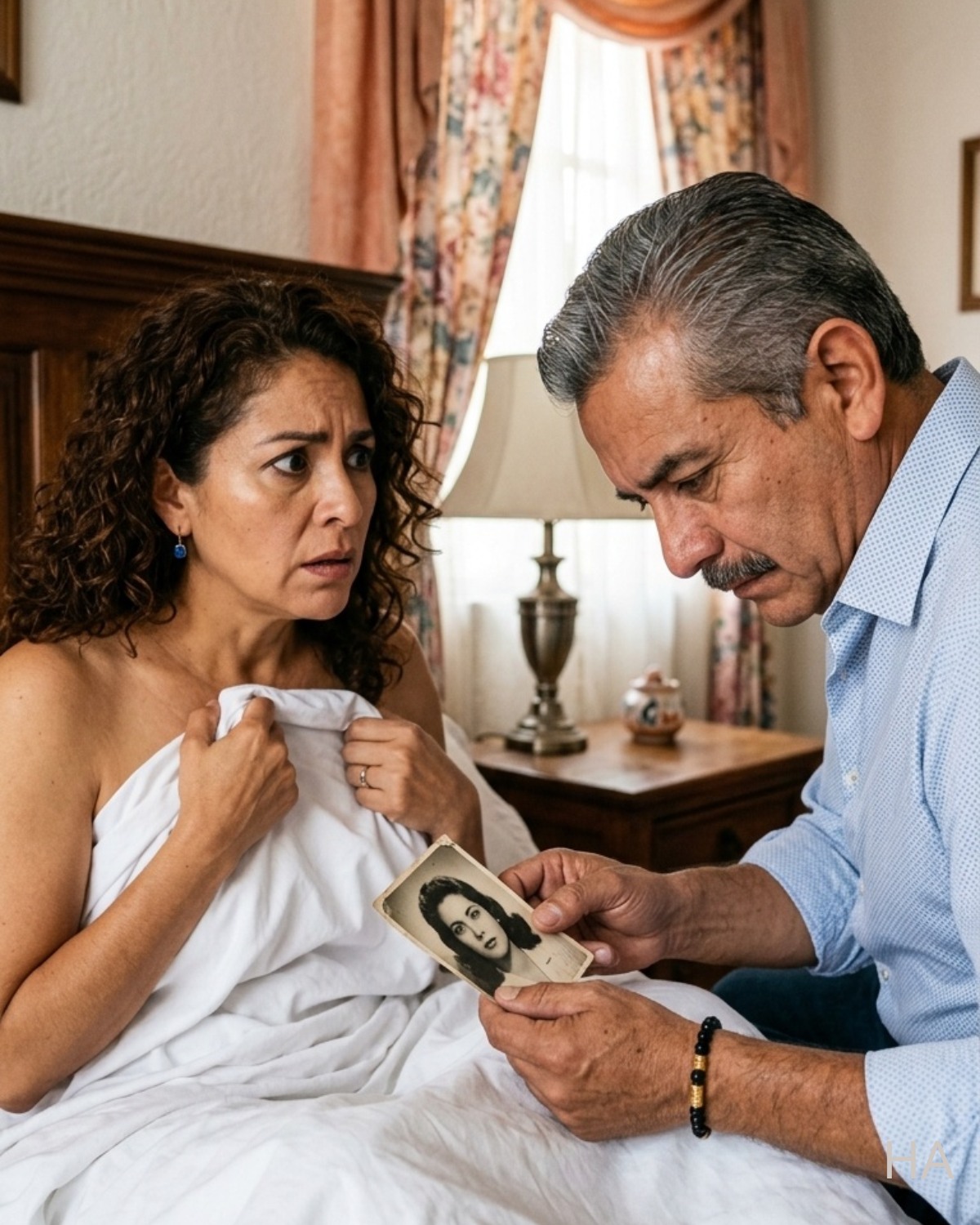
The photograph trembled between Arturo’s fingers like it had its own heartbeat.
Ofelia Morales sat frozen on the motel bed, the rough sheet pulled to her chest, staring at the image of herself at twenty-five years old. The young woman in the picture looked hopeful, shy, and heavily pregnant, one hand resting over the life inside her. Her hair was pinned back with a white ribbon. Her smile was small but real. She had been standing at a county fair outside San Antonio, Texas, beside a booth of paper flowers and cheap carnival prizes.
Ofelia remembered that day.
She had eaten roasted corn with too much butter. Efraín had complained about the heat. Her mother-in-law, Beatrice Rivas, had told her the dress made her look “wide as a barn door.” Ofelia had laughed weakly then, because back then she still believed swallowing humiliation was the price of being a good wife.
Two months later, in a private Catholic hospital in Austin, they told her the baby had been stillborn.
They never let her hold him.
They gave her a sealed little box and told her not to open it because “some grief is kinder unseen.”
For forty years, Ofelia had buried the question beneath duty, marriage, church, silence, and shame.
Now a stranger in a roadside motel was holding proof that her grief had been manufactured.
“Where did you get that photo?” she whispered.
Arturo wiped his face with both hands. “From my mother’s things.”
“Who was your mother?”
“Ruth Delgado. She was a nurse at St. Agnes Hospital in Austin in 1983.”
Ofelia’s hand flew to her mouth.
St. Agnes.
The name alone opened a locked room inside her.
White walls. A crucifix over the bed. Efraín standing near the window, refusing to look at her. Beatrice whispering to the doctor in the hallway. The nurse who stroked Ofelia’s forehead after the delivery and said, “Sleep now, sweetheart. It’s already over.”
Only it had not been over.
It had been stolen.
Arturo reached into his wallet again and pulled out a folded paper so old the creases were soft. He handed it to her.
Ofelia took it with shaking fingers.
It was a copy of a hospital intake form.
Her name was there.
Ofelia Rivas.
Date: August 17, 1983.
Delivery: male infant.
Status: live birth.
She made a sound that was not a word.
Arturo lowered his head. “I’m sorry.”
“No,” she said, suddenly sharp. “No. Don’t say sorry. Tell me everything.”
He looked up.
His eyes were red, but steady now.
“My mother died last week. Lung cancer. On the last night, she kept saying she had to confess before God took her. I thought she meant some ordinary guilt. But then she told me about the baby.”
Ofelia clutched the paper.
Arturo continued, “She said a wealthy woman came to the hospital with a priest and a doctor. The woman said her son’s wife was unfit, poor-blooded, unstable, and would ruin the Rivas name if she raised the child. My mother was young and broke. My father had left. She had me, no savings, no protection.”
“She paid her,” Ofelia said.
Arturo nodded.
“Five thousand dollars. In 1983, that was more money than my mother had ever seen. Enough to disappear from Austin, move to El Paso, and start over.”
Ofelia closed her eyes.
Five thousand dollars.
That was the price of her son.
A used car. A down payment. A hospital bill.
Forty years of pain sold for five thousand dollars.
Arturo’s voice cracked. “My mother said she helped switch the paperwork. They told you the baby died. They told another family the baby was available through a private arrangement. But something went wrong.”
Ofelia opened her eyes. “What do you mean?”
“The adoptive family backed out.”
Her breath stopped.
“My mother panicked. She couldn’t bring the baby back. She couldn’t tell the truth. The doctor and the woman who paid her threatened to report her, ruin her, maybe worse. So she took the baby herself.”
The room seemed to tilt.
Ofelia stared at Arturo.
He stared back.
For several seconds, neither moved.
Then Ofelia looked at the newborn photograph again. The blue blanket. The hospital bracelet. The tiny gold earrings pinned to the cloth.
Her earrings.
The ones Beatrice had said must have been lost during the emergency.
Ofelia’s voice became almost inaudible.
“Where is my son?”
Arturo swallowed.
“Ofelia…”
Her whole body went cold.
“Where is he?”
Arturo’s hands shook again.
“My mother named him Samuel. Samuel Delgado. He grew up in El Paso. He became a teacher. He had two daughters.” His voice broke. “He died three years ago from an aneurysm.”
The sentence landed silently.
Not like a scream.
Like the final shovel of dirt on a grave she had already mourned once, wrongly.
Ofelia did not cry at first.
Her face emptied.
She looked down at the photograph of the baby she had never held and realized life had been crueler than death. Death would have taken her son once. This had taken him every day, every birthday, every Christmas morning, every first step, first word, school picture, scraped knee, graduation, wedding, fatherhood, illness, and final breath.
He had lived.
He had grown up.
He had died.
And she had been alive the whole time, only a few hundred miles away, cooking dinners for the people who stole him.
Arturo whispered, “I’m sorry.”
Ofelia hit him.
Not hard enough to injure him. Her palm struck his cheek with a sound that shocked them both.
He accepted it.
She hit his chest next, then again, fists weak and shaking.
“Why didn’t she tell me?” Ofelia cried. “Why did she wait? Why did she let him die without knowing me?”
Arturo did not defend Ruth.
Good.
If he had, Ofelia might have hated him forever.
“She was a coward,” he said. “And I think she hated herself too much to become brave until death was already in the room.”
Ofelia collapsed forward.
Arturo caught her before she fell off the bed.
She sobbed against a stranger’s shoulder in a cheap motel outside Houston while the morning light turned gray and hard around them. The night before, she had gone with him because she wanted to feel desired once before disappearing into old age, widowhood, and dutiful loneliness. Now he was holding her while her entire life split open.
When the crying finally loosened, she pulled away.
“Who paid?” she asked.
Arturo did not pretend not to understand.
He reached into his coat pocket and pulled out one more paper.
A photocopy of a handwritten note.
The ink had faded, but the signature remained clear.
Beatrice Rivas.
Ofelia stared at the name.
Efraín’s mother.
The woman who sat in the front pew every Sunday at Our Lady of Grace.
The woman who had worn black lace to Ofelia’s wedding and told everyone she was “praying this girl learns her place.”
The woman who had held Ofelia’s hand after the supposed stillbirth and whispered, “God takes what we are not ready to raise.”
Ofelia’s stomach turned.
Beatrice was ninety-two now.
Still alive.
Still sharp.
Still treated by the church ladies like a saint carved from old stone.
“She knew,” Ofelia whispered.
“She arranged it,” Arturo said.
Ofelia looked at him sharply. “Did Efraín know?”
Arturo hesitated.
That hesitation was another knife.
“My mother said the husband was told after. She did not know if he agreed beforehand.”
Ofelia thought of Efraín in the hospital room.
His dry eyes.
His silence.
The way he never once asked to see the baby.
The way he told her, two months later, “We should stop speaking of it. My mother says grief becomes selfish when it lingers.”
Her marriage had not been cold because the baby died.
Her marriage had been cold because Efraín had known something and chosen silence.
Ofelia slowly stood.
Her knees trembled, but she did not fall.
“Get dressed,” she said.
Arturo blinked. “What?”
“We’re going to Austin.”
He looked at the window, then back at her. “Ofelia, you need time.”
“I had forty years of time.”
“But Beatrice is powerful. Her name is all over that church. The Rivas family still owns property, businesses—”
Ofelia turned to him.
“I slept beside her son for thirty-seven years. I buried him. I served coffee to that woman every Christmas while she looked at me like I was dirt tracked onto her rug. She stole my child, and I thanked her for bringing casserole.”
Her voice lowered.
“I am done needing permission to walk into rooms.”
Arturo stared at her.
For the first time since she met him, he looked afraid of her.
Good.
She got dressed.
Not quickly. Not with panic. She put on her blouse, buttoned it carefully, combed her gray hair with wet fingers, wiped her face, and put on the same gold earrings she had worn when her son was born. The earrings Beatrice had stolen once, then returned years later in a jewelry box after Efraín’s aunt “found them in an old drawer.”
Ofelia had thought it was a miracle.
Now she knew it was evidence.
Arturo drove because Ofelia’s hands would not stop shaking.
The highway stretched ahead under a flat Texas sky. Trucks passed. Gas stations blurred. The world outside the car looked ordinary, which offended Ofelia. How dare people buy coffee, argue over directions, change radio stations, and pump gas while her past burned down beside them?
Arturo spoke after nearly an hour.
“Samuel was a good man.”
Ofelia stared out the window.
“Don’t.”
“I think you should know.”
She closed her eyes.
“I said don’t.”
He went quiet.
Five miles passed.
Ten.
Then she whispered, “Was he happy?”
Arturo gripped the wheel.
“Yes,” he said. “Not always. No one is. But he was loved. He loved teaching. He taught history at a public high school. He coached debate. He made terrible pancakes. He read bedtime stories with voices.”
Ofelia covered her mouth.
“He had daughters,” she said.
“Yes. Clara and Elise. They’re sixteen and nineteen now.”
Ofelia turned slowly.
Granddaughters.
The word did not fit inside her yet.
“Do they know?” she asked.
“No. I didn’t want to say anything until I found you.”
“You found me at a dance hall?”
His mouth tightened. “I had your old name, a photo, and a city. I found your church first. Then your friend Berta. She said you were going dancing that night.”
Despite everything, Ofelia almost laughed.
“Berta sent you?”
“She said you needed someone to dance with more than you needed another church committee.”
That sounded exactly like Berta.
Ofelia leaned back.
“Does Berta know?”
“No.”
“Good. She’ll be unbearable.”
Arturo glanced at her.
There was grief in his eyes, but also relief that she had made a joke.
A terrible joke.
A necessary one.
They reached Austin by late afternoon.
Ofelia did not go to Beatrice first.
She went to her own house.
A small brick home in South Austin where she had lived with Efraín for twenty-nine years. The lawn was neat because Ofelia still watered it every morning. The porch had geraniums. The living room smelled faintly of lemon polish and old wood. Every object inside suddenly looked like a prop from a lie.
The wedding photo on the mantel.
Efraín’s arm around her waist.
Beatrice standing behind them, smiling like a queen who had just purchased a servant.
Ofelia took the photo down and turned it face-first on the table.
Then she walked to the hallway closet and pulled out a locked metal box.
Inside were documents: Efraín’s death certificate, insurance papers, her marriage certificate, old hospital bills, letters, photographs, and the sealed box they had given her after the birth.
She had never opened it.
For forty years, it sat wrapped in brown paper at the bottom of the metal box. She had been told opening it would harm her healing. She had been told a good mother lets the dead rest. She had been told so many things by people who needed her not to look.
Arturo stood in the doorway.
“Ofelia.”
She set the box on the kitchen table.
Her fingers hovered over the old tape.
Then she cut it open.
Inside was not a baby.
Of course it was not a baby.
It was a bundle of folded hospital linens weighted with a small sack of sand.
Ofelia stared.
A sound tore out of her so raw that Arturo stepped back.
Not because it scared him.
Because it deserved space.
She picked up the cloth and held it like it might still transform into the child she had been denied.
Sand spilled onto the table.
Forty years of mourning.
A bag of sand.
That was when Ofelia stopped crying.
Completely.
She placed the fake burial box, the hospital form, the photographs, and Beatrice’s signed note into a folder. Then she called the one person who had never liked the Rivas family.
Her comadre Berta.
Berta answered on the second ring.
“Ofelia? Did you survive your scandalous night?”
“Come to my house.”
The laughter died. “What happened?”
“Bring your car. And your temper.”
“I’m on my way.”
Then Ofelia called an attorney.
His name was Martin Ellis, a retired judge turned private lawyer who had once helped her with Efraín’s estate. He agreed to come after hearing only three sentences.
By 7 p.m., Ofelia’s kitchen had become a war room.
Berta arrived first, hair wild, earrings enormous, ready to fight God if needed. She hugged Ofelia, glared at Arturo, then listened as the story unfolded.
When Ofelia opened the fake burial box, Berta sat down hard.
“That old witch,” she whispered.
Martin Ellis arrived twenty minutes later. He was seventy, serious, and still carried himself like a courtroom followed him around.
He reviewed every document quietly.
Then he looked at Ofelia.
“This is enough to begin an investigation.”
“Begin?” Berta snapped. “She stole a baby.”
Martin did not flinch. “Forty years ago. We will need corroboration, hospital records, witness statements, and proof of chain. Some records may be gone. Some people are dead. But this—” he tapped the live birth form and Beatrice’s note “—this is not nothing.”
Ofelia sat straight-backed at the table.
“What can happen to Beatrice?”
“Legally? At her age, with the time passed, we need to see what charges are still viable. Civilly, there may be claims depending on fraud, concealment, emotional distress, possibly estate issues if your son was deprived of inheritance rights.”
“My son is dead.”
Martin’s face softened.
“Yes.”
Ofelia looked at the newborn photo.
“But he had daughters.”
The room went quiet.
Martin nodded slowly. “Then they may have rights too.”
Arturo spoke from the corner. “Samuel never knew. He thought Ruth was his mother. He loved her.”
Ofelia looked at him.
“I don’t want to erase her,” he said. “I know what she did was unforgivable. But she raised him. She was his mother in the life he knew.”
Ofelia wanted to hate him for saying that.
But she could not.
Because underneath her rage lived another truth: Samuel had not grown up abandoned. He had been loved by someone, even if that someone had first participated in stealing him.
That made the grief more complicated.
Truth usually does.
The next morning was Sunday.
Beatrice Rivas never missed Mass.
Neither did half of Austin’s old Catholic society, which made it the perfect place.
Berta thought so too.
“Public shame is best served after communion,” she declared.
Martin strongly disagreed.
“You will not confront a ninety-two-year-old woman in church.”
Ofelia looked at him.
“I won’t confront her in church,” she said.
Martin relaxed slightly.
“I’ll confront her outside.”
He sighed. “That is not what I meant.”
Ofelia wore black.
Not widow black.
Battle black.
A simple dress, low heels, pearl rosary in one hand, gold earrings in her ears. Berta drove. Arturo came reluctantly. Martin followed in his own car because, as he put it, “Someone needs to keep this from becoming a criminal event.”
Our Lady of Grace was full.
White stone walls. Stained glass. Incense. Familiar faces. Women who had brought casseroles after Efraín’s funeral. Men who still nodded respectfully at the Rivas name. Children fidgeting in pews. The choir singing like heaven had not been used as cover for hell.
Beatrice sat in the front pew.
Of course.
She wore lavender.
Her white hair was arranged perfectly. Her hands rested on a polished cane. From behind, she looked fragile.
Ofelia knew better.
Fragility and innocence were not the same thing.
Mass moved slowly.
Too slowly.
Ofelia did not pray.
Or perhaps she did, but not with words the church would approve of.
When the service ended, Beatrice remained near the front as people approached her like subjects greeting a queen. She accepted kisses, compliments, gentle touches on her arm. Someone asked after her health. Someone told her she was a pillar of the parish.
Then Ofelia walked toward her.
The crowd parted out of habit.
Beatrice saw her and smiled with faint annoyance.
“Ofelia,” she said. “You missed Bible study on Thursday.”
Ofelia looked at the woman who had stolen her son.
“I was busy finding my child.”
Beatrice’s smile froze.
Not vanished.
Froze.
For half a second, only Ofelia saw the fear.
Then Beatrice recovered.
“What a strange thing to say.”
Berta muttered, “Not strange enough.”
Martin coughed in warning.
Ofelia opened the folder and took out the photograph of herself at twenty-five.
She held it up.
“Do you remember this?”
Beatrice looked at the photo.
Her hands tightened on the cane.
“No.”
Ofelia took out the hospital form.
“Do you remember St. Agnes?”
Beatrice’s face changed again.
Small changes.
Tiny.
But after forty years of being studied by this woman, Ofelia could read every line.
“Ofelia,” Beatrice said quietly, “you are making a scene.”
“No,” Ofelia replied. “I am returning one.”
People nearby began to listen.
Beatrice looked around and lowered her voice. “Whatever you think you know, this is not the place.”
“You made a hospital room the place.”
Beatrice’s eyes sharpened.
There she was.
Not the saint.
Not the elder.
The woman beneath.
“You were unfit,” Beatrice hissed.
The words were so quick, so venomous, so automatic that even she seemed surprised they escaped.
Ofelia smiled.
It was a terrible smile.
“Thank you.”
Beatrice looked confused.
Berta lifted her phone.
Recording.
Martin closed his eyes.
“Beatrice,” he said, stepping forward, “I am Martin Ellis, counsel for Mrs. Morales. You will be receiving formal notice regarding the evidence in our possession and any statements you choose to make from this point forward.”
Beatrice stared at him.
The crowd had fully noticed now.
“What evidence?” one church woman whispered.
Ofelia turned slightly, holding up the newborn photo.
“My son was born alive in 1983,” she said, voice clear enough for the people nearest to hear. “I was told he died. He was taken from me. My mother-in-law paid for it.”
Gasps moved through the church entrance like wind.
Beatrice’s lips trembled.
Not with guilt.
With fury.
“You stupid girl,” she whispered. “After all these years, you still don’t understand what I saved this family from.”
The recording captured that too.
Ofelia stepped closer.
“What was his name?”
Beatrice blinked.
“My son. What name did you erase?”
For the first time, Beatrice looked away.
Ofelia’s voice broke, but she did not lower it.
“His name was Samuel. He became a teacher. He had daughters. He died without knowing his mother because of you.”
Something moved across Beatrice’s face then.
Not remorse exactly.
Recognition.
Perhaps age had weakened her defenses.
Perhaps the name pierced something.
Perhaps even monsters have rooms they avoid entering.
“He lived?” Beatrice whispered.
Ofelia stared.
“You didn’t know?”
Beatrice’s mouth opened slightly.
Martin leaned in, suddenly alert.
Beatrice looked toward the church doors, toward the sunlight, toward the old women who now stared at her like the statue had cracked.
“They told me the nurse took care of it,” she said.
The sentence was quiet.
But Berta’s phone caught it.
Ofelia felt the world shift again.
“You thought they killed him?”
Beatrice did not answer.
The answer was in her silence.
Ofelia staggered back.
Arturo caught her elbow.
Forty years of horror expanded.
Beatrice had not only paid to steal the baby.
She had paid believing he would vanish completely.
A living adoption had been almost mercy compared to what Beatrice had intended.
Berta said, “Jesus, Mary, and every saint in this building.”
Martin’s face had gone hard.
“Mrs. Rivas,” he said, “you should not say another word without an attorney.”
Beatrice lifted her chin, trying to recover dignity from ruins.
“I did what was necessary.”
Ofelia looked at her.
“No,” she said. “You did what evil people call necessary when love stands in their way.”
Then she walked out.
The scandal broke by Tuesday.
Not because Ofelia wanted headlines.
Because church scandals travel faster than legal filings, and someone had already told someone who had told a retired journalist who still hated the Rivas family from an old property dispute. By sunset, every old family in Austin knew something had happened outside Our Lady of Grace.
Martin filed petitions.
Hospital archives were requested. St. Agnes had closed years earlier, but some records survived through a medical network merger. A retired clerk remembered irregular sealed birth files from the early 1980s. A former priest’s notes referenced “private family intervention regarding Rivas infant.” Ruth Delgado’s deathbed confession, recorded on Arturo’s phone during her final hours, became another piece of the puzzle.
Then DNA confirmed it.
Samuel Delgado had been Ofelia’s son.
His daughters, Clara and Elise, were Ofelia’s granddaughters.
Meeting them was harder than confronting Beatrice.
Clara was nineteen, guarded, tall, with Samuel’s eyes.
Elise was sixteen, quiet, wearing a hoodie and holding her sister’s hand.
They met in a lawyer’s office in El Paso because neutral ground seemed kindest to everyone. Arturo came with them. Ofelia brought Berta, because courage sometimes needs a loud friend in red lipstick.
For several seconds, grandmother and granddaughters only stared at one another.
Ofelia saw him in them.
Not baby Samuel.
A man she never knew.
The shape of Clara’s brow. The way Elise’s mouth tightened when she was trying not to cry. Their hands. Their hair. The living evidence of a stolen life.
Clara spoke first.
“So you’re our grandmother.”
Ofelia pressed a tissue to her mouth.
“Yes.”
Elise’s eyes filled immediately.
Clara stayed stiff. “Did you give him away?”
Ofelia flinched.
“No.”
“Did you know?”
“No.”
“Can you prove that?”
Berta started to speak, but Ofelia raised a hand.
The question was fair.
Painful.
But fair.
Ofelia opened the folder and slid copies across the table. Not too many. Just enough. The false death notice. The live birth record. Ruth’s confession summary. Beatrice’s note. The DNA report.
Clara read everything.
Her face changed slowly.
Elise began crying first.
Clara did not cry until she saw the baby photo with the blue blanket.
“That’s Dad?” she whispered.
Arturo nodded.
Ofelia’s voice trembled. “I never held him.”
Clara looked at her then.
The wall did not fall.
Not completely.
But a door opened.
“He made pancakes every Saturday,” Clara said. “They were terrible.”
Ofelia laughed and sobbed at the same time.
Arturo had told her that too.
Now Samuel’s daughter was telling her.
The detail became real.
For the next two hours, they shared what could be shared. Ofelia told them about the fair photo, the pregnancy cravings, the baby name she had chosen—Gabriel—before everything was taken. Clara told her Samuel loved old maps and hated coconut. Elise said he sang in the car even when they begged him to stop. Arturo told them Ruth had kept every school drawing Samuel ever made.
No one knew where to place Ruth in the story.
Kidnapper.
Mother.
Coward.
Caretaker.
Criminal.
The woman who raised Samuel with love after stealing him from the woman who bore him.
Clara finally said, “I don’t know how to hate her.”
Ofelia nodded through tears.
“I don’t either. But I don’t know how to forgive her.”
“That seems fair,” Elise whispered.
It was fair.
That was enough for one afternoon.
Beatrice’s health declined rapidly after the confrontation.
Or perhaps her power did.
For decades, people had mistaken the two.
She retreated to the Rivas house, a stone mansion in Austin’s old money hills, guarded by family, lawyers, and silence. But silence did not work the way it once had. The parish removed her from two honorary committees. A hospital foundation quietly took down a plaque bearing the Rivas name. Old friends stopped visiting. Some because they were horrified. Some because they were afraid their own secrets might be near hers.
Efraín, dead three years, could not be questioned.
But his papers could.
Martin found old letters in a bank deposit box. Letters between Efraín and Beatrice from 1983. Not full confession. Men like Efraín rarely wrote anything too clear. But there were enough phrases to condemn him.
“Mother, she cannot know.”
“Ofelia is fragile but obedient.”
“The matter must remain buried.”
“I will not raise another man’s decision as my son.”
Ofelia read that last line three times.
Another man’s decision.
That was what Efraín had called his own child.
Not baby.
Not son.
Decision.
She had spent thirty-seven years cooking for a man who knew she went to bed crying every August and never told her why.
When Martin offered to pursue claims against Efraín’s estate records, Ofelia surprised him.
“No.”
He looked up. “No?”
“I want the truth public. I want Samuel’s daughters recognized. I want Beatrice named. But I will not spend what remains of my life fighting a dead man for money I don’t need.”
Clara, sitting beside her, looked over.
Ofelia continued, “Whatever legal inheritance belongs to the girls, pursue it. Not for revenge. For record. But I am done letting the Rivas family decide the shape of my days.”
Berta smiled.
“That’s my girl.”
Ofelia was sixty-five, but in that moment, she felt younger than she had at forty.
The civil case settled before trial.
The Rivas family trust agreed to a substantial payment to Clara and Elise, though no amount could buy the years lost. More importantly, the settlement included a formal statement acknowledging that Samuel Delgado was the biological son of Ofelia Morales and Efraín Rivas, born alive at St. Agnes Hospital in 1983 and wrongfully separated from his mother through actions arranged by Beatrice Rivas.
Beatrice refused to sign.
Her legal guardian signed on her behalf after a judge compelled disclosure.
Ofelia framed the acknowledgment.
Not because paper could heal.
Because for forty years, paper had lied.
Now paper would tell the truth.
On the first anniversary of the motel morning, Ofelia visited Samuel’s grave.
It was in El Paso under a mesquite tree, modest and well-kept. Clara and Elise came with her. Arturo stayed back near the car, giving them space.
The stone read:
Samuel Delgado
Beloved Father, Teacher, Friend
1974–2020
Ofelia knelt slowly, knees aching.
She touched his name.
“Hello, my son,” she whispered.
The girls stood behind her, crying quietly.
Ofelia placed the old newborn photo beside the grave, protected in a clear sleeve. Then she placed the fair photo of herself pregnant next to it.
Beginning and end.
Missing middle.
“I would have loved you,” she said. “Every day. I need you to know that. Wherever you are, whatever you know now, I would have loved you.”
Clara knelt beside her.
“He was loved,” Clara said.
Ofelia turned.
Clara took her hand.
“Not by you then,” she whispered. “But he was loved. And maybe now… maybe he gets more.”
Ofelia broke down.
Clara held her.
Elise joined them.
For the first time, Ofelia held Samuel’s daughters not like strangers, but like a continuation of a stolen embrace.
Arturo watched from a distance and cried alone.
He had lost a brother he thought was a brother, gained a truth he did not know how to carry, and found the woman whose pain his mother had helped create. Ofelia did not know what he was to her. Witness. Stranger. Family by theft. Messenger of grief.
They did not become lovers.
That one night remained what it was: lonely, human, complicated, and strange enough to open a tomb.
But they became something.
Arturo visited sometimes. He brought Samuel’s old school photos, report cards, drawings, Father’s Day cards from the girls. Ofelia gave him copies of her pregnancy photos and letters she had written to the baby after the supposed stillbirth, letters she had never shown anyone.
One afternoon, Arturo handed her a box.
“My mother kept this,” he said.
Inside was the blue hospital blanket.
Ofelia touched it with trembling fingers.
For a moment, she hated Ruth Delgado so deeply she could taste it.
Then she imagined young Ruth, terrified, poor, holding a stolen baby and choosing to raise him rather than let him vanish into whatever Beatrice had intended.
Hate became tangled.
She lifted the blanket to her face and breathed in old cotton, dust, and time.
“Thank you,” she said.
Arturo nodded.
He understood she was not thanking him for the theft.
She was thanking him for bringing back what remained.
Beatrice died two years later.
Ofelia did not go to the funeral.
She went dancing.
Berta insisted.
“Black dress?” Berta asked.
“Red,” Ofelia said.
The same old dance hall in Austin had a band playing boleros that night. Ofelia wore lipstick, earrings, low heels, and a red dress Clara had helped her pick out. She danced with a widower named Henry who smelled like cedar and asked before touching her waist. She danced with Arturo once too, slow and sad and gentle, both of them aware that desire had become something different between them.
At 10 p.m., Ofelia stepped outside for air.
Her phone buzzed.
A message from Clara.
“We’re okay. Elise says wear the red dress again next time.”
Ofelia smiled.
A second message came.
“Dad would have liked you.”
That one made her sit down on the bench.
Berta found her there ten minutes later.
“You crying?”
“Yes.”
“Good crying or bad crying?”
Ofelia thought about it.
“Both.”
Berta sat beside her. “That’s usually the honest kind.”
Years later, Ofelia’s life looked nothing like the one people expected for her.
She sold the South Austin house full of Efraín’s ghost and moved to a smaller place halfway between Austin and El Paso. Not exactly practical, but symbolic enough to please her. Clara visited during college breaks. Elise spent one summer with her and taught her how to use video calls properly. Ofelia learned to make Samuel’s terrible pancakes from a recipe Clara claimed he invented and everyone else endured.
They were truly awful.
Ofelia made them every year on his birthday.
She also began speaking at women’s church groups and elder circles about family silence, medical coercion, and the ways powerful families bury women’s pain under words like dignity and obedience. She never described the motel unless someone asked how she found out.
When they did, she answered honestly.
“At sixty-five, I did something lonely and impulsive because I wanted to feel alive. God, fate, or plain old chaos used it to hand me the truth. I no longer judge the door by how strange it looks. Sometimes liberation enters through the wrong room.”
People gasped.
Berta loved that part.
The Rivas name never recovered fully.
Some descendants tried to distance themselves. Some apologized. Some called Ofelia bitter. She stopped caring. The formal acknowledgment remained public. Samuel’s daughters received what they were owed. St. Agnes’s successor hospital created a patient rights archive review after pressure from Martin and several journalists. A plaque bearing Beatrice’s name was removed from the parish hall and replaced with a smaller one honoring “mothers separated from their children by coercion, secrecy, and shame.”
Ofelia attended that dedication.
She stood in the back with Clara and Elise.
When the priest blessed the plaque, Ofelia did not feel peace exactly.
Peace was too smooth a word.
She felt witnessed.
That was enough.
At seventy, Ofelia hosted Christmas for the first time in decades without dread.
Not the old kind of Christmas where she cooked for Efraín’s relatives while Beatrice inspected the table. This Christmas was loud, mismatched, and warm. Berta brought tamales because she said turkey was “colonial sadness.” Arturo brought wine and stayed in the kitchen where he felt useful. Clara brought her fiancé. Elise brought a girlfriend she introduced nervously until Ofelia hugged her and said, “Good. More girls at the table.”
There were candles, music, too much food, and Samuel’s photo in the center of the mantel.
Not hidden.
Not whispered about.
Present.
Before dinner, Ofelia raised a glass.
“I spent most of my life believing I had lost a child to death,” she said. “Then I learned I had lost him to cruelty. For a while, I thought that truth would kill me. It didn’t. It brought me you.”
Clara cried immediately.
Elise tried not to and failed.
Ofelia looked around the room.
“I cannot get back the years. I cannot hold Samuel as a baby. I cannot hear him call me Mom. But I can love what remains. I can say his name. I can refuse to let the people who stole him also steal the rest of my life.”
Berta lifted her glass. “To refusing.”
Everyone laughed through tears.
“To refusing,” Clara said.
They drank.
Later that night, after everyone left or fell asleep, Ofelia stood alone near the mantel.
She picked up the photograph of Samuel as a newborn.
For forty years, she had imagined death when she thought of that baby.
Now she imagined life.
Samuel learning to walk in a small house in El Paso. Samuel carrying a backpack to school. Samuel rolling his eyes at chores. Samuel falling in love. Samuel holding Clara for the first time. Samuel reading to Elise. Samuel burning pancakes. Samuel laughing. Samuel aging. Samuel living.
Not with her.
That wound would never fully close.
But living.
Her son had lived.
And because he lived, Clara and Elise lived.
Because they lived, Ofelia had a future she never expected.
She pressed the photo to her chest.
“Goodnight, my boy,” she whispered.
Outside, the Texas night was quiet.
Inside, the house held the sound of sleeping family.
At sixty-five, Ofelia had gone to a motel with a stranger because she wanted one night of feeling alive. She woke to the most devastating truth of her life. But that truth, cruel as it was, tore open the grave they had buried her in while she was still breathing.
Her mother-in-law had stolen her son.
Her husband had helped bury the lie.
A nurse had carried guilt to her deathbed.
A stranger had brought the evidence.
And Ofelia, the widow everyone expected to shrink politely into old age, became the woman who pulled forty years of silence into the light.
She did not get justice the way young people imagine justice.
No prison cell could hold all the years stolen. No settlement could purchase a first birthday, a first word, a mother’s first embrace. No public statement could repair a life built around a false coffin filled with sand.
But Ofelia got truth.
She got names.
She got granddaughters.
She got the right to stop serving the memory of people who had ruined her.
And most of all, she got herself back—not the young woman in the photograph, not the obedient wife, not the grieving mother with empty arms, but the old woman in the red dress who learned, late but not too late, that being alive means more than surviving what others did to you.
It means opening the box.
Even when they told you not to.