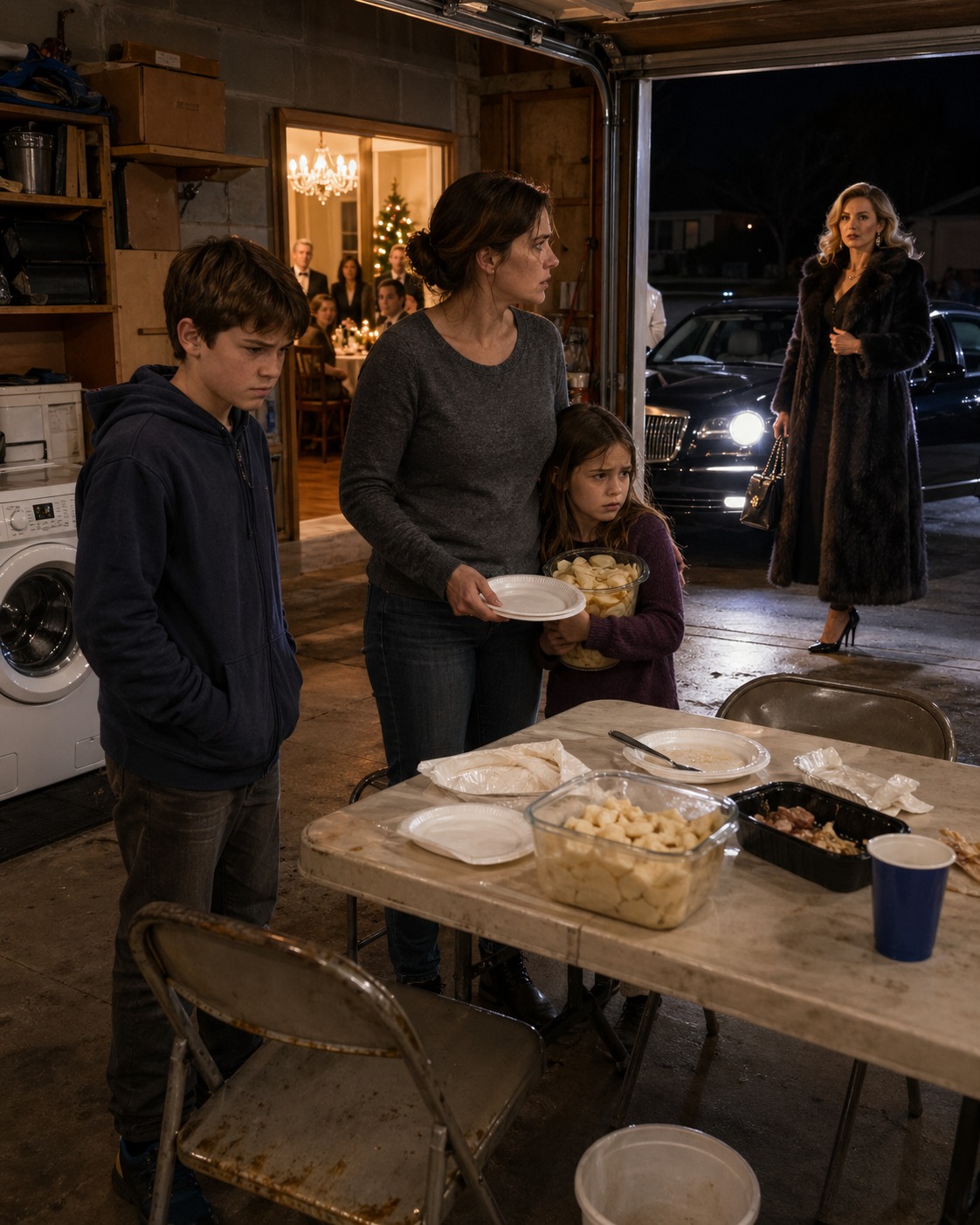
You are still holding the paper plates when the woman steps out of the black limousine.
For one second, you think she must have the wrong house. Women like her do not come looking for women like you, especially not through the garage, especially not while you are standing beside a folding table with cold turkey, dry mashed potatoes and two children trying not to cry.
She is tall, elegant, maybe in her late fifties, wearing a cream coat that looks too expensive to touch. Her hair is silver, perfectly styled, and there is something in her face that makes even the chauffeur stand straighter when she moves.
“Mariana Alvarez?” she asks.
Your name sounds different in her mouth.
Behind you, Diego stiffens. Sofía clutches the aluminum-covered dish of apple salad to her chest. You wipe your hands on your coat, suddenly embarrassed by the disposable plates, the garage smell, the humiliation you were trying to swallow before your children could taste it.
“That’s me,” you say carefully.
The woman’s expression softens.
“My name is Charlotte Whitmore. I’m sorry to arrive like this on Christmas Eve, but I was told I would find you here.”
The curtains in the dining room open so fast they slap against the glass.
Inside, Verónica’s guests stop laughing. Your sister’s face appears between the golden lights and the reflection of crystal glasses. Your mother stands behind her, squinting as if trying to understand why a limousine is parked in front of the house and why the woman from it is not ringing the front doorbell.
Charlotte glances past you into the garage.
Her eyes move over the folding table, the metal chairs, the overturned bucket Sofía had been given as a seat, the cold food, the uncovered concrete floor. Then her gaze lands on your children.
Something changes in her face.
Not pity.
Anger.
“Were you eating out here?” she asks.
You open your mouth, but no sound comes out.
A mother can survive many humiliations when she is alone. You can pretend they do not matter. You can tell yourself people are tired, stressed, careless, cruel only for a moment.
But when your children are standing beside you, cheeks red from shame instead of cold, there is no way to pretend.
Before you can answer, Verónica rushes through the side door wearing red lipstick, gold earrings and a smile sharp enough to cut glass.
“Good evening!” she says too brightly. “You must be looking for Esteban. We’re expecting several important guests tonight. You should have come through the front.”
Charlotte does not look at her.
“I came for Mariana.”
Verónica blinks.
Your mother steps into the garage too, wrapping her shawl around herself.
“Mariana?” she says, confused. “Why would anyone come in a limousine for Mariana?”
Diego’s jaw tightens.
That sentence lands harder than Verónica’s insult because it comes from the woman who raised you.
Charlotte finally turns toward them.
“And you are?”
Verónica straightens, suddenly aware of the expensive coat, the chauffeur, the black car, the kind of power money cannot fake.
“I’m Verónica Salgado. Mariana’s sister. This is my home.”
Charlotte’s eyes drift to the folding table again.
“I see.”
Your brother-in-law Esteban appears behind Verónica, still holding a wine glass. He freezes the second he recognizes Charlotte. His face drains so quickly you almost think he might faint.
“Mrs. Whitmore,” he says.
Verónica turns toward him.
“You know her?”
Esteban swallows.
“Everyone knows her.”
The garage goes silent.
Charlotte steps closer to you.
“Mrs. Alvarez, I apologize for the intrusion. My father asked me to deliver something to you personally if he was not able to do it himself.”
Your throat tightens.
“Your father?”
“Henry Whitmore.”
The name means nothing to Verónica. It means nothing to your mother.
But it means something to you.
Your breath catches.
Don Enrique.
That was what you called him because he hated being called Mr. Whitmore. You had met him at the private rehabilitation clinic where you cleaned rooms at night after finishing your day shift at the school cafeteria. He had been old, thin, stubborn and alone.
You had not known he was wealthy.
You only knew he hated hospital food, liked cinnamon tea and cried quietly every December when he thought nobody could hear him.
“He died?” you whisper.
Charlotte nods once.
“Three weeks ago.”
You lower your eyes.
You had not seen him in almost two months because the clinic said his family had moved him. You had prayed he was somewhere peaceful. You had hoped someone was sitting with him.
“I’m sorry,” you say.
Charlotte studies your face as if your grief answers a question she had been carrying.
“He told me you would say that,” she says. “He also told me you would not ask what he left you. You would ask whether he suffered.”
The garage becomes too quiet.
Your eyes burn.
“Did he?”
Charlotte’s face softens again.
“No. Not at the end.”
You nod, but tears slip down your cheeks anyway.
Because you remember feeding him soup when his hands shook. You remember bringing him a small paper star Sofía made because he said his room looked like a storage closet for dying men. You remember Diego fixing the volume on his radio. You remember Henry telling your children they had “good bones and brave eyes.”
Verónica lets out a small, fake laugh.
“Well, that’s very sad, of course,” she says. “But we’re in the middle of Christmas dinner, so maybe Mariana can receive whatever this is another day.”
Charlotte looks at her.
For the first time, Verónica seems to realize she has spoken to the wrong woman in the wrong tone.
“No,” Charlotte says. “It has already waited long enough.”
The chauffeur opens the back door of the limousine and takes out a leather folder. He hands it to Charlotte with both hands. She does not open it immediately.
Instead, she turns toward Diego and Sofía.
“What are your names?”
Diego hesitates.
“Diego.”
“Sofía,” your daughter whispers.
Charlotte smiles gently.
“My father talked about you both. He said Diego fixed things before adults admitted they were broken. And Sofía made the best paper stars in Mexico City.”
Sofía’s mouth falls open.
“He kept them?”
“All of them.”
Your daughter’s eyes fill with tears.
Verónica’s face twists with confusion and irritation.
Your mother whispers, “Mariana, what is this?”
You do not answer because you do not know.
Charlotte opens the leather folder.
“My father changed his will six weeks before he passed,” she says. “He left a personal letter for you, an education trust for your children, and legal ownership of a property he purchased last year.”
You stare at her.
The words do not enter your mind all at once. They hover around you like a language you almost understand.
“Property?” you repeat.
Charlotte nods.
“A commercial property in Coyoacán. It used to be a bakery.”
Your knees almost give out.
A bakery.
Your father’s bakery.
The one Verónica convinced your mother to sell after your father died because, according to her, you were too poor and too emotional to manage anything. The one you cried over for months. The one where you learned to knead dough standing on an upside-down crate while your father sang old boleros before sunrise.
“That bakery was sold,” you whisper.
“To my father’s holding company,” Charlotte says. “He told me you mentioned it once. He said it was the only time he heard your voice break.”
You cover your mouth.
Diego looks at you.
“Mom?”
You cannot answer him.
The garage smells like gasoline and humiliation, but suddenly you are ten years old again, standing beside your father while flour dusts the air like snow.
Charlotte continues.
“He wanted you to have it back.”
Verónica makes a sound like a laugh choking on itself.
“That’s impossible.”
Charlotte closes the folder.
“It is not.”
Esteban puts his wine glass down on the washing machine because his hand is shaking.
Verónica looks at him.
“Say something.”
But Esteban is not looking at her.
He is looking at Charlotte Whitmore as if the ground beneath his expensive shoes has turned to ice.
“Mrs. Whitmore,” he says carefully, “perhaps we should discuss this inside. This garage is not appropriate.”
Charlotte’s eyes sharpen.
“Apparently it was appropriate for Mariana and her children.”
Nobody speaks.
The sentence hangs there, bright and merciless.
Verónica’s cheeks flush.
“There’s been a misunderstanding,” she says. “Mariana insisted on being out here. She gets uncomfortable around guests. You know how prideful people can be.”
Diego moves before you can stop him.
“No, she didn’t.”
Your sister turns toward him.
“Diego, adults are speaking.”
He pulls out his phone.
“No. You were speaking. I recorded it.”
Your heart stops.
“Diego,” you whisper.
He looks at you, and in his eyes you see something you should have seen earlier. He is not just hurt. He is tired. Tired of watching you swallow insults so he and his sister can have cousins, grandparents, a place at a table that never really had room for them.
He presses play.
Verónica’s voice fills the garage.
“You eat in the garage, Mariana. You’re used to leftovers.”
Sofía starts crying.
Your mother closes her eyes.
Verónica’s mouth opens, then closes.
From inside the dining room, someone gasps.
Diego stops the recording.
“That’s what happened,” he says.
Charlotte looks at Verónica for a long moment.
Then she says, “Thank you, Diego.”
Your son’s shoulders rise as if nobody important has ever thanked him for telling the truth.
Verónica tries to recover.
“He’s a child. He doesn’t understand family dynamics.”
“No,” Charlotte says. “Children usually understand cruelty before adults finish excusing it.”
Esteban steps forward quickly.
“Mrs. Whitmore, please. My wife can be intense, but this has nothing to do with the Monteverde housing proposal.”
Verónica turns sharply.
“What proposal?”
Charlotte lifts one eyebrow.
Esteban looks like he wants the concrete floor to open and swallow him.
Charlotte answers for him.
“Your husband’s firm submitted a proposal for a community housing partnership funded by the Whitmore Foundation. The final review was scheduled for tonight. I accepted your invitation because Mr. Salgado insisted his family values aligned with our mission.”
Your mother makes the sign of the cross.
Verónica looks from Charlotte to Esteban.
“You invited her here?”
Esteban’s face is gray.
“I didn’t know she was coming for Mariana.”
Charlotte’s expression hardens.
“That much is clear.”
You suddenly understand the polished dining room, the expensive wine, the exaggerated warmth Verónica had shown every guest except you. This dinner was not just Christmas. It was a performance. A stage.
And your sister had put you in the garage so her perfect life would not have to include evidence of where she came from.
Charlotte turns to Esteban.
“Our foundation builds transitional homes for women and children who have been pushed aside by people with more power than conscience. Tonight, I watched your household push a widow and her children into a garage on Christmas Eve.”
Esteban whispers, “She’s not a widow.”
You flinch.
Verónica hisses, “Esteban.”
But it is too late.
Charlotte looks at you.
Your hands go cold.
Your husband, Luis, had not died. Sometimes you wished it were that simple. He had left three years ago with debts, excuses and a woman from his office, then disappeared somewhere in Texas. No child support. No phone calls on birthdays. Just silence and bills.
Verónica had always used that against you too.
Not abandoned.
“Hard to keep.”
Not struggling.
“Bad at choosing men.”
Not surviving.
“Living off scraps.”
Charlotte’s eyes soften, but her voice remains firm.
“Then she is a mother who has been carrying more than the people at this table cared to see.”
Your mother’s face crumples.
“Mariana, we didn’t know—”
You turn to her.
“You didn’t ask.”
Those three words leave your mouth before you can soften them.
Your mother steps back.
For years, you had protected her from the truth because she was old, because she was tired, because Verónica was loud and you were not. You let your mother believe you were fine because you did not want to beg for love.
But tonight, standing in a garage with your children watching, you finally understand that silence did not protect anyone.
It only made cruelty comfortable.
Charlotte hands you the leather folder.
“You do not need to sign anything tonight,” she says. “My father instructed that you receive independent legal counsel, paid by the estate, before accepting any part of this. He was very clear that generosity without dignity is just another form of control.”
Your fingers tremble around the folder.
That sounds exactly like Henry.
Verónica suddenly steps toward you, smiling too widely.
“Mari,” she says, using the nickname she only uses when she wants something. “Why didn’t you tell us you knew someone like this?”
You look at her.
The garage seems to hold its breath.
“Because I didn’t know he was someone like this.”
Verónica laughs nervously.
“You always were dramatic. Of course we’re happy for you. Come inside. Bring the kids. We’ll make space at the table.”
Sofía pulls closer to you.
That tells you everything.
Your daughter is not comforted by the invitation. She is afraid of what it costs.
You look through the open door into the dining room. The table is beautiful. The candles are still burning. The turkey is carved, the glasses are full, and there are empty chairs that could have been offered before a limousine made you valuable.
“No,” you say.
Verónica’s smile freezes.
“What?”
You lift the disposable plates.
“We were not welcome when we arrived.”
“Mariana, don’t be childish.”
Diego steps beside you.
“She said no.”
Verónica’s eyes flash.
But before she can speak, Charlotte turns to your children.
“I have a car waiting. My staff prepared dinner at my hotel suite because I hoped your mother might allow me to speak with her privately. There is hot food, real chairs and no one will be asked to sit in a garage.”
Sofía looks up at you.
“Can we go?”
The question breaks you.
Not because she wants to leave.
Because she is asking permission to be treated kindly.
You kneel in front of her.
“Yes, my love. We can go.”
Verónica grabs your arm.
“You cannot just leave on Christmas Eve.”
You look down at her hand.
Slowly, she lets go.
“I can,” you say. “You already placed us outside.”
Your mother begins to cry.
“Mariana, please. Don’t split the family over one bad moment.”
You turn to her fully.
“One bad moment?” you repeat. “Mama, Diego is twelve. Sofía is nine. They know exactly which relatives look away when we are humiliated. That is not one bad moment. That is a lesson.”
Your mother’s lips tremble.
You want her to say she is sorry.
Not “come back.”
Not “don’t make a scene.”
Just sorry.
But she looks at Verónica first.
And that tells you she is still choosing the easier daughter.
So you choose your children.
You take Sofía’s hand. Diego picks up the aluminum dish of apple salad because he refuses to leave behind something his sister made with love. Charlotte walks beside you, not ahead of you, and the chauffeur opens the limousine door.
Before you get in, Esteban hurries after you.
“Mariana, wait.”
You stop.
Not because you owe him anything.
Because you are done running from people who should be ashamed.
He lowers his voice.
“Please. Whatever happened tonight, don’t let it affect the proposal. There are employees depending on that contract.”
You stare at him.
“Were they depending on your values too?”
His face tightens.
“You don’t understand business.”
“No,” you say. “But I understand children.”
He looks past you at Charlotte.
“Mrs. Whitmore—”
Charlotte cuts him off.
“The review is over.”
Esteban’s face collapses.
Verónica hears from the garage doorway.
“What does that mean?”
Charlotte looks directly at her.
“It means your husband built a presentation on compassion while allowing cruelty in his own home. That tells me everything I needed to know.”
Then she enters the limousine.
You follow with your children.
As the door closes, you see Verónica standing in the garage, surrounded by cold food, dirty concrete and the same shame she had prepared for you.
For once, it belongs to her.
The limousine pulls away.
For the first minute, nobody speaks.
Sofía sits so carefully on the leather seat it breaks your heart. Diego holds the salad dish on his lap like it is fragile treasure. You keep the leather folder pressed against your chest, afraid that if you loosen your grip, the whole night will turn out to be a cruel dream.
Charlotte sits across from you.
“I am sorry your children had to experience that,” she says.
You look out the window at the Christmas lights blurring through your tears.
“They’ve experienced worse quietly.”
Charlotte nods.
“My father suspected that.”
You turn back to her.
“How?”
“He said people who know hunger often apologize before accepting food. He said you did that every time he offered to buy dinner for your children.”
You laugh once, softly, painfully.
“I thought he was just a lonely old man.”
“He was,” she says. “He was also stubborn, difficult and richer than anyone needs to be. But near the end, he knew the difference between people who served him because of his name and people who sat beside him when they thought he had nothing to give.”
You lower your eyes.
“I didn’t do anything special.”
Charlotte leans forward.
“My father disagreed.”
The limousine turns into the entrance of a luxury hotel in Polanco. Sofía’s eyes widen at the lights, the tall glass doors, the enormous Christmas tree glowing in the lobby. Diego tries to act unimpressed, but you see him staring too.
A man in a dark suit opens the car door.
“Good evening, Mrs. Whitmore.”
Charlotte steps out, then waits for you.
Not as if you are staff.
Not as if you are an inconvenience.
As if you belong wherever you choose to stand.
Upstairs, in a private suite, there is a dining table set for four.
Four.
Not three folding chairs and a bucket.
Four real chairs, four cloth napkins, four plates, four glasses of sparkling cider beside one glass of wine no one touches. There is roasted chicken, warm bread, soup, mashed potatoes, vegetables and a small space in the center of the table where Charlotte places Sofía’s apple salad.
“She made this,” Diego says quickly.
Charlotte smiles at Sofía.
“Then it belongs in the center.”
Sofía’s face changes.
It is small, almost invisible, but you see it.
A little piece of dignity returning.
You all sit down.
At first, your children eat quietly, like they are afraid someone will take the food away. Then Sofía tastes the soup and smiles. Diego asks whether the bread is made in the hotel kitchen. Charlotte tells him it is, and somehow they end up talking about ovens, repairs and how old buildings make strange noises at night.
You barely eat.
Your body is too full of shock.
After dinner, Charlotte gives you Henry’s letter.
The envelope is thick, your name written in shaky handwriting.
Mariana,
If you are reading this, it means Charlotte finally did what I told her to do instead of arguing with me. She means well, but she inherited my talent for making simple things sound like court proceedings.
You smile through tears.
I know you will say you do not deserve what I left. You will be wrong. You gave me what money could not buy. You gave me ordinary kindness when I was no longer useful to anyone.
You stop reading for a moment.
The room goes blurry.
Your children sit beside you on the couch, both leaning in silently.
Henry’s letter continues.
You told me once your father had a bakery and that you remembered the smell of bread before sunrise better than you remembered any holiday gift. You also told me your children had never seen you receive something without having to pay for it later. That stayed with me.
You press the page against your chest.
So I bought the bakery. I was going to give it to you myself, but time is a thief and I am slower than I used to be. If you want it, it is yours. If you do not, sell it and use the money to build whatever life you were told you could not have.
Diego whispers, “Mom.”
You keep reading.
There is also a trust for the children’s education. Not charity. Investment. The boy has engineer hands, and the girl has artist eyes. Do not let the world make either of them small.
Sofía starts crying.
The final lines are crooked, as if Henry’s hand had been weak.
One more thing. Stop apologizing for taking up space at tables where you bring more love than the people sitting at the head of them.
You fold the letter slowly.
Charlotte says nothing.
That is another kindness.
The next morning, your phone has seventy-two missed calls.
Most are from Verónica.
Some are from your mother.
Three are from Esteban.
There are messages too.
At first, Verónica is angry.
How could you embarrass me in my own home?
Then scared.
Esteban says you destroyed his deal.
Then sweet.
Mari, we are sisters. Christmas was stressful. Let’s talk.
Then desperate.
Please call me before this gets worse.
You do not answer.
Instead, you sit at the hotel desk with Charlotte’s lawyer and ask every question you can think of. You read every document. You learn the trust is real. The bakery is real. The education fund is real.
Your life has not magically become easy.
But it has become possible.
That afternoon, Charlotte’s lawyer drives you to Coyoacán.
The bakery stands on a quiet corner with faded blue tiles near the entrance and a rusted metal sign above the door. The old name is gone, painted over years ago, but you still see it in your memory.
Panadería Alvarez.
Your father’s hands dusted with flour.
Your mother singing while counting coins.
Verónica stealing warm conchas from the tray.
You, small and happy, believing family meant everyone got fed.
The lawyer unlocks the door.
Inside, dust floats in the sunlight. The display cases are empty. The ovens are old. The floor needs work, the walls need paint, and the whole place smells like abandonment.
But beneath it all, you smell something else.
Memory.
You step inside and break down.
Not pretty crying.
Not silent crying.
You sob so hard Diego wraps his arms around your waist and Sofía presses her face into your coat.
“I thought it was gone,” you whisper.
Diego looks around.
“We can fix it.”
You laugh through tears.
“We?”
He shrugs.
“I’m good at fixing things before adults admit they’re broken.”
You stare at him.
Then all three of you laugh.
For the first time in months, maybe years, the laugh does not feel stolen.
It feels earned.
Three days after Christmas, Verónica shows up at the hotel.
You do not know how she found out where you were staying. Maybe your mother told her. Maybe Esteban did. Maybe people like Verónica always know how to find the person they need something from.
She is waiting in the lobby wearing oversized sunglasses and a camel coat.
When she sees you, she stands too quickly.
“Mari.”
Diego moves closer to Sofía.
That is enough to harden your heart.
“Don’t come near my children,” you say.
Verónica stops.
Her mouth trembles.
“I came to apologize.”
You wait.
She removes her sunglasses. Her eyes are red, but you do not know if the tears are for guilt or consequences.
“I was wrong,” she says. “What I said was cruel.”
“Yes.”
She flinches.
“I was stressed. Esteban had this huge opportunity, and the house was full, and I thought—”
“You thought my children belonged next to gasoline and cardboard.”
Her face crumples.
“No. I didn’t think.”
“That is worse.”
She looks away.
People in the lobby glance toward you, then politely look elsewhere.
Verónica lowers her voice.
“Esteban may lose everything. The proposal, investors, clients. That woman has influence everywhere.”
You almost smile.
There it is.
Not “How are Diego and Sofía?”
Not “Did they sleep?”
Not “I am ashamed.”
Just consequences wearing the mask of apology.
“So that’s why you came,” you say.
“No,” she says quickly. “I came because you’re my sister.”
“You remembered that after the limousine.”
Her face hardens for half a second. Then she softens it again.
“You always do this. You make yourself the victim.”
Something inside you goes still.
There she is.
The real Verónica.
Not sorry.
Cornered.
You step closer.
“No, Verónica. I made myself quiet. You made me the victim because it was convenient. Last night, I stopped helping you.”
Her eyes shine with anger now.
“You think money makes you better?”
“No,” you say. “But I watched you think money made me worse.”
She has no answer.
You take a breath.
“I am not calling Charlotte. I am not saving Esteban’s proposal. I am not explaining away what my children heard. Whatever happens to your life now is not my revenge. It is your reflection.”
Verónica’s lips part.
For one second, she looks small.
Then she whispers, “Mama is devastated.”
You feel the old hook in your chest.
Guilt.
Duty.
Family.
You almost reach for it.
Then you remember Sofía on an overturned bucket.
You let the hook fall.
“Mama watched,” you say.
Verónica looks down.
“She’s old.”
“She was old enough to laugh inside while my children sat in the cold.”
That lands.
Your sister wipes under her eye.
“I don’t know how to fix this.”
For once, you believe her.
“You start by not asking the people you hurt to protect you from the cost.”
Then you walk away.
Your legs shake in the elevator.
Diego notices.
“You okay?”
You look at your son, already too grown, already too watchful.
“No,” you say honestly. “But I’m proud of myself.”
He nods.
“Me too.”
That almost makes you cry again.
Over the next months, life becomes a strange mixture of paperwork, dust, school runs and repair estimates.
You move out of your tiny apartment and into a modest rental near the bakery while the legal transfer finishes. You keep your job at the school cafeteria at first because security still matters to you. You are not foolish with miracles. You know money can open doors, but discipline keeps them from closing again.
Charlotte becomes less like a mysterious benefactor and more like a stern aunt your children are slightly afraid of and secretly adore.
She hires tutors for them through the trust, but never makes them feel bought. She brings Sofía art supplies and asks to see every drawing. She gives Diego an old radio from her father’s collection and tells him, “Break it carefully, then make it better.”
He does.
Your mother calls often.
At first, you let every call go unanswered. Then one Sunday, after church, you answer.
She cries immediately.
“Mariana, I miss you.”
You close your eyes.
“What do you miss, Mama? Me, or the daughter who never complained?”
Silence.
Then a small sob.
“I failed you.”
The words stun you.
You sit down on the edge of your bed.
Your mother continues, voice shaking.
“I told myself Verónica needed more because she had a big life, a big house, important people. I told myself you were stronger. I thought because you survived everything, you didn’t need defending.”
You stare at the wall.
“That’s what hurt the most.”
“I know.”
“No, Mama. You don’t. Diego heard you laugh.”
She begins crying harder.
“I am ashamed.”
You want to forgive her instantly because she is your mother. Because a wounded child still lives inside you, waiting for her to choose you.
But you are not only a daughter anymore.
You are a mother.
“Shame is not enough,” you say.
“What can I do?”
You look toward the kitchen where Sofía is humming while drawing and Diego is arguing with a toaster he has decided to repair.
“You can start by apologizing to my children without excuses.”
“I will.”
“And you will not mention Verónica. You will not tell them to forgive anyone. You will not ask me to repair the family so everyone else feels better.”
Your mother exhales.
“Okay.”
You do not know if she means it.
But it is a beginning.
Verónica does not come around for months.
You hear pieces of her life through cousins who pretend not to gossip while giving you every detail. Esteban loses the Whitmore proposal. Then he loses two investors who heard about it. Then his company shrinks, and the house in Santa Fe becomes too expensive to maintain.
You do not celebrate.
You are too busy.
The bakery consumes you.
You rename it The Warm Table because Diego says “No Leftovers” sounds too angry and Sofía says “Panadería Alvarez” makes you cry every time you say it. The old ovens are repaired. The walls are painted soft cream. The blue tiles by the entrance are cleaned until they shine again.
On opening morning, you wake at 3:47 a.m.
Just like your father used to.
You stand in the kitchen, hands dusted with flour, heart pounding like you are about to step onto a stage. Diego carries trays. Sofía places small paper stars near the register. Charlotte arrives with coffee and pretends she is not emotional.
Your mother comes too.
She stands outside for ten minutes before entering.
When she finally walks in, she does not go to you first. She goes to Diego and Sofía.
Then she kneels.
“I am sorry,” she says.
Sofía looks at you.
You nod once, letting her decide.
Your mother continues.
“I should have protected you. I should have told your aunt she was wrong. I should have brought you inside. I didn’t, and that was my fault.”
Diego watches her carefully.
“No excuses?” he asks.
Your mother wipes her face.
“No excuses.”
Sofía looks down at her shoes.
“We were cold.”
“I know.”
“And I worked hard on the salad.”
Your mother breaks.
“I know, mi niña.”
Sofía hesitates, then reaches into a basket and hands her a small roll.
“It’s warm,” she says.
Your mother takes it with both hands as if it is forgiveness.
It is not.
Not fully.
But it is a door left unlocked.
The bakery becomes more than a business.
At first, people come because of the story. They whisper about the sister, the limousine, the Christmas Eve garage. They come wanting drama with their coffee.
But they return because the bread is good.
Because the bolillos are warm, the cinnamon rolls sell out before noon, and the apple pastries Sofía helps design become famous in the neighborhood. Because Diego builds a small bell above the door from old radio parts, and customers love it.
Because you greet people like your father did.
As if feeding someone is not a transaction.
As if it is a promise.
One afternoon, nearly a year after that Christmas Eve, Verónica walks in.
You see her before she sees you.
She looks different. Less polished. Her hair is tied back, her coat simple, her face thinner. She pauses at the entrance when the bell rings, and for one fragile moment, she looks like the sister who once stole warm conchas from your father’s tray and laughed with powdered sugar on her lips.
Then she sees you.
The bakery goes quiet in your mind, though customers continue talking around you.
Diego is in the back. Sofía is at school. Your mother is not there.
Good.
This conversation belongs to the two of you.
“Mariana,” Verónica says.
You wipe your hands on your apron.
“Verónica.”
She looks around the bakery.
“You did it.”
You say nothing.
Her eyes move over the shelves, the lights, the paper stars, the framed photo of your father near the register. Then they stop on a small sign by the counter.
Everyone eats inside.
Her face tightens.
“I deserve that,” she says.
“Yes,” you say. “You do.”
She nods slowly.
“I sold the house.”
You had heard.
“I’m sorry.”
She looks surprised.
“Are you?”
“I’m sorry for what losing it did to your children,” you say. “Not for what it did to your pride.”
Her eyes fill.
“I’ve been in therapy.”
You lift an eyebrow.
“I have,” she insists quietly. “At first because Esteban said I needed to fix my image. Then because I realized my image was the only thing I cared about.”
That lands differently.
Not enough to erase the past.
But enough to make you listen.
She continues.
“I hated you.”
You absorb that without flinching.
“I know.”
“I hated that Papa loved teaching you things. I hated that you could be poor and still make people feel warm. I hated that Mama worried about you even when she did nothing. I hated that you didn’t need a perfect table to make people love you.”
Your throat tightens despite yourself.
Verónica wipes her tears angrily.
“So I made sure you had no table.”
The truth is uglier when spoken plainly.
But at least it is truth.
“I can’t give that night back to your children,” she says. “I can’t undo what I said. I can’t ask you to forgive me just because my life got smaller.”
“No,” you say. “You can’t.”
She nods.
“I came to ask if I can apologize to them someday. Not today. Not as a trick. Just someday, if they want.”
You study her.
There is no demand in her voice.
No performance.
No Esteban hiding behind the door.
For the first time, Verónica has arrived without an audience.
“I’ll ask them,” you say. “And if they say no, the answer is no.”
She exhales shakily.
“Okay.”
Then she looks toward the display case.
“Can I buy bread?”
You almost laugh.
Not because it is funny.
Because life is strange enough to bring your sister, the woman who fed you cold scraps in a garage, into your bakery asking to pay for warm bread.
“Yes,” you say. “Customers can buy bread.”
She winces at the boundary, but accepts it.
“What do you recommend?”
You look at the trays.
“The apple rolls. Sofía’s recipe.”
Verónica’s face crumples.
“I’ll take six.”
You box them yourself.
She pays full price.
When she leaves, she pauses at the door.
“Mari?”
You look up.
“I’m glad Papa’s bakery came back to you.”
For once, you believe she means it.
“Me too,” you say.
The bell rings as she leaves.
You stand there for a moment, breathing in sugar, yeast and memory.
That night, you tell Diego and Sofía everything.
You do not soften it. You do not push forgiveness into their hands like another burden. You tell them their aunt came, admitted what she did and asked whether she might apologize someday.
Diego stares at the table.
“She didn’t ask for money?”
“No.”
“She didn’t ask you to call Mrs. Whitmore?”
“No.”
Sofía pokes at her soup.
“Did she mention my salad?”
You smile.
“She bought six apple rolls.”
Sofía tries not to look pleased.
Diego notices and rolls his eyes.
“She still made us eat in a garage.”
“I know,” you say.
“So we don’t have to forgive her.”
“No.”
“And if we do someday?”
“Then that will be yours to decide too.”
Sofía thinks for a long time.
“I don’t want to see her yet.”
“Then you won’t.”
Diego leans back.
“I might want to hear her apologize. But not because she deserves it. Because I deserve to say what I think.”
You look at your son.
That boy who once held cold plates in a garage now understands something many adults never learn.
An apology is not a gift to the guilty.
Sometimes it is a microphone for the wounded.
Christmas Eve comes again.
One full year since the garage.
This time, you do not go to Santa Fe. You do not wait for anyone to decide whether you belong. You open The Warm Table after hours and host dinner for people who have nowhere gentle to go.
Charlotte comes.
Your mother comes early and spends three hours washing dishes without being asked.
Diego sets up extra chairs. Sofía decorates every table with paper stars. There is turkey, soup, warm rolls, apple salad and a long wooden table your father would have loved.
Nobody eats outside.
Nobody gets disposable plates unless they ask to take food home.
Halfway through dinner, the bell rings.
You look up.
Verónica stands at the door with Esteban behind her and their two children between them.
For a second, the old pain returns.
Your body remembers the garage before your mind can stop it.
Diego sees them and stands.
Sofía reaches for your hand under the table.
Verónica does not step inside.
She waits at the threshold.
Smart woman.
Your mother freezes near the kitchen.
Charlotte watches silently from the corner, sharp as ever.
Verónica’s voice shakes.
“We brought toys for the donation table,” she says. “And food. If you don’t want us to stay, we won’t.”
No demand.
No smile for strangers.
No performance.
Just a box in her hands and fear in her eyes.
You look at Diego.
Then Sofía.
This is their wound too.
Diego walks to the door first.
He stops in front of Verónica.
“You made my mom cry,” he says.
Verónica nods.
“I did.”
“You made Sofía sit on a bucket.”
Her face crumples.
“I did.”
“You said we lived on leftovers.”
“I did.”
His voice hardens.
“Why?”
Verónica takes a breath.
“Because I was cruel. Because I was ashamed of things I should have respected. Because I wanted to feel above your mother, and I used you and your sister to do it.”
The room is silent.
Diego stares at her.
Then he says, “That’s the first honest thing you’ve ever said to me.”
Verónica lowers her head.
“I’m sorry, Diego.”
He does not hug her.
He does not smile.
But he steps aside.
Sofía comes next.
She is holding one of her paper stars.
“You didn’t eat my salad,” she says.
Verónica’s tears fall.
“No. And I should have. I’m sorry.”
Sofía studies her.
Then she hands Verónica the paper star.
“This doesn’t mean I forgive you.”
Verónica takes it carefully.
“I understand.”
“It means you can come in if my mom says yes.”
Everyone looks at you.
For a moment, you remember yourself one year ago, standing in a cold garage with paper plates in your hands, waiting for someone else to give you permission to feel human.
Now this is your door.
Your table.
Your choice.
You look at Verónica.
“You can come in,” you say. “But understand something. This place is not where we pretend the past didn’t happen. This is where people come in with respect or not at all.”
Verónica nods.
“I understand.”
You step aside.
She enters quietly.
Not as queen of the house.
Not as the sister with the better life.
Just as another person carrying something she cannot undo.
And maybe that is enough for one night.
Later, after everyone has eaten, after children are laughing and your mother is drying plates with red eyes, you step outside for air.
The bakery glows behind you.
Warm light spills onto the sidewalk. Through the window, you see Diego showing Esteban’s son how the doorbell works. You see Sofía arranging apple rolls on a tray while Verónica watches from a respectful distance.
Charlotte joins you outside.
“My father would have liked this,” she says.
You smile.
“I hope so.”
“He knew what he was doing.”
You look through the window at the long table.
“No,” you say softly. “He gave me a door. I had to decide to walk through it.”
Charlotte nods.
Behind the glass, Sofía laughs at something Diego says. Your mother wipes her face with a dish towel. Verónica looks at the paper star in her hand like it is something holy.
You think about that garage.
The cold plates.
The bucket.
The sentence that was meant to reduce you to nothing.
You are used to leftovers.
Maybe Verónica was right in one way.
You had been living on what people gave after they were done keeping the best for themselves. Leftover attention. Leftover respect. Leftover space at tables where your children were treated like stains on the tablecloth.
But not anymore.
Now you know something you should have known long ago.
You were never made for leftovers.
You were made to build a table so warm that even the people who once pushed you outside would have to learn how to knock before entering.
And when Diego comes to the door and calls, “Mom, the rolls are ready,” you turn back toward the light.
This time, you do not enter through the garage.
You walk through the front door.