PART 2
You arrive in Monterrey just as the sky turns the color of cold steel.
The children sit in the back of the SUV, unusually quiet, each dressed in the clothes they chose with painful seriousness. Mateo wears a navy sweater and keeps checking the folder beside his seat. Diego holds his sketchbook against his chest like armor. Camila stares out the window with her jaw set, already angry at people she has not met yet.
Sofía adjusts her glasses and asks the question no one else wants to ask.
“Mom, what if he says we’re not his?”
You keep both hands on the steering wheel.
“Then he will say it in front of evidence.”
The Santillán house appears at the end of a private road, glowing with Christmas lights, gold wreaths, and the kind of wealth that has never had to explain itself. You remember arriving there as Rodrigo’s wife ten years ago, nervous and hopeful, carrying a tray of cookies you had baked yourself. His mother, Regina, had smiled politely and said, “How domestic,” as if love were something hired help did better.
Now you pull into the driveway with four children who carry her son’s eyes.
For a moment, you do not turn off the engine.
The house is full of ghosts.
You remember Rodrigo kissing your hand beneath that same porch. You remember him promising children, travel, a house in the mountains, a life that would be “better than anything your family could imagine.” You remember the day he changed, when the doctors said pregnancy might be difficult and his family began treating your body like a failed investment.
Then you remember the night you found out you were pregnant.
Four heartbeats.
Four miracles.
And one husband who looked at the ultrasound like it was a lawsuit.
Mateo touches your shoulder from the back seat.
“We don’t have to go in.”
You turn and look at him.
At seven, he has already learned to sound older when he is afraid. That breaks your heart more than crying would have. You reach back and squeeze his hand.
“Yes, we do,” you say. “Not because we need them. Because the truth deserves a room.”
Camila nods hard.
“Then let’s ruin Christmas.”
“Camila,” Sofía says, correcting her like a tiny lawyer, “we’re not ruining Christmas. He ruined it eight years ago. We’re presenting documentation.”
Diego smiles for the first time all day.
You laugh softly.
That little laugh saves you.
You step out first, then help each child down. The cold bites through your coat, and somewhere inside the house, music plays too loudly, a cheerful Christmas song about peace on earth. The irony almost makes you turn around.
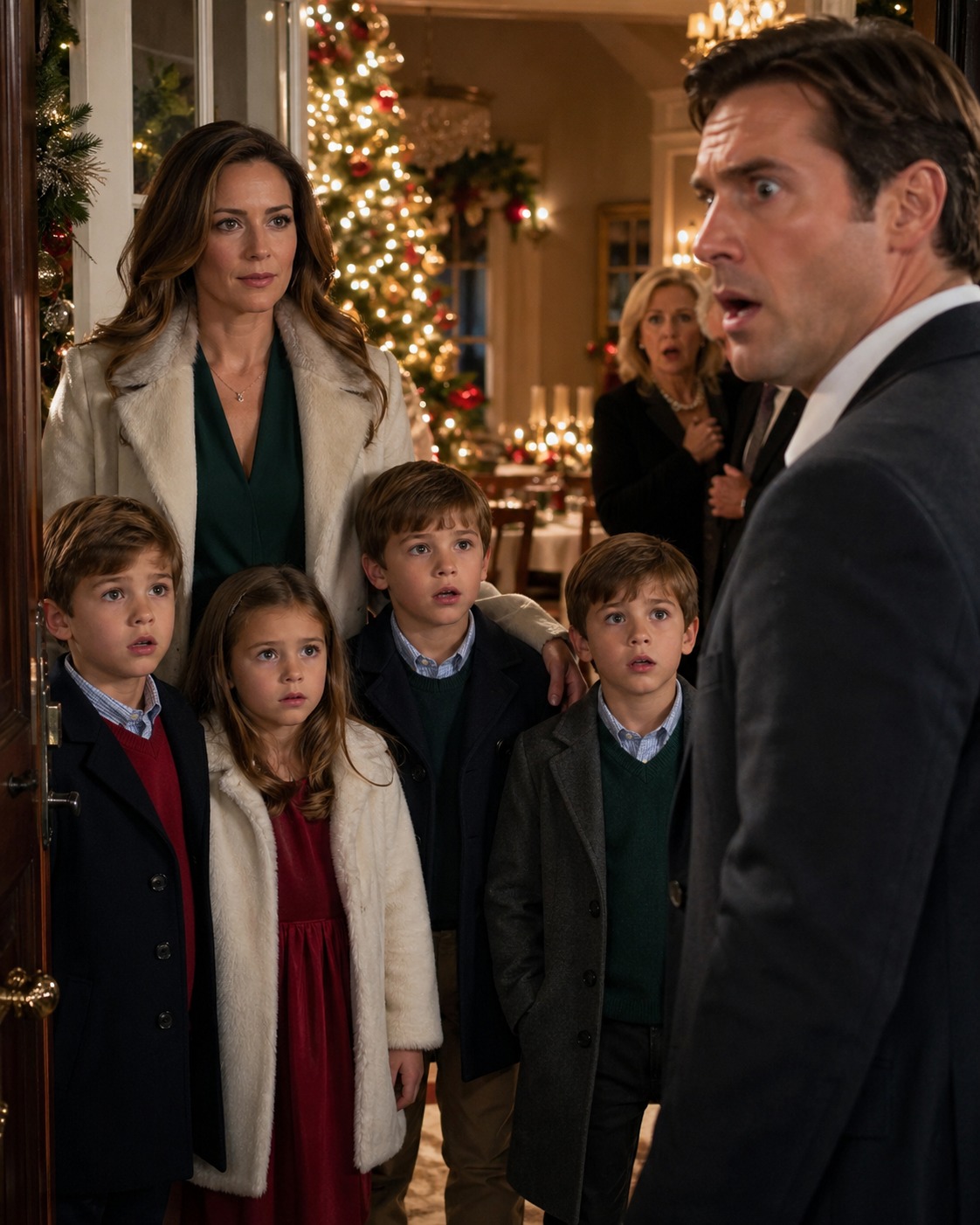
But then the front door opens.
Rodrigo stands there in a black turtleneck and expensive watch, smiling before he fully sees you.
“Mariana,” he says. “You actually came.”
His eyes drop to the children.
The smile dies.
Not slowly.
All at once.
Behind him, the voices inside the house fade.
The children instinctively move closer to you. Camila steps forward, brave as a match in the wind. Mateo holds Diego’s sleeve. Sofía looks straight at Rodrigo’s face, studying him like a math problem that has finally admitted it is wrong.
Rodrigo’s lips part.
“What is this?”
You smile.
“Merry Christmas, Rodrigo.”
His face goes pale.
A woman appears behind him, elegant, thin, with a diamond necklace and a confused frown. You recognize her from society photos: Valeria Montes, Rodrigo’s second wife. The caption always calls her graceful, philanthropic, and devoted. You wonder if she knows she married a man who abandoned four children before breakfast.
Valeria looks at the kids.
Then at Rodrigo.
“Who are they?”
Nobody answers fast enough.
That is when Regina Santillán appears at the top of the foyer stairs.
She is older now, but still terrifyingly polished. Silver hair pinned back. Pearls at her throat. Red silk dress. The kind of woman who could destroy someone with a toast and never raise her voice.
Her eyes move from you to the children.
Then her hand flies to her chest.
Because she sees it.
Everyone does.
Mateo has Rodrigo’s eyes.
Diego has Rodrigo’s mouth.
Camila has the Santillán chin.
Sofía has the little dimple on the left cheek that appears in every childhood photo of Rodrigo displayed in the hallway behind him.
Regina whispers, “Dios mío.”
Rodrigo snaps back to life.
“Mariana, what kind of scene are you trying to create?”
You look past him at the dining room full of relatives, candles, crystal glasses, and children in matching holiday clothes. The same family that once watched you be blamed for not getting pregnant quickly enough is now watching your four children stand outside in the cold.
“No scene,” you say. “You invited me to dinner.”
Rodrigo lowers his voice.
“Not with strangers.”
Camila’s eyes flash.
“We’re not strangers.”
Your hand finds her shoulder.
Not yet, you think.
Let him speak.
Rodrigo looks at the children again, panic hidden under anger.
“Mariana, this is inappropriate.”
Sofía raises her hand like she is in school.
“Is it inappropriate because we exist or because people can see us?”
The silence behind Rodrigo deepens.
Someone inside gasps.
Rodrigo stares at Sofía as if he has been struck.
You almost feel sorry for him.
Almost.
Regina comes down the stairs slowly.
“Rodrigo,” she says, her voice thin. “Who are these children?”
He does not answer.
So you do.
“They are Mateo, Diego, Camila, and Sofía. They are seven years old. They were born eight months after Rodrigo divorced me.”
The room freezes.
Valeria’s face changes first.
Not with jealousy.
With calculation.
She looks at Rodrigo like she has just discovered a crack under marble.
Rodrigo laughs once, too loudly.
“That’s ridiculous.”
Mateo’s hand tightens around the folder.
You say nothing.
Rodrigo points toward the door.
“You can leave. Whatever game this is, I’m not playing.”
Diego looks up at you.
His eyes are wet but steady.
You kneel slightly and whisper, “You are safe.”
Then you stand.
“No, Rodrigo. You invited me here to show your family I had nothing. You wanted me alone at your table while everyone arrived with children, so you could prove the story you’ve told for eight years.”
Regina turns slowly toward her son.
“What story?”
Rodrigo’s jaw locks.
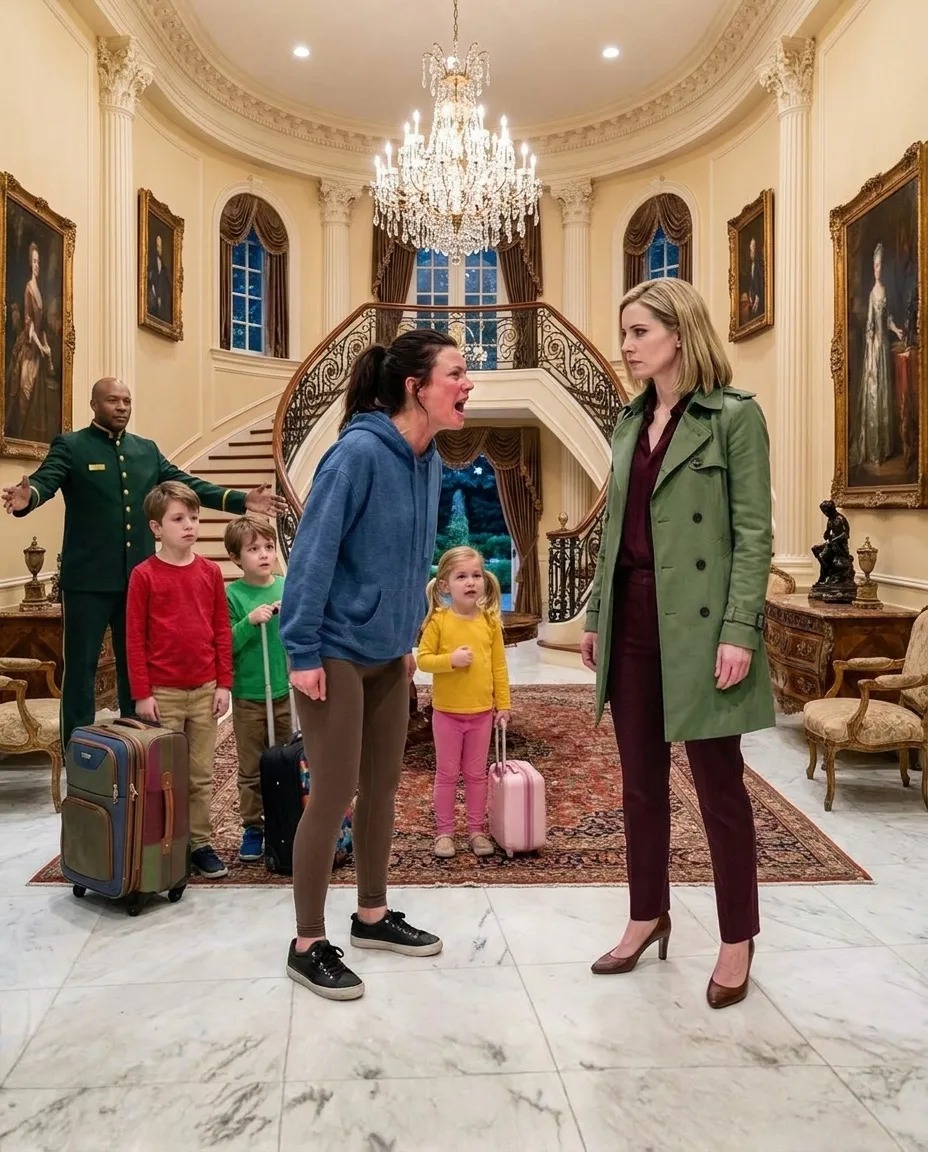
You step into the foyer without asking permission. The children enter behind you, one by one, their shoes quiet against the marble floor. The family parts for them as if the truth has a body and needs space to breathe.
“I think Rodrigo should answer that,” you say.
The dining room remains silent.
An uncle lowers his wineglass.
A cousin pulls her child closer, not out of fear, but shock.
Valeria folds her arms across her chest, eyes on her husband.
Rodrigo looks around the room and realizes there is no private corner left. He built this humiliation as a stage for you, but he forgot stages have lights. Now everyone can see him.
He lifts his chin.
“I have no idea who these children are.”
The sentence lands like a slap.
Diego flinches.
Camila steps forward.
“You’re lying.”
“Camila,” you say softly.
“No,” she says, voice shaking but loud. “He’s lying. He has our eyes. He has our last name in the papers. He has Mom’s messages. He knows.”
Rodrigo’s face turns red.
“You trained them?”
You feel something inside you go still.
There it is.
The same man.
The same arrogance.
The same instinct to turn your pain into manipulation.
You reach into your coat and pull out the first document.
“Birth certificates.”
Rodrigo looks away.
You place them on the entry table beside a porcelain nativity scene.
“Hospital records.”
Another document.
“Prenatal ultrasounds.”
Another.
“Court notices.”
Another.
“Certified delivery receipts.”
The lawyer in the family, Rodrigo’s older cousin Daniel, steps forward despite himself.
“Certified notices?”
You look at him.
“Yes.”
Rodrigo snaps, “Stay out of it.”
Daniel ignores him and picks up the top page.
His eyes move quickly.
Then slowly.
Then he looks at Rodrigo with horror.
“These were sent to your office.”
Rodrigo’s mother grips the banister.
“What notices?”
You answer before Rodrigo can lie again.
“Paternity notifications. Child support petitions. Medical expense claims. Custody filings. All delivered to Rodrigo Santillán’s business office or legal representative over seven years.”
Valeria’s face drains.
“You told me you had no children.”
Rodrigo turns to her.
“I don’t.”
Mateo speaks then.
Quietly.
“You do.”
Everyone looks at him.
He is trembling, but he opens the folder he carried from Santa Fe and takes out a small photo. It is an ultrasound image, old and carefully protected in plastic. Four little shapes. Four names written in your handwriting later, after you knew who they were.
Mateo holds it out.
“You knew when we were this small.”
Rodrigo does not take it.
That refusal tells everyone more than any confession could.
Regina descends the final step.
Her face has lost every trace of polish.
“Rodrigo,” she whispers. “Did you know?”
He looks at her.
For a second, he is a boy again, desperate not to disappoint the mother who raised control like religion.
Then he chooses cowardice.
“She told me she was pregnant after we separated. I had reasons to doubt.”
Your laugh cuts through the room.
“Reasons?”
“You were angry. We were divorcing.”
“You filed the divorce the day after seeing the ultrasound.”
The room inhales.
Rodrigo’s eyes sharpen.
“That’s not true.”
You take out the next page.
“Clinic timestamp. Divorce filing timestamp. Would you like Daniel to read them out loud?”
Daniel does not move.
He does not need to.
Rodrigo wipes a hand over his mouth.
“She said there were four. That was absurd. I thought she was lying to trap me.”
Camila’s voice breaks.
“We’re standing right here.”
For one second, Rodrigo looks at her.
Really looks.
And maybe he sees what he tried to erase.
Four children who lost a father before they were born because he decided their existence was inconvenient.
But regret does not reach his face.
Only fear does.
He points at you.
“You disappeared.”
That makes you angry enough to smile.
“I disappeared into survival. There is a difference.”
You turn to the family.
“I was twenty-eight, pregnant with quadruplets, abandoned, and fighting a high-risk pregnancy alone. Rodrigo froze our joint accounts, canceled my private insurance, and told mutual friends I was unstable.”
Valeria gasps.
You continue.
“My parents sold their house to help me. My brother moved in for three months. My best friend slept in hospital chairs. Rodrigo sent one message after the children were born.”
You pull out your phone.
Eight years of pain live in one screenshot.
You read it aloud.
Do not contact me again. Those children are your problem.
The room breaks.
Regina sits down on the stairs.
Valeria closes her eyes.
One of Rodrigo’s aunts starts crying.
Rodrigo lunges for the phone, but Javier—one of his younger cousins—blocks him.
“Don’t.”
Rodrigo glares.
“You too?”
Javier looks disgusted.
“They’re children.”
That sentence finally cracks the family loyalty in the room.
Children.
Not scandal.
Not inheritance.
Not revenge.
Children.
Rodrigo takes a step back.
“Everyone calm down. This is emotional manipulation.”
Sofía pushes her glasses up.
“No, it’s evidence.”
Somebody almost laughs, then stops because the room is too heavy.
Regina looks at you.
“Why didn’t you come to us?”
The question is quiet.
It hurts anyway.
You look at the woman who once told you not to “make motherhood your whole identity” while also blaming you for not producing grandchildren fast enough.
“I did.”
She stiffens.
You reach into the folder again.
“Letters. Three of them. Sent to this house. Signed for by your house manager.”
Regina shakes her head.
“No.”
“You never answered.”
“I never received them.”
You look at Rodrigo.
He looks away.
Regina follows your gaze.
Her voice becomes dangerous.
“Rodrigo.”
He says nothing.
You hand her copies of the delivery receipts.
Regina’s hands shake as she reads them.
“Carmen signed,” she whispers. “Carmen worked for us for twenty years.”
“She called me two months later,” you say. “She cried. She said Rodrigo made her give him the envelopes and told her never to mention my name again.”
Regina’s face hardens slowly.
Not at you.
At him.
“You intercepted letters about my grandchildren?”
Rodrigo snaps, “They weren’t proven to be mine!”
“They were babies!” Regina shouts.
The chandelier seems to tremble.
No one in that house has ever heard Regina Santillán shout.
Rodrigo freezes.
Regina stands, eyes blazing.
“You let me believe I had no grandchildren. You let me sit through Christmas after Christmas mourning a family line you told me ended with you. You let me blame Mariana.”
You look down.
That part still hurts.
Regina turns to you.
“I did blame you.”
“Yes,” you say.
Her lips tremble.
“I am sorry.”
You nod once.
Not forgiveness.
Recognition.
Valeria steps toward the table and picks up the birth certificates.
Her hands are elegant, manicured, still wearing Rodrigo’s diamond. She reads each name silently. Mateo Rodrigo. Diego Andrés. Camila Beatriz. Sofía Elena.
Then she looks at her husband.
“You told me Mariana never wanted children.”
Your stomach turns.
Of course.
Another version of the lie.
Rodrigo says, “Valeria, this is not the time.”
“It is exactly the time.”
He lowers his voice.
“Do not embarrass me in front of my family.”
She laughs softly.
That laugh is not amused.
It is a woman hearing the lock click open.
“You invited your ex-wife to Christmas to embarrass her.”
Rodrigo says nothing.
Valeria places the certificates down carefully.
“How many times did I cry because the treatments failed? How many times did you tell me God had a plan while knowing you had four children living in another city?”
The family looks at him again.
Another lie rises to the surface.
You look at Valeria with new understanding.
She was not your enemy.
She was another woman trapped inside Rodrigo’s story.
Valeria’s voice breaks.
“You watched me inject hormones into my body for two years.”
Regina covers her mouth.
Rodrigo says sharply, “That has nothing to do with this.”
“It has everything to do with this,” Valeria says. “You knew you could have children. You knew fertility wasn’t the issue. You let me believe I was failing.”
The room goes silent in a new way.
Darker.
You see it then.
Rodrigo had not only abandoned your children.
He had built a second marriage on the same cruelty.
His comfort required women to blame themselves.
You step closer to Valeria.
“I’m sorry.”
She looks at you, surprised.
Then her eyes fill.
“I’m sorry too.”
Rodrigo laughs bitterly.
“This is incredible. You two are bonding now?”
Camila turns to him.
“You’re mean.”
The simplicity of it lands harder than any insult.
Rodrigo’s face twitches.
Camila continues.
“You’re not scary. You’re just mean. Mom always said maybe you were afraid, or confused, or not ready. But you’re just mean.”
You close your eyes.
There are truths children can say because they have not learned to decorate them.
Rodrigo steps toward her.
“Watch your tone.”
Mateo moves instantly, standing between Rodrigo and Camila.
Diego stands beside him.
Sofía takes Camila’s hand.
Four small bodies.
One wall.
You feel your heart crack open with pride and sorrow.
“Do not speak to my children that way,” you say.
Rodrigo turns on you.
“They are not your weapon.”
“No,” you say. “They are your witnesses.”
A knock sounds at the open front door.
Everyone turns.
Your attorney, Lucía Herrera, steps inside wearing a dark coat and carrying a black leather case. Beside her is a court-appointed notary and a private process server. Rodrigo’s face changes from anger to alarm.
Lucía looks at you.
“Are you ready?”
You nod.
Rodrigo points at her.
“What is this?”
Lucía walks into the foyer.
“Rodrigo Santillán, you are being served with an updated petition for recognition of paternity, retroactive child support, medical reimbursement, emotional damages related to documented abandonment, and sanctions for avoidance of previous legal notices.”
The process server hands him the packet.
Rodrigo does not take it.
So the man places it on the entry table beside the nativity.
Merry Christmas.
Lucía continues.
“You are also being notified that the court has approved expedited DNA testing, though we have sufficient documentary grounds to proceed.”
Rodrigo’s mouth goes dry.
“You planned this.”
You look at him.
“No. You invited me. I came prepared.”
Daniel, the cousin-lawyer, picks up the petition and scans the first page.
His eyebrows lift.
“Retroactive support for four children over seven years…”
He stops.
The number is too large to say aloud at Christmas dinner.
Regina sits down again.
Valeria removes her wedding ring.
Rodrigo sees it.
“Valeria.”
She sets the ring on the table.
The sound is tiny.
The damage is not.
“You can deal with your children before you pretend to be a husband again,” she says.
He looks at you with pure hatred then.
There is no love left. Maybe there never was, not the kind that survives inconvenience. You see the boyish charm that once fooled you burn away, leaving a man who resents every truth he cannot purchase.
“You think this makes you powerful?” he asks.
You shake your head.
“No. It makes you accountable.”
He laughs.
“You want money.”
Mateo says, “We wanted a dad.”
That destroys the room.
Even Rodrigo has no answer.
Diego begins to cry silently, turning his face into your coat. You put one arm around him and pull him close. Sofía’s eyes are wet behind her glasses, but she keeps her chin high. Camila looks furious because anger is easier than heartbreak.
Regina walks toward the children slowly.
She stops a few feet away, as if approaching wild animals.
“I am your grandmother,” she says softly. “I did not know. That does not excuse it. But I did not know.”
Mateo studies her.
“You were mean to Mom?”
Regina closes her eyes.
“Yes.”
“Why?”
She opens them.
“Because I believed a lie that made my son look innocent.”
Sofía nods thoughtfully.
“That is a bad reason.”
Regina lets out a broken laugh through tears.
“Yes, sweetheart. It is.”
Camila crosses her arms.
“Are you going to be mean now?”
“No.”
“Promise?”
Regina looks at all four children.
Then at you.
“I promise I will try to earn the right not to be a stranger.”
You appreciate the wording.
Not grandmother.
Not family.
Not love.
The right.
Earned.
Mateo looks at you.
You nod slightly.
He steps forward first.
Regina kneels, ignoring her silk dress on the marble floor, and Mateo lets her hug him. Then Sofía. Then Diego, who hesitates longest. Camila stands back, arms crossed, eyes narrowed.
Regina looks at her.
“You don’t have to.”
Camila says, “Good.”
Then she hugs her anyway.
The old woman breaks.
Not quietly.
Not elegantly.
She holds the four children and sobs with the grief of eight stolen Christmases.
Rodrigo stands apart, watching his mother weep over the children he rejected.
For the first time, he looks truly alone.
The dinner never happens.
No one can eat turkey after a family history detonates in the foyer. Guests leave quietly or gather in corners whispering. The children end up in the breakfast room with hot chocolate, guarded by Regina’s nieces like royal witnesses.
Valeria sits beside you in the kitchen.
She looks exhausted.
“I feel stupid,” she says.
“You weren’t stupid.”
“I believed him.”
“So did I.”
She looks at you.
“For how long?”
“Long enough to marry him.”
That almost makes her smile.
Then she looks toward the children.
“They’re beautiful.”
“Yes,” you say. “They are.”
“I tried so hard to have a baby with him.”
“I know.”
Her voice drops.
“I’m relieved now that I didn’t.”
You understand.
That relief carries shame, but it should not.
She removes a tissue from her sleeve and wipes her face.
“What will you do if the DNA test is ordered?”
“We’ll comply.”
“You already know.”
“Yes.”
She nods.
“So does he.”
Across the house, Rodrigo is arguing with Lucía in the study. His voice rises, then falls, then rises again. He threatens countersuits, defamation claims, parental alienation, custody petitions, financial audits, anything that might turn the room away from the simple fact that four children exist because he abandoned them.
Lucía’s voice never changes.
That is why you hired her.
By midnight, you gather the children to leave.
Regina follows you to the door.
“Please,” she says. “Can I see them again?”
You look at the children.
This cannot be your decision alone.
Mateo says, “Maybe.”
Diego says nothing.
Sofía asks, “Will Rodrigo be there?”
Regina’s face tightens.
“No. Not unless you want him there.”
Camila says, “Then maybe.”
Regina nods like she has been granted more mercy than she deserves.
You pull the children’s coats around them.
Rodrigo appears at the end of the hallway.
For a second, nobody moves.
He looks at them.
All four.
His children.
Then he looks at you.
“This is not over.”
You give him the calmest smile of your life.
“No, Rodrigo. It’s finally beginning.”
The DNA test happens ten days later.
Rodrigo arrives with two attorneys, a reputation consultant, and the expression of a man attending his own execution. The children sit beside you in the waiting room. Mateo reads a book upside down because he is too nervous to notice. Diego draws a Christmas tree with five people under it, then scratches out one and starts over.
Camila glares every time Rodrigo looks your way.
Sofía asks the nurse whether DNA ever lies.
The nurse says, “Not when collected properly.”
Sofía nods.
“Good.”
Rodrigo avoids their eyes.
That is what hurts them most.
Not the legal fight.
Not the money.
The avoidance.
Children can survive anger better than absence. Anger at least admits they are there.
The results return five days later.
99.9999%.
Four times.
Rodrigo Santillán is the biological father of Mateo, Diego, Camila, and Sofía.
You read the report alone first.
Not because you doubted it.
Because the official truth still has a way of making old pain new.
You remember the pregnancy tests lined up on your bathroom counter. You remember the doctor saying “four heartbeats” while you laughed and cried. You remember calling Rodrigo with shaking hands, believing even after everything that he would come back because no man could hear about four children and walk away.
He walked away.
Now a lab confirms what your body had known before the world did.
Court moves faster after that.
Rodrigo’s legal team tries to negotiate quietly. He offers a lump sum in exchange for confidentiality. You reject it. He offers educational trusts without public admission. You reject it. He offers to recognize the children privately but asks to avoid retroactive support because “it would damage his liquidity.”
Lucía laughs so hard she has to mute the call.
The judge is not amused.
Seven years of avoidance do not look good on paper. Four children with documented medical costs, school fees, childcare expenses, and a mother who sent repeated notices look worse. Rodrigo’s intercepted letters and frozen insurance create a pattern no expensive attorney can perfume.
Regina testifies voluntarily.
That shocks everyone.
She appears in court wearing black, hands folded, voice steady but devastated. She admits she repeated Rodrigo’s lies. She admits she blamed you. She admits she never received the letters because her son took them. Then she looks at the judge and says, “My grandchildren should not pay for the cowardice of adults.”
Rodrigo does not look at her.
Valeria files for divorce before the first hearing ends.
That makes headlines.
The Santillán family tries to control the scandal, but scandals involving rich men and hidden children grow legs. Society pages that once praised Rodrigo’s holiday parties now publish timelines. Former assistants leak that he avoided legal mail for years. Someone finds an old email where he called your pregnancy “an inconvenience I refuse to fund.”
That word follows him everywhere.
Inconvenience.
Four children see it online before you can stop them.
Mateo pretends not to care.
Diego cries in the shower.
Camila punches a pillow until the seam splits.
Sofía asks whether a person can be both a father and a bad man.
You sit with them on the living room floor and answer carefully.
“Yes,” you say. “A person can be biologically one thing and emotionally something else. Biology is fact. Love is behavior.”
Sofía writes that down.
Camila says, “Then he has bad behavior.”
Mateo mutters, “He has no behavior.”
Diego whispers, “Maybe he just doesn’t know us.”
You pull him into your arms.
“Baby, that is true. But he chose not to know you.”
Diego nods against your chest.
You hate Rodrigo most in moments like that.
Not in court.
Not in the headlines.
At home, when your children try to make his rejection less sharp by giving him explanations he does not deserve.
Three months later, the judge issues the order.
Full legal recognition.
Retroactive child support.
Medical reimbursement.
Educational trusts.
Therapy coverage.
Public correction of prior false statements made by Rodrigo regarding your pregnancy and motherhood.
No forced visitation.
Any relationship with the children must begin through a therapeutic reunification process and only if each child consents.
It is more than money.
It is a document saying they were always real.
You frame the first page.
Not in the living room.
In your office.
A reminder that truth sometimes needs signatures because some people refuse to recognize it when it is breathing right in front of them.
Regina begins visiting in April.
The first meeting happens in a family therapist’s office. She brings no gifts because the therapist warned her not to purchase affection. She brings photos instead. Rodrigo at seven. Rodrigo missing his front tooth. Rodrigo sleeping with a soccer ball. Rodrigo standing beside a Christmas tree with the same serious expression Mateo wears when he thinks.
Mateo studies the photo for a long time.
“He looked like me.”
Regina cries.
“Yes.”
Camila asks, “Was he mean then?”
Regina smiles sadly.
“No. He was spoiled. That is not the same, but sometimes it grows into the same thing if nobody stops it.”
You look at her with surprise.
She is learning.
Slowly.
Sofía asks about family medical history and takes notes.
Diego asks whether anyone in the family draws.
Regina tells him Beatriz, Rodrigo’s grandmother, painted watercolors. The next visit, she brings a small box of Beatriz’s brushes. Diego holds them like treasure.
Over time, Regina becomes Abuela Regina.
Not quickly.
Not perfectly.
Earned.
She attends school events. She learns their favorite snacks. She apologizes more than once, without asking you to comfort her. She never brings Rodrigo’s name into the room unless the children do first.
That matters.
Rodrigo does not begin therapy until the court threatens restrictions on future petitions.
Even then, his first letters are awful.
Dear children, I regret the confusion.
Camila circles “confusion” in red pen and writes: Coward word.
Dear Mateo, Diego, Camila, and Sofía, the situation between your mother and me was complicated.
Sofía writes: Avoids accountability.
Dear kids, I was young and scared.
Mateo says, “He was thirty.”
Diego is the only one who keeps reading quietly.
You worry about that.
Diego carries hope like a glass bowl.
One afternoon, he asks if Rodrigo might love them later.
You sit beside him at the kitchen table.
“Maybe.”
He looks up.
“You don’t know?”
“No.”
“Do you want him to?”
You answer slowly.
“I want anyone in your life to love you well. If he becomes capable of that, I won’t stand in the way. But I won’t let him practice on your heart without care.”
Diego thinks about that.
Then he nods.
“Can I draw him mean for now?”
“Yes.”
He draws Rodrigo as a Christmas tree with no lights.
It is devastating.
And accurate.
One year after the Christmas dinner, Regina invites you and the children back to Monterrey.
Not to Rodrigo’s house.
To hers.
The invitation is careful, written by hand, with no pressure. Christmas lunch, small group, Valeria invited too if that is comfortable, Rodrigo not present. The children vote on it.
Mateo says yes because he wants to see the old family library.
Sofía says yes because she has questions about inheritance law and genetics.
Camila says yes because she wants Regina’s cook to make the cinnamon cookies again.
Diego says yes quietly.
You go.
This time, no one waits at the door to mock you.
Regina meets you outside in a simple sweater, not silk. She kneels before the children without worrying about the cold stone. The house looks different in daylight, less like a fortress, more like a place trying to learn how to be a home.
Valeria comes too.
She is divorced now, lighter somehow, studying to become a counselor for women recovering from emotionally abusive marriages. She hugs you at the door and brings gifts for the children: books, art paper, science puzzles, and a soccer ball.
No one mentions Rodrigo during lunch.
Then, near dessert, a car pulls into the driveway.
Regina’s face changes.
You know before anyone says it.
Rodrigo.
The children freeze.
Your body moves before thought. You stand and step between them and the doorway, heart hammering. Regina rises too, furious.
“I told him not to come,” she says.
Rodrigo enters without knocking.
He looks different.
Thinner. Older. Less polished. The scandal has taken something from him, though not enough. He holds four wrapped gifts in his hands.
Regina’s voice cuts through the hall.
“Leave.”
He stops.
“I just want to see them.”
Mateo stands behind you.
“You don’t get to surprise us.”
Rodrigo looks at him.
The resemblance is almost painful.
“You’re right,” he says.
That surprises everyone.
Camila narrows her eyes.
“Then why did you?”
Rodrigo swallows.
“Because I am still selfish.”
The room goes silent.
It is the first honest thing you have heard him say without a lawyer nearby.
He sets the gifts down on the floor.
“I won’t come closer.”
Sofía asks, “Did your therapist tell you to say that?”
Rodrigo almost smiles, then thinks better of it.
“Yes.”
Sofía nods.
“Sounds like therapy.”
Diego peeks around your coat.
Rodrigo sees him and his face softens.
For once, it does not look performed.
“I wrote letters,” Rodrigo says. “Real ones this time. Not excuses. Your therapist has copies. Your mom can decide when or whether you read them.”
You do not respond.
This is not a scene you will manage for him.
Rodrigo looks at you.
“I was cruel.”
You hold his gaze.
“Yes.”
“I was afraid.”
“Yes.”
“I used fear as permission to abandon them.”
You feel the room tighten.
“Yes.”
His eyes redden.
“I told myself you lied because that made me free.”
No one speaks.
He looks at the children.
“But you were real. All of you. And I knew enough to know I might be wrong. That is what I have to live with.”
Camila’s arms are crossed so tightly her knuckles are white.
“Good.”
Rodrigo nods.
“Yes.”
Diego whispers, “Do you want to be our dad now?”
Your heart stops.
Rodrigo’s face breaks.
“I want to become someone who deserves to know you,” he says. “But wanting does not mean I get it.”
You close your eyes briefly.
That was the right answer.
Too late.
But right.
Mateo looks at him.
“We don’t forgive you.”
Rodrigo nods.
“I understand.”
Sofía adds, “We might not later either.”
“I understand.”
Camila says, “I might never.”
Rodrigo’s voice cracks.
“I understand.”
Diego says nothing.
Rodrigo looks at him gently.
“You don’t have to decide today.”
For one moment, the house holds a possibility that is not forgiveness and not revenge.
Just truth.
Then Rodrigo steps backward.
“I’ll go.”
Regina walks him to the door, not tenderly, not cruelly. Before he leaves, Rodrigo looks at you one last time.
“I’m sorry, Mariana.”
You study the man who once broke you and then invited you back to witness the loneliness he thought he had left you with.
“I believe you are sorry,” you say.
His eyes fill with hope.
You do not feed it.
“But my life is no longer waiting for your apology.”
He accepts that like a wound he earned.
Then he leaves.
The children do not open the gifts that day.
They put them in Regina’s study.
A month later, Diego asks for his.
Inside is a leather sketchbook and a letter.
He reads the letter with you sitting beside him. Rodrigo apologizes for absence without asking for love. He says Diego’s drawings are beautiful because Regina sent him copies, but he understands if Diego hates that he saw them. He writes one sentence that makes Diego cry.
I missed your childhood because I chose comfort over courage. You do not owe me the chance to miss less.
Diego closes the letter.
“I don’t forgive him,” he says.
“I know.”
“But I want to draw in the sketchbook.”
“That is allowed.”
Healing, you learn, does not arrive as one family hug under Christmas lights.
It comes in uneven pieces.
A grandmother learning birthdays.
A boy drawing in a gift from a father he does not trust.
A girl writing “coward word” in red pen and slowly needing the pen less.
A mother watching without forcing her children to hate or love according to her wounds.
Three years after that first Christmas, the children are ten.
Mateo plays chess and beats adults without mercy. Diego paints a mural at school of four trees growing from one root. Camila joins debate club and terrifies teachers in the best way. Sofía says she wants to become a judge because “some adults need instructions with consequences.”
You thrive too.
Not because of child support.
Because the legal fight forced you to stop hiding your life.
You publish an essay about abandoned mothers, legal avoidance, and the way wealthy men use silence as strategy. It goes viral. Then comes a nonprofit, then speaking events, then a legal support network for women whose children were denied, hidden, or financially abandoned by powerful fathers.
You call it The Four Heartbeats Fund.
The children help choose the logo.
Four small stars.
One strong line beneath them.
Rodrigo contributes because the court requires him to.
Later, he contributes more because maybe guilt can become useful if it stops asking to be admired.
He sees the children twice a month now, supervised at first, then in carefully structured visits. Camila still calls him Rodrigo. Sofía calls him “biological father” when annoyed. Mateo calls him Dad once by accident and refuses to speak for ten minutes afterward. Diego calls him Dad first on purpose, then cries the whole car ride home.
You do not interfere.
You hold them after.
That is your job.
On the fourth Christmas after the confrontation, Regina hosts dinner again.
This time, everyone is invited with consent.
You, the children, Valeria, Regina, some cousins, and Rodrigo.
It is not perfect.
Families rebuilt from harm never are.
There are awkward pauses. Careful seating choices. Too many therapists’ recommendations living invisibly under the table. Rodrigo still sometimes looks at the children like he is counting the years he lost and finding the number impossible.
But he does not deny them.
He does not diminish you.
He does not joke about loneliness.
Before dinner, Regina asks the children to hang four ornaments on the tree. Each ornament has their name and the year they first came to the Santillán house.
Mateo frowns.
“That was the bad Christmas.”
Regina nods.
“Yes.”
Camila asks, “Why remember it?”
Regina touches the ornament gently.
“Because truth entered this house that night. Painfully, but it entered.”
Sofía says, “That is historically accurate.”
Diego hangs his ornament first.
Then Mateo.
Then Sofía.
Camila waits until last.
She looks at Rodrigo, who stands across the room, silent.
“You’re still on probation,” she tells him.
He nods solemnly.
“I know.”
She hangs the ornament.
Everyone breathes.
At dinner, nobody pretends the past did not happen.
That is the miracle.
There is laughter too. Real laughter. Mateo beats Daniel at chess in twenty moves after dessert. Sofía interrogates Rodrigo about taxes until he begs for mercy. Camila teaches Regina how to use voice notes and immediately regrets it. Diego gives Valeria a painting of the house with open doors.
Later, you step onto the patio for air.
Monterrey is cold and clear under the stars.
You hear the door open behind you.
Rodrigo.
He stands a careful distance away.
“Thank you for letting me be here,” he says.
“I didn’t let you,” you reply. “They did.”
He nods.
“You raised them well.”
“Yes,” you say.
This time, you do not soften it.
He looks at you with something like respect.
“You did.”
For years, you imagined him finally saying that. You imagined it would heal every hospital night, every unpaid bill, every school event where you clapped alone, every birthday where the children asked fewer questions because your face answered too many.
It does not heal everything.
But it lands.
And something tired inside you sits down.
Rodrigo looks toward the window, where the children are laughing around the tree.
“I don’t know if I’ll ever stop regretting it.”
“You shouldn’t.”
He nods.
“I know.”
“But regret is not parenting,” you say. “Showing up correctly is.”
“I’m trying.”
“I see that.”
He looks surprised.
You look back at the children.
“I don’t say that for you. I say it because they notice too.”
For a while, neither of you speaks.
Then Rodrigo says, “When I invited you that first Christmas, I wanted you to feel small.”
You give a short laugh.
“You failed.”
“Yes,” he says. “Spectacularly.”
You almost smile.
He continues, “I thought you would walk in alone and I would feel like I had won.”
You turn toward him.
“And then?”
His eyes move to the window.
“You walked in with my whole life.”
The words hang in the cold air.
Not romantic.
Not absolving.
Just true.
You look at the four children inside: Mateo explaining chess, Diego showing his painting, Camila arguing about dessert portions, Sofía correcting someone’s grammar with devastating politeness.
Your whole life too.
You did not win because Rodrigo lost.
You won because they lived.
Because they grew.
Because the truth he buried learned to walk, talk, ask questions, draw pictures, demand justice, and eat Christmas cookies under the roof where they were once denied.
Regina calls everyone in for a photo.
You hesitate at the patio door.
Photos used to hurt. They reminded you of missing people, empty spaces, explanations you were tired of giving. But this time, the children pull you in.
You stand in the center.
Mateo on one side.
Diego leaning into you.
Camila holding your hand like she is protecting you from the camera.
Sofía adjusting everyone’s position because “composition matters.”
Regina stands behind them.
Valeria stands beside you.
Rodrigo stands at the edge, not erased, not centered.
That feels right.
The camera flashes.
A new record enters the world.
Not of a perfect family.
Of a truthful one.
That night, back at the hotel, the children fall asleep in a pile across the two beds, still half-dressed, exhausted from sugar and emotion. You sit by the window, looking at Monterrey’s lights, the same way you looked at Santa Fe’s lights the night Rodrigo called to mock you.
Your phone buzzes.
A message from Regina.
Thank you for bringing them that night, even though we did not deserve the truth so gently.
You answer after a long moment.
I didn’t bring it gently. I brought it in matching coats.
She sends back a laughing emoji and four hearts.
You smile.
Then you look at your sleeping children.
Rodrigo once believed you would arrive with nothing.
No husband.
No children.
No proof.
No power.
He forgot that women abandoned in silence learn to build entire worlds while no one is watching.
You built one from prenatal appointments, court forms, sleepless nights, school lunches, birthday candles, fever medicine, bedtime stories, and the stubborn refusal to let your children inherit your heartbreak as shame.
The world called them a scandal.
You called them miracles.
Rodrigo called them impossible.
The DNA called them his.
But every ordinary morning had already called them yours.
And years later, when people asked about the Christmas dinner where Rodrigo Santillán’s perfect lie collapsed, you never described the look on his face first.
You described the children.
Four seven-year-olds at the door.
Four pairs of polished shoes on cold marble.
Four brave hearts walking into a house that had erased them.
Four voices saying, without needing to shout, that the truth had arrived for dinner.
And no one in that family ever mistook your silence for loneliness again.