The Papers She Never Meant Me To See
When my baby was only three weeks old, I found the papers my mother never meant for me to see
When my baby was three weeks old, my mom offered to help clean the house. While she was downstairs, I noticed her purse sitting open. Inside were legal papers, already signed by my dad, claiming I should not be the one raising my own child.
My hands went cold. I called my husband, then my lawyer, then the authorities. My mom was still holding the mop when the front door opened…
For one second, the whole house seemed to stop breathing. The mop was still in my mother’s hand, its wet gray strands dripping onto the kitchen tile she had been scrubbing with the kind of fierce energy she usually reserved for criticizing my life. The lemon cleaner she brought with her stung the air, too bright and artificial, covering the softer smells of our home: baby lotion, warm milk, coffee gone cold on the counter, the faint cedar scent from the toy chest Evan had built while I was pregnant.
My mother looked up from the floor. She smiled first. That was the part I remember most clearly.
Not fear. Not guilt. Not surprise.
A smile. The same polished, practiced smile Barbara Wright used at charity luncheons, country club brunches, and family dinners when she wanted everyone to believe she was the only calm person in the room. A smile that told people she was generous, reasonable, concerned, and always slightly disappointed in whoever stood across from her.
“Lila,” she said, straightening slowly, one hand resting at her lower back like she had been working herself to exhaustion for my sake. “Who was at the door?”
I stood in the hallway with my three-week-old son against my chest, his tiny face turned toward my collarbone, his breath warm through my shirt. Leo made a soft newborn sound in his sleep, a small sigh that cut through me harder than any scream could have.
Behind me, the front door was open. On the porch stood Evan, my husband, still wearing the wrinkled blue shirt and tie he had left in that morning when he went to teach American history to eleventh graders. His hair was windblown from the rush of leaving school.
His messenger bag hung from one shoulder, half unzipped, papers sticking out. He looked nothing like the gentle man who graded essays with a green pen because red felt “too much like punishment.”
His face was pale. His eyes were not.
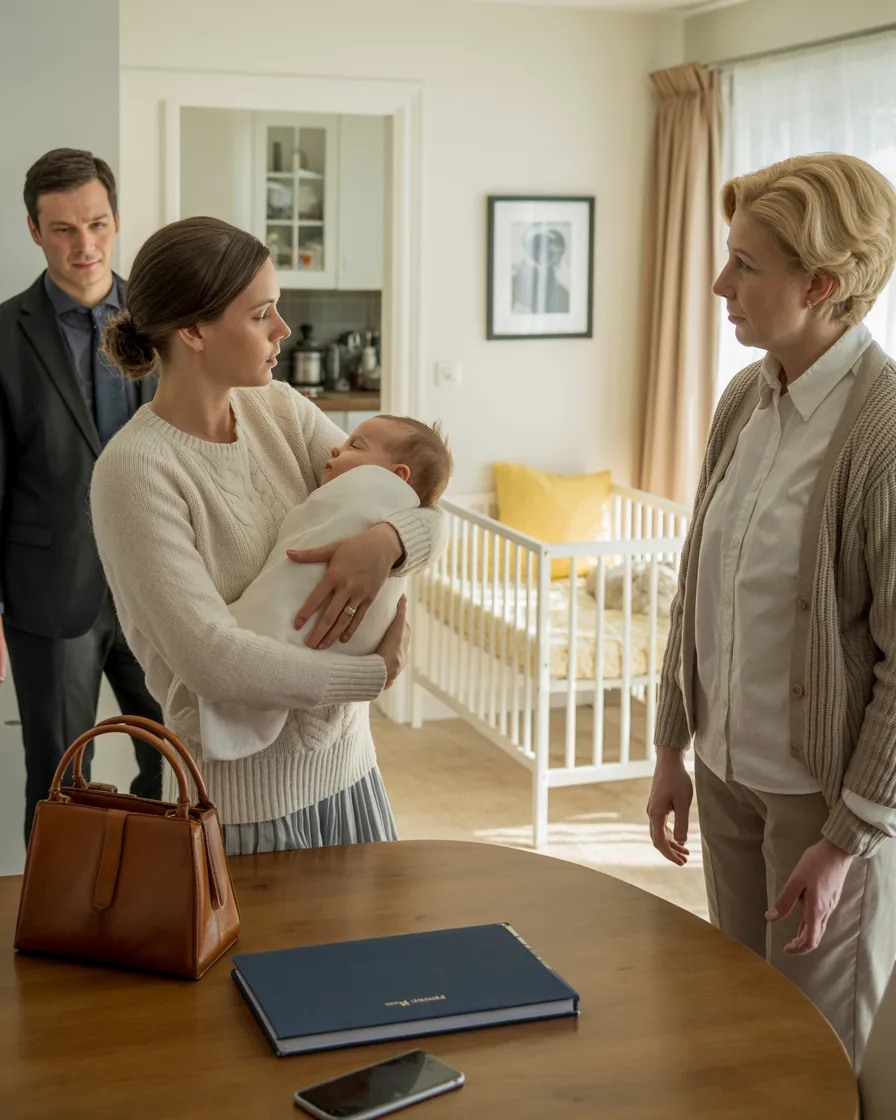
Beside him stood Meline Carter, my family lawyer, in a charcoal suit and cream coat, holding a leather portfolio against her side. She had the expression of a woman who had entered homes like mine before, homes where relatives came carrying casseroles and left behind traps. Behind her, a county family services supervisor waited on the walkway with a slim folder tucked beneath her arm, her presence quiet but official enough to make the air tighten.
My mother’s smile faltered only then. Just a flicker. Tiny.
But I saw it. For years, Barbara had trained me to doubt my own reactions. To soften my discomfort.
To translate her control into concern. To accept that if she criticized my clothes, my career, my house, my marriage, my choices, my income, or my body, she was simply “trying to help.” But motherhood had changed the wiring inside me. Exhausted as I was, stitched together by sleepless nights and milk stains and hormones that made me cry over diaper commercials, there was now one truth I could feel in my bones without explanation.
My mother was standing between me and my child. And she knew it. Forty-eight hours earlier, I had still been trying to believe she was merely difficult.
I was thirty-two years old, three weeks postpartum, and living in the soft chaos of new motherhood in a yellow house on a quiet street outside Columbus, Ohio. Evan and I had bought the house four years earlier with a fixed-rate mortgage, stubborn budgeting, and more optimism than furniture. It was modest by my mother’s standards: two stories, three bedrooms, a little back porch, a maple tree out front, and a driveway Evan insisted on shoveling himself even though the neighbors all hired snow services.
To me, it was everything. My art studio faced the backyard, where morning light came through the windows in long gold rectangles. I worked as a freelance illustrator, mostly children’s books, educational posters, and cover art for small publishers.
It was not the kind of career Barbara understood. She liked salaries with titles, offices with glass doors, husbands with corporate parking spots, and houses where every room looked staged even when people lived in them. Evan taught history at a public high school.
That, to my mother, was almost worse. “He’s very noble,” she used to say, which sounded like praise until you heard the way she held the word noble between two fingers like a used napkin. “But noble doesn’t pay for private school.”
Evan never took the bait.
He would smile, refill her coffee, and ask if she wanted more pie. That infuriated her more than arguing would have. When Leo was born, I thought the baby might soften her.
That is one of the lies daughters tell themselves when they have mothers like mine. We believe the right milestone will finally unlock the tenderness we have been chasing since childhood. Graduation.
Marriage. Pregnancy. Birth.
We keep handing them moments wrapped in hope, waiting for them to become the parent we needed. Barbara arrived at the hospital with a monogrammed blanket, a designer diaper bag, and a face full of tears that looked perfect in photographs. She held Leo for exactly seven minutes while Evan stood beside my bed and I watched, too tired to interpret anything beyond the fact that my son was finally breathing in the world.
“He is beautiful,” she whispered. For one foolish moment, I believed we had turned a corner. Then she looked at me and said, “You look awful, sweetheart.
We’ll have to get you presentable before anyone visits.”
There it was. The corner had been painted on a wall. Three weeks later, the doorbell rang while I was trying to eat toast over the sink with one hand.
Leo was strapped to my chest in a soft gray wrap, sleeping after a night that felt less like a night and more like a survival exercise. Evan had returned to work two days earlier because his school district’s leave policy had been written by people who apparently believed newborns operated on office schedules. I opened the door and found my mother holding a plastic bucket of cleaning supplies.
She did not ask to come in. She stepped across the threshold, kissed the air beside my cheek, and said, “I couldn’t stand thinking of you living in all this.”
All this meant a burp cloth on the couch, two mugs in the sink, folded laundry in a basket, and a stack of unopened mail on the dining room table. A normal person would have seen a home with a newborn.
Barbara saw evidence. “Mom, you didn’t have to drive over.”
“I know I didn’t have to.” She set the bucket on the floor and scanned the entryway, her eyes moving over the tiny socks near the stairs, the bassinet beside the couch, the half-finished thank-you cards on the console table. “That’s what help is, Lila.
Doing things before people ask because they’re too overwhelmed to know what they need.”
I was too tired to fight the sentence. So I let her in. For the first hour, she cleaned like she was auditioning for sainthood.
She wiped counters, rearranged pantry shelves, folded the throw blanket on the couch, and made little tsking sounds whenever she discovered something she considered proof of decline. She asked how often Leo was feeding, whether I was tracking diapers, whether Evan was “really helping” or “just holding the baby when it suited him.”
Then she opened the pantry and found Leo’s formula. It was the expensive kind, recommended by our pediatrician after his stomach reacted badly to the first brand we tried.
Evan had driven across town at ten at night to find it. We had a handwritten feeding log taped to the inside of the cabinet because new parents are not people so much as exhausted record-keeping machines. Barbara picked up the container, read the label, and frowned.
“This is absurdly expensive.”
“It works for him.”
She dropped it into the trash. I stared at the sealed container lying on top of coffee grounds and a banana peel. “Mom.”
She pulled a generic brand from her grocery bag and placed it on the shelf.
“You need to learn practical habits. Babies do not require boutique powder.”
“The pediatrician recommended that one.”
“Doctors recommend whatever samples are on their desks.” She wiped the counter with a paper towel. “You and Evan have to be careful now.
Freelance income, teacher salary, new baby. This is not the time for emotional spending.”
Emotional spending. That was what she called anything I chose.
Art school had been emotional spending. My wedding, even though Evan and I paid for most of it ourselves, had been emotional spending. The vintage rocking chair I bought from a neighbor and refinished for the nursery was emotional spending.
Apparently, feeding my son something that didn’t make him cry for hours was emotional spending too. I wanted to snap. The words rose fast and hot: Our mortgage is nearly paid down.
My business cleared six figures last year. You financed a luxury car you did not need because Olivia said it matched your image. But Leo stirred against my chest, and exhaustion sat heavy on my tongue.
So I breathed through it. Barbara’s eyes flicked toward me. Watching.
Waiting. Later, I would understand that she wanted a reaction. She wanted raised voices.
Tears. A trembling hand. Something she could record, describe, twist, or label.
At the time, I only thought she was being cruel in the ordinary way she knew how to be cruel. “Go upstairs and rest,” she said eventually, sliding the mop into the bucket. “I’ll do the downstairs.
You look like you’re about to fall over.”
“I don’t need—”
“Lila.” Her tone turned soft. “Let me be your mother for five minutes.”
I hated how well that worked. I hated that some part of me still wanted her to mean it.
So I nodded and started toward the stairs. That was when I saw her purse. It was sitting open on the dining room table, a large tan leather tote with gold hardware and a silk scarf tied around one handle.
Barbara was never careless with that bag. She treated it like an extension of her body. Yet there it was, zipper wide, the dark interior visible from across the room.
A white pharmacy bag sat on the chair beside it. Her blood pressure medication. The driver had rung the bell minutes earlier, asking for ID verification, and I had signed because Barbara was elbow-deep in floor water.
When I reached into the purse to find her wallet, my fingers brushed against the rough edge of a manila folder. At first, I planned to push it aside. Then I saw my name.
Not handwritten. Printed. Lila Wright.
Beneath it, in bold block letters:
Petition for emergency guardianship and temporary custody. The words did not enter my mind all at once. They hovered, disjointed and impossible.
Emergency. Custody. Guardianship.
My name. The wet swish of the mop continued in the kitchen. Barbara hummed a cheerful tune.
I pulled the folder out. The stack of papers was thick, heavier than it should have been. My hand shook so badly the top page fluttered.
I laid the folder on the dining table and angled my body so the kitchen doorway was blocked from view. The first page described me as “emotionally unstable following childbirth.”
The second page claimed I was unable to provide consistent care for Leo. The third page referenced “episodes of irrational distress.”
I read one paragraph three times before my brain accepted what it said.
Last Tuesday, the mother became hysterical after dropping a bottle and expressed inability to continue caring for the infant. The memory came back with humiliating clarity. I had dropped a bottle of pumped milk.
Three ounces. It hit the kitchen floor and cracked open. I had been running on less than two hours of sleep.
Leo had finally settled. Evan was upstairs changing sheets because spit-up had become our new household weather. I sank to the floor and cried because anyone who has fed a newborn from her own body understands that spilled milk is not just milk.
It is time, pain, effort, and one more tiny defeat when you already feel made of paper. Barbara had been there. She had sat beside me and patted my shoulder.
“Oh, sweetheart,” she had said. “Everyone gets overwhelmed.”
Now I understood. She had not been comforting me.
She had been gathering language. I turned the page. Attached was a “maternal wellness evaluation” from a doctor I had never met.
The report suggested I required “structured rest away from the infant” and that temporary placement with a financially stable relative would be “strongly advisable.” The language was cold, clinical, and disgusting in its restraint. At the bottom was a blue notary seal. Something about it caught my eye.
I am an illustrator. My work depends on detail. I know when a line has been copied, when a texture has been cloned, when a letter has been stretched without regard for proportion.
I can spot a bad digital stamp the way Evan can spot a fake historical quote. The blue seal looked wrong. Too sharp around the edge.
Slight blur near the name. The letter spacing uneven, one pair of letters pressed together as if the image had been resized from a low-resolution source. It was not a real stamp.
It was pasted onto the page. My mother had not just exaggerated. She had brought forged paperwork into my home.
I turned to the signature page, already knowing and praying I was wrong. Barbara’s signature was there first, large and dramatic, all loops and confidence. Below it was my father’s.
Kenneth Wright. Small, neat, familiar. The same careful blue-ink signature he used on birthday cards, school permission slips, and the check he gave Evan and me when Leo was born with a note that said, For whatever the baby needs.
Beside his name was a checked box. Parent supports emergency placement. My knees nearly gave out.
My father had taught me to ride a bike in a church parking lot. He had once driven three hours in the snow because my college car wouldn’t start. He was quiet, conflict-avoidant, and too accustomed to letting my mother steer every room, but I had always believed there was a soft place in him that belonged to me.
Now his name sat on a document designed to take my son out of my arms. I pressed one hand against the table. Breathe.
The mop stopped. I froze. A cabinet closed in the kitchen.
Water sloshed in the bucket. Barbara coughed once, then resumed humming. I had seconds.
I pulled out my phone, silenced it, and photographed everything. The cover page. The statement about the spilled milk.
The false medical report. The fake seal. My father’s signature.
The checked box. My mother’s signature. Then, as I slid the folder back, my knuckles brushed something else beneath the silk lining of the tote.
A navy leather book. Thick. Heavy.
Brass clasp. I should have left it. I did not.
I opened it and saw the title on the first page in plum-colored ink. Leo’s First Years. My sister Olivia’s handwriting.
I knew it instantly. Those dramatic loops. The sharp cross on every t.
The theatrical flourish on the capital L. Olivia wrote grocery lists like invitations to royal weddings. My sister had not visited Leo once.
She had skipped my baby shower, ignored the birth announcement for three days, and sent a white cashmere blanket through our mother with no note. Yet she had filled out a baby memory book. I turned to the first dated entry.
Two years in the future. My sweet Leo, today you turned two. We celebrated in the garden with blue balloons and the string quartet you love.
I thank God every day that I was able to step in before your birth mother’s instability damaged your future. She meant well, but she could not give you the life you deserved. You are safe now with your real mommy.
The room blurred. Birth mother. Real mommy.
I read the words again and again until they stopped being impossible and became something worse. Planned. Olivia had written my son’s future without me in it.
There were pages about private preschool interviews, a Christmas at her ski lodge, a nursery with imported wallpaper, a birthday party on the lawn of her country club. Every few entries, I appeared as a sad footnote. A fragile woman.
A cautionary tale. A person who had “made the loving choice” to let her wealthier sister raise the child properly. My son slept against my chest through all of it.
His tiny fingers curled into my sweater. His mouth made a small rooting movement in his dreams. He had Evan’s chin and my nose and a soft crease above his left eyebrow that appeared when he was about to fuss.
He was not an accessory. He was not a consolation prize. He was not a gift my family could redirect because Olivia’s nursery was empty and my mother disliked my tax bracket.
He was my child. The rage that came then was so pure it frightened me. Not hot.
Not messy. Cold. Clear.
Useful. I closed the book. I returned it to the exact angle where I found it.
I smoothed the silk lining. I slid the manila folder back into the side pocket. I adjusted the purse zipper to the same careless opening.
Then I went upstairs. “Mom,” I called toward the kitchen, making my voice sound weak and tired. “I’m going to lie down while Leo sleeps.”
“Good girl,” she called back.
Good girl. I locked myself inside the nursery. The room was painted soft yellow.
Felt stars turned lazily above the crib. A stack of clean diapers sat on the changing table, impossibly ordinary. The glider in the corner still held the blanket Evan’s students had made for us, a patchwork of badly sewn squares and handwritten history jokes.
It should have felt safe. Instead, it felt like a room under siege. I placed Leo in his crib and called Evan.
He answered on the second ring. “Hey, love. Everything okay?”
“They’re trying to take Leo.”
The background noise on his end vanished.
I heard the hard clatter of something dropping. Later, he told me it was his coffee mug hitting the teachers’ lounge floor. “What?”
“My mother has papers in her purse.
Emergency custody. A fake evaluation. Dad signed.
Olivia has a baby book written like Leo is already hers.”
There was no panic in his answer. That was one of the reasons I loved him. He became quiet first.
Then exact. “Lock the nursery door. Do not confront her.
I’m leaving now. Call Meline.”
The line went dead. I called Meline Carter next.
Two years earlier, I had designed the logo for her family law practice: a simple black door slightly open with a line of gold light beneath it. She told me then that family law was often about helping people find the door out of rooms they didn’t know had become dangerous. Now I needed her to open one for me.
I sent the photos while the call rang. She answered crisply. “Meline Carter.”
“Open the email I just sent you.
Please. Right now.”
I heard clicking. Then silence.
Not ordinary silence. Professional silence. The kind that meant a person trained to handle emergencies had just found one.
“Lila,” she said, and her voice had changed completely. “Does your mother know you found these?”
“No.”
“Keep it that way.”
I gripped the side of the crib. “What do I do?”
“You do not confront her.
You do not cry in front of her. You do not raise your voice. If she is building a case that you’re unstable, every reaction becomes material.
You are calm. You are tired. You are grateful for her help.
You let her leave with her purse.”
“She forged a seal.”
“Yes.”
“My father signed.”
“Yes.”
“My sister wrote herself into my son’s life.”
“I understand.” Meline’s voice stayed steady. “And now we build the record that proves it. Send me everything.
Texts. Emails. Pediatric records.
Feeding logs. Your business income. Mortgage records.
Anything showing stability. I’m clearing my day.”
“What if she files tomorrow?”
“Then we meet her in court with a stronger hand than she knows exists.”
“What if she files before that?”
“We move first if we have to.”
I looked at Leo sleeping beneath the felt stars, and for the first time since the folder came out of the purse, my fear had direction. Meline continued.
“Listen carefully. Your mother expects you to act like the person she described on paper. Don’t give her that person.”
So I went downstairs.
Barbara was rinsing the mop in the sink, humming again. The leather tote sat on the dining room table, innocent as a sleeping animal. “Did he go down?” she asked.
“For now.”
“You look like you’re going to faint.” She dried her hands on a towel. “I could take him tonight, you know. Let you sleep.”
It was the cruelest offer I had ever heard.
I looked at her face. The woman who gave birth to me stood ten feet away, offering to help while carrying papers that would erase me from my son’s life. She looked calm.
Almost loving. For the first time, I wondered how many times in my childhood she had worn that same face while doing damage I was too young to name. “That’s kind,” I said.
“But Evan should be home soon.”
Her mouth tightened. “He is? I thought he had meetings after school.”
“His stomach is bothering him.
He texted.”
That small lie landed perfectly. Barbara disliked Evan because he was steady in ways she could not control. He did not chase her approval.
He did not accept her insults disguised as advice. Most of all, he loved me without requiring me to become more impressive first. Two minutes later, his car pulled into the driveway.
Barbara moved quickly after that. The concerned grandmother vanished beneath irritation. She packed her cleaning supplies, zipped the leather tote, and gave Evan a cool nod when he stepped into the kitchen looking pale and convincing.
“You poor thing,” she said, though her tone suggested inconvenience rather than sympathy. “Drink water.”
“I will,” Evan said. He did not look at her purse.
He did not look at me. He simply stood between her and the stairs until she left. The second her sedan turned the corner, Evan locked the front door.
Then he turned around and took Leo from my arms with shaking hands. The sight of his fear nearly broke me. For the next hour, our home became a crime scene in everything but official name.
Evan downloaded the photos to his laptop while I walked him through every detail. The folder. The seal.
Dad’s signature. Olivia’s baby book. The future birthday entries.
The fake concern. The formula in the trash. The way Barbara had watched me for a reaction.
“She has details,” I said. “Too many. She wrote things from days she wasn’t here long enough to observe.”
Evan looked up sharply.
“What do you mean?”
“The document mentions me crying after I dropped milk. She was here for that. But there are other notes.
Night crying. Feeding patterns. Things from times she wasn’t in the house.”
His face changed.
We began searching. Not wildly. Methodically.
Evan checked outlets, smoke detectors, picture frames. I checked the bookshelf, the nursery shelf, the ceramic bowl Barbara gave me “for keys” after Leo was born. We moved through the downstairs slowly, refusing to wake the baby, refusing to let panic make us sloppy.
Evan found it behind the history books on the mantel. A small black cube, smaller than a matchbox, tucked behind a thick biography of Abraham Lincoln. A tiny lens faced the living room.
A red light blinked faintly, hidden in the shadow between books. I sat down hard on the couch. For three weeks, I had nursed my child in that room.
Cried in that room. Walked in circles at three in the morning with milk leaking through my shirt and tears on my face. I had believed those moments belonged to my family alone.
My mother had been watching. Evan did not smash the camera. That would have been easy.
Instead, he removed the memory card with the care of a historian handling a primary source. “Let’s see what she collected,” he said. The files were arranged by date.
There were hours of us simply living. Me folding laundry. Evan grading papers.
Leo sleeping. Me eating toast over the sink. Evan dancing awkwardly with the baby when he thought I was upstairs.
Me crying quietly on the couch after a long night, then wiping my face and picking Leo up the second he stirred. Nothing dangerous. Nothing unloving.
Only exhaustion. Only care. Then we opened a file from the previous afternoon.
Barbara walked into view holding a duster. She tidied the mantel. Adjusted a photograph.
Reached into her pocket. Made a call. The audio was clear.
“Ken,” she said. “Yes, the doctor signed. It cost more without an examination, but it’s done.
Olivia needs the nursery ready by Friday. We file first thing in the morning.”
Evan’s hand closed over mine. On the screen, my mother paced slowly, her voice brisk and practical.
“No, the judge won’t question it if the story is tight. Lila looks exhausted because she is exhausted. We use that.
But I need one more visual incident.”
She paused near the kitchen archway. “I’ll put something in her tea tomorrow. Not enough to hurt her, just enough to make her sleep too deeply.
When the baby cries and she doesn’t respond, I’ll record it. A neglect video will make the order automatic.”
The room went cold. Evan stood so fast his chair scraped.
“I’m calling the authorities.”
I caught his wrist. He stared at me as if I had become someone else. “We need Meline.”
“She admitted it.”
“And if we confront her now, she’ll destroy the documents, claim she was venting, and say we’re paranoid.
We need her to file. We need her to put the forged papers in front of a judge. We need the whole thing on record.”
Evan breathed hard through his nose.
The teacher was gone. The calm man with the green pen was gone. In his place was a father measuring the distance between rage and strategy.
Finally, he sat. “Then we back up everything.”
He copied the files to two hard drives, a secure cloud folder, and a flash drive. Meline joined us by video, hair pulled back, suit jacket still on though it was late evening.
She watched the key clip without blinking. When it ended, she said, “Tomorrow morning, we go to court.”
“They filed?”
“Yes. Electronic preliminary filing came through at 5:12.
Emergency hearing at nine.”
I held Leo close and felt his heartbeat against my chest. Meline looked directly into the camera. “Lila, you need to be ready for what they will say.
It will be ugly. They will describe normal postpartum fatigue as instability. They will describe your work as unreliable.
They will describe your home as insufficient because your sister has more money. You cannot react.”
“I know.”
“No. You need to understand.
The judge will watch you while they lie.”
Evan reached for my hand. “I can do it,” I said. And because Leo shifted in my arms, because his tiny mouth opened and closed as if searching for me even in sleep, I knew it was true.
The next morning, I wore a black blazer over a white blouse. It barely fit right. My body was still unfamiliar to me, softer and sore and healing in ways no one warns you about honestly enough.
But the blazer gave me shape. Structure. A reminder that I had been a professional before I became a mother and that becoming a mother had not erased the person who could stand in a room and think clearly.
Evan wore his charcoal suit. Leo wore a blue knit onesie and slept through the drive to downtown Cincinnati as if his entire future was not strapped into the car seat behind us. The courthouse smelled like floor wax, old paper, and burnt coffee from a vending machine.
Meline met us outside courtroom four, holding a slim portfolio. She looked at Leo first, then at me. “Ready?”
“No.”
“Good.
Honest people rarely feel ready.”
Inside, my mother sat at the petitioner’s table wearing soft beige instead of her usual hard lines. She had dressed for sympathy. Cashmere cardigan.
Minimal jewelry. Pale lipstick. A tissue folded in one hand.
My father sat beside her, gray-faced, eyes fixed on the table. He looked like a man already regretting his choices but not enough to undo them before consequences arrived. Olivia sat in the second row.
Camel coat. Designer bag. Smooth hair.
Hungry eyes. She did not look worried. She looked impatient.
That did more to steady me than any pep talk could have. Judge Gallagher entered at nine exactly, an older man with silver hair, tired eyes, and the stern patience of someone who had watched too many families turn love into litigation. Barbara’s attorney, Mr.
Belmont, stood first. He was expensive. You could tell by how gently he moved, how little paper he carried, how confident he was that the room would organize itself around his voice.
“Your Honor,” he began, “we are here under urgent circumstances involving the safety of a three-week-old infant.”
He painted me exactly as the papers had. Exhausted. Unstable.
Overwhelmed. Financially uncertain. A creative freelancer with unpredictable income.
Married to a public school teacher. A young mother “showing signs of concerning postpartum deterioration.” He described the spilled milk incident like evidence. He described normal newborn crying like crisis.
He described Barbara as a devastated grandmother trying to prevent harm before it was too late. I sat still. My hands were folded in my lap.
Evan’s knee touched mine beneath the table. Leo slept in his carrier between us, occasionally making tiny dreaming sounds that nearly undid me. Then Belmont held up the forged evaluation.
“We are not relying solely on family concern,” he said. “We have a professional assessment supporting immediate temporary placement with the child’s aunt, Olivia Sterling, whose household offers stability, resources, and an appropriate environment while the mother receives the care she needs.”
Olivia lifted her chin slightly. There it was.
The sales pitch. My son, repackaged as a transfer to a better address. Judge Gallagher read silently for several moments.
Then he looked at Meline. “Counselor, these are serious allegations supported by what purports to be medical documentation. Does your client have a response?”
Meline stood.
No drama. No rush. “Yes, Your Honor,” she said.
“We have proof that this petition rests on forged documents, unlawful surveillance, and a coordinated attempt to manufacture a custody emergency.”
The courtroom changed. Belmont turned toward Barbara. Barbara’s tissue stopped moving.
Meline handed the judge three enlarged photographs: the fake seal, the magnified pixel edges, and the signature page. She explained my profession. How digital artifacts worked.
Why ink should bleed into paper fibers. How the notary named on the report had retired years earlier and was not practicing in Ohio. Belmont went pale.
“I was not aware—”
“I believe you,” Judge Gallagher said sharply. “For your sake, counsel, I sincerely hope that remains true.”
Meline placed the hidden camera on the evidence table. Barbara inhaled.
Just once. But I heard it. “This device,” Meline said, “was discovered inside my clients’ home, hidden behind books on their fireplace mantel.
It recorded the living room where my client feeds and cares for her newborn. The memory card contains hours of private family footage. It also contains a recording of the petitioner discussing the preparation of these documents and a plan to create a misleading neglect video.”
The judge’s face hardened.
“Play it.”
The bailiff connected the flash drive. The monitor flickered on. Our living room appeared on the screen.
For a few seconds, nothing happened. Then Barbara walked into the frame, duster in hand, looking every inch the helpful grandmother. The courtroom watched her call Ken.
The courtroom heard her say the doctor signed without examining me. The courtroom heard her say Olivia’s nursery needed to be ready by Friday. The courtroom heard her say she would put something in my tea to make me sleep too deeply.
A woman in the gallery gasped. My father buried his face in his hands. Barbara sat rigid, staring at herself on the screen as if the video were a stranger betraying her.
Then the recording reached the line about filming Leo crying while I failed to respond. Judge Gallagher slammed his gavel once. The crack cut through the room.
“Enough.”
The monitor froze on Barbara’s face. The real Barbara stood abruptly. “I was trying to protect my grandson!”
Her attorney reached for her sleeve.
“Mrs. Wright, please sit down.”
She shook him off. “She is not fit for him.
Look at her. Look at this life. Freelance work?
A teacher’s salary? That child could have everything with Olivia. The best schools, the best doctors, a real future.
I did what any grandmother with sense would do.”
The silence that followed was worse than shouting. Because she had finally said it plainly. Not safety.
Status. Not love. Ownership.
Olivia stood in the gallery, trembling with rage. “The nursery is already done,” she cried. “We painted it.
Marcus ordered the crib. Mom said Friday. You promised.”
Every head turned.
Olivia seemed to realize too late that she had spoken in front of a judge. Her mouth closed. Her fingers clutched her designer bag until the leather bent.
Judge Gallagher looked at her with open disgust. “Bailiff,” he said, “escort that woman out of my courtroom. Now.”
Olivia protested all the way to the doors, but the sound faded into the hallway.
Then came the phones. Barbara’s phone buzzed first on the petitioner’s table. Ken’s followed.
Then Belmont’s. Then a muffled vibration from the hallway, probably Olivia’s. Evan had waited until the recording played in court, then sent a carefully prepared package of evidence—not to strangers, not to gossip sites, not to the world, but to the people directly entangled in the deception: Olivia’s husband, her attorney, Barbara’s club board, and the professional contacts who had been used as character references in the petition.
No commentary. No insults. Just the court-filed documents, the video clip, and the emergency hearing notice.
Truth does not need decorative language when it has timestamps. Barbara looked down at her buzzing phone, and for the first time in my life, I saw her understand that she did not control the room. Judge Gallagher denied the petition with prejudice.
He granted an immediate protective order covering me, Evan, and Leo. Barbara, Ken, and Olivia were forbidden from contacting us directly, coming to our home, approaching Leo’s daycare or medical appointments, or using third parties to pressure us. He referred the forged evaluation, false filing, and surveillance device to the proper legal authorities for review.
Then he looked at me. Not with pity. With respect.
“Mrs. Wright,” he said, “your composure today likely prevented a terrible misuse of this court. Your child is safe with you.”
I did not cry until we reached the parking garage.
There, between concrete pillars and the echo of car doors, I unbuckled Leo from his carrier and held him so tightly he protested with a small, offended squawk. Evan wrapped both arms around us. Meline stood beside the car, looking away politely while I fell apart.
“You did it,” Evan whispered into my hair. “No,” I said, still shaking. “We did.”
Two years have passed.
Barbara never returned to the woman she was before that hearing. Not socially. Not legally.
Not in my mind. The investigation moved quietly, as legal processes often do, but the consequences arrived one by one. She pleaded to charges tied to falsified filings and unlawful surveillance.
She avoided a long public trial, but not public disgrace. The country club revoked her membership under a conduct clause she used to brag about when it applied to other people. Friends stopped inviting her to luncheons.
The women who once complimented her centerpieces crossed grocery aisles to avoid eye contact. My father cooperated to protect himself. That was the final shape of him.
Not evil in the dramatic way. Not powerful. Just weak.
Weak enough to sign without reading. Weak enough to follow Barbara into a scheme that could have destroyed his daughter. Weak enough to become useful only when consequences reached his own door.
Olivia’s marriage did not survive the footage. Marcus, who managed wealth for people who valued discretion above almost anything, filed for divorce within a month. He had tolerated Olivia’s curated sadness online because it suited his polished life.
He did not tolerate evidence of her demanding another woman’s baby in a public courtroom. Her online following turned too. The women who had once held her through infertility grief watched her scream that a nursery had already been painted for my child, and sympathy curdled into outrage.
She tried to explain. Tried to reframe. Tried to become the victim of “family misunderstanding.” But screenshots are stubborn.
Video is worse. As for us, we left Columbus. Not immediately.
First, we changed locks. Changed numbers. Met with therapists.
Filed every order. Sat awake too many nights listening for cars that did not come. Healing did not feel like relief at first.
It felt like withdrawal from danger, the body not trusting quiet because quiet had once hidden traps. Eventually, we sold the house. I thought I would grieve it more than I did.
Instead, on moving day, as Evan carried the last box to the truck and Leo slept in his stroller under the maple tree, I walked through every room and said goodbye not to the house, but to the version of myself who had survived there. The woman who found the papers. The woman who did not scream.
The woman who learned that calm can be sharper than rage. We bought a property in northern Ohio, where pine trees ringed the yard and the nearest neighbor waved from far enough away to feel friendly without feeling close. Evan took a job at a rural high school where his students brought him apples from their family orchards and complained about homework with the same conviction as city kids.
I converted a sunroom into a studio and signed contracts with two publishers that had once felt too big for me to approach. My work changed after everything. More shadows.
More light. More mothers holding doors closed against storms. More children sleeping safely beneath impossible skies.
Leo is two now. He runs everywhere. He has grass stains on most of his pants and a laugh that sounds like a bell dropped into sunlight.
He calls our golden retriever Barnaby “Barby,” which makes Evan and me exchange looks across the yard and try not to laugh for reasons our son will understand only when he is much older. He knows nothing about the navy leather book. He knows nothing about the fake papers, the hidden camera, the courtroom, or the woman who tried to rewrite his life before he could speak his first word.
Someday, we will tell him enough. Not everything at once. Enough.
He will know that some people confuse money with love. That some relatives believe blood gives them ownership. That his parents protected him not because he was property to guard, but because he was a person to love.
He will know that family is not proven by titles, tears, or matching DNA, but by what people do when your safety costs them comfort. On quiet evenings, I sit on the back porch with chamomile tea. For months after the hearing, I could not drink it.
Even the smell made my stomach twist. Then one autumn afternoon, Evan placed a mug beside me and said, “Only if you want.”
I did. Now I drink it slowly while Leo chases Barnaby through the grass and Evan grades papers at the patio table, green pen in hand.
The tea tastes like reclaimed territory. Sometimes guilt still knocks. It uses my mother’s voice.
My father’s silence. Olivia’s grief. It asks whether cutting them off was too harsh, whether a good daughter should leave a door open, whether forgiveness should look like access.
Then I remember the papers. The forged seal. My father’s blue-ink signature.
The baby book written two years into a future where I had been reduced to “birth mother.”
The camera hidden behind our books. The court monitor showing my mother’s own words. And the guilt leaves with nowhere to sit.
People say motherhood makes you soft. They are wrong. Motherhood made me tender.
It also made me steel. Before Leo, I still tried to negotiate with people who mistook my boundaries for suggestions. I still believed there was a version of myself good enough, successful enough, agreeable enough to finally earn my mother’s unconditional love.
I still thought my father’s quietness meant kindness. I still pitied Olivia more than I mistrusted her. Then I found the papers in my mother’s purse.
And I understood that protecting peace sometimes requires ending the performance of family. The people who truly love you do not require you to surrender your dignity for closeness. They do not call control concern.
They do not write legal stories where you disappear. They do not look at your exhaustion and see opportunity. My mother came into my home with a mop, a smile, and a plan.
She believed I was too tired to notice. She forgot that even exhausted mothers have instincts sharper than sleep. She forgot that I built a career on seeing what others miss.
She forgot that Evan teaches history, and history belongs to those who preserve the evidence. Most of all, she forgot that Leo was not alone in that house. He had me.
He had his father. He had a life no one else had the right to claim. And when the front door opened, when my mother stood there still holding the mop, when she finally saw the people I had called standing behind me, I watched the first crack form in the world she had built.
By the time the judge finished reading his order, that world was gone. Mine was just beginning.