If Ximena Carter had learned anything from poverty, it was how to lower her eyes without lowering her dignity. She had cleaned rich people’s kitchens, scrubbed marble floors, folded towels softer than anything she owned, and smiled at women who left lipstick on crystal glasses worth more than her rent. But standing in the service hallway of the Whitmore mansion, soaked in fear and rainwater, she realized obedience had finally brought her to the edge of something that could swallow her whole.
Valentina Whitmore stood in front of her wearing a white silk robe, a diamond bracelet, and the kind of smile that never reached the eyes.
“Ximena,” Valentina said again, her voice soft enough to be mistaken for kindness. “What were you doing downstairs so long?”
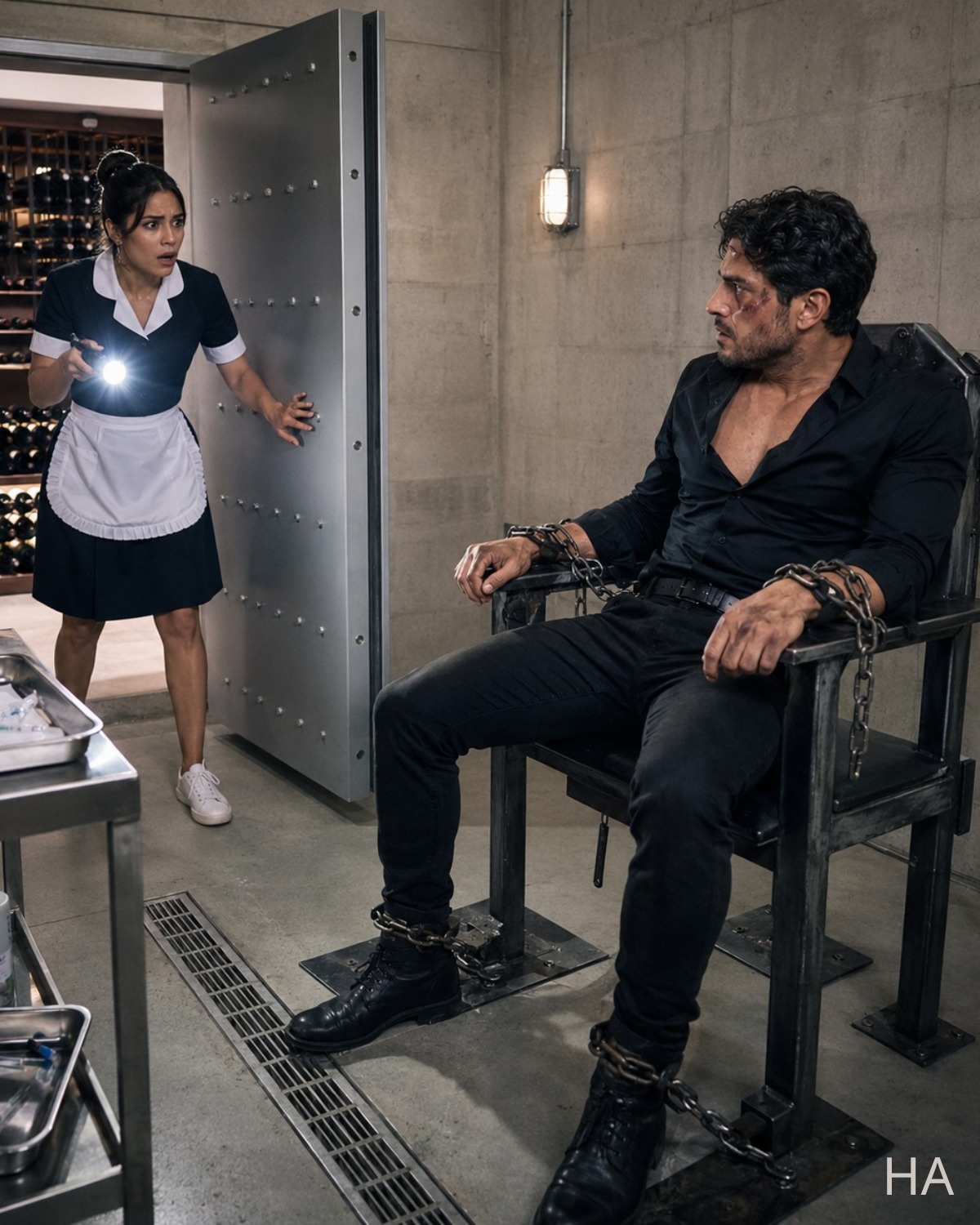
Ximena’s fingers tightened around the flashlight. Her heart was beating so hard she thought Valentina might hear it over the storm. Beneath her feet, hidden under wine bottles and polished stone, a man the world believed dead was chained to a metal chair. Above them, politicians, donors, and judges were sipping expensive whiskey in a mansion famous for charity.
And Ximena had just seen the truth.
“I couldn’t find the breaker,” she said.
Valentina’s smile did not move. “But the power is back.”
“I found it eventually.”
A long silence stretched between them.
Valentina stepped closer, and the faint scent of jasmine perfume wrapped around Ximena like a warning.
“Did you open any doors?”
Ximena forced herself to look confused. “Doors?”
“The service area is old. There are locked spaces. Storage. Mechanical rooms. Things staff don’t need to touch.”
Ximena swallowed. “I just did what Mrs. Rivera told me.”
Mrs. Rivera, the head housekeeper, appeared at the far end of the hallway with a stack of towels pressed to her chest. Her face was expressionless, but her eyes snapped to Ximena for half a second.
Not fear.
Instruction.
Say nothing.
Valentina turned slightly. “Elvira, did you send her?”
“Yes, ma’am,” Mrs. Rivera said. “The guests were complaining. I needed someone quick.”
“And she was gone nearly fifteen minutes.”
“The panel sticks,” Mrs. Rivera replied. “It always has.”
Ximena realized then that Mrs. Rivera knew. Maybe not everything. Maybe not names, not numbers, not the full shape of the horror. But she knew enough to lie without hesitation.
Valentina studied both women.
Then she laughed softly.
“Fine. Go help in the kitchen. The senator hates cold lamb.”
Ximena lowered her head. “Yes, ma’am.”
She walked away slowly, every step feeling like a test. She did not run until she reached the service pantry and closed the door behind her. Only then did she press both hands over her mouth and fight the scream clawing up her throat.
Erasmo Beltran.
Alive.
Chained under the mansion of the most admired philanthropic couple in New York.
No. Not Erasmo anymore. In America, the newspapers called him Elias Bell. Former smuggling boss. Informant. Ghost. Three weeks earlier, federal officials had said he died in a warehouse fire near Baltimore before testifying against several organized crime groups.
But he had not died.
He had been hidden.
And he had told Ximena the Whitmores were worse than the criminals they pretended to fight.
At 1:17 a.m., the dinner ended.
The guests left through the front entrance beneath umbrellas held by security guards. Cameras flashed outside the gate because the Whitmores never hosted anyone without making sure the right people knew it. Senator Paul Wexler shook Rodrigo Whitmore’s hand under the porch lights and praised his “commitment to vulnerable women and children.” Valentina kissed the cheek of a federal judge and promised to send another donation to his wife’s foundation.
Ximena watched from the kitchen doorway, feeling sick.
Their foundation.
Whitmore Hope Initiative.
The same organization that paid hospital bills, funded shelters, supported immigrant women, gave scholarships, and appeared in glossy magazine spreads under headlines like: “The Couple Bringing Dignity Back to the Forgotten.”
Forgotten.
That word now felt like a threat.
When the last guest left, Rodrigo Whitmore removed his tuxedo jacket and handed it to a waiting butler without looking at him. He was tall, silver-haired, and handsome in the way old money trained men to be handsome: expensive, calm, untouchable. Valentina moved beside him like a queen returning from a performance.
“Where is the new girl?” Rodrigo asked.
Ximena froze.
Mrs. Rivera stepped forward. “In the kitchen, sir.”
“Send her home early.”
Ximena’s stomach dropped.
Valentina’s eyes flicked toward the service hallway. “No. Let her stay until morning. The roads are flooded. It would be irresponsible to send staff out in this weather.”
The way she said irresponsible made Ximena’s skin go cold.
Rodrigo looked at his wife.
For one tiny second, Ximena saw something pass between them. Not affection. Not disagreement. Calculation.
“Fine,” he said. “Then keep her busy.”
Mrs. Rivera nodded.
By 2 a.m., the mansion was quiet.
Ximena stood in the laundry room folding guest towels while the storm hammered the roof. Her hands moved automatically, but her mind was downstairs with the chained man and his request.
A burner phone.
Water.
A red leather notebook in Rodrigo’s office.
If you find it, you don’t just save me. You save yourself.
Every sensible part of her screamed not to get involved. Her mother was at St. Mary’s Hospital in Queens, fighting kidney failure with a strength Ximena could not afford to lose. The Whitmores had paid two months of her mother’s treatment through their foundation after Ximena’s application was approved. She had cried when the money came through.
Now she understood it had not been mercy.
It had been a leash.
At 2:23, Mrs. Rivera entered the laundry room and closed the door.
Ximena looked up.
The older woman’s face was pale.
“You saw him,” Mrs. Rivera said.
Ximena did not answer.
Mrs. Rivera crossed the room and grabbed her wrist. “Listen to me. You are going to finish folding these towels. Then you are going to clean the east guest room. Then you are going to leave at 6 a.m. and never come back.”
“Who is he?”
“No one you can save.”
“He said they’re taking women.”
Mrs. Rivera’s grip tightened painfully.
Ximena’s breath caught. “So it’s true.”
Mrs. Rivera looked toward the door, then lowered her voice to a whisper.
“I have worked in this house for eleven years. I have seen girls come in through the foundation office and never leave through the front door. I have seen staff disappear after asking questions. I have seen police cars arrive and leave without reports. You think truth protects poor women? It doesn’t. It gets them buried.”
Ximena’s eyes burned. “Why didn’t you leave?”
Mrs. Rivera’s face hardened. “Because they brought my son here once and showed me a video of him walking to school. They said if I quit, he would not reach the gate.”
The room seemed to tilt.
Ximena thought of her mother in the hospital bed, tubes in her arm, asking every visit if Ximena had eaten.
“They know about my mom,” Ximena whispered.
“Of course they do. They know everything before they hire you.”
Ximena pulled her hand free. “Then why did you send me downstairs?”
Mrs. Rivera looked away.
The answer was terrible before she said it.
“Because I am tired,” she whispered. “Because when the power died, I saw a chance. Because I thought maybe you would be smarter than me, braver than me, or young enough to still believe someone might help.”
Ximena stared at her.
Mrs. Rivera opened her apron pocket and pulled out a cheap black phone.
A burner.
Ximena stopped breathing.
“I bought it six months ago,” Mrs. Rivera said. “Never had the courage to use it.”
She placed it in Ximena’s hand.
“There’s one number saved. A federal agent. I think she’s clean. I don’t know for sure. Her name is Rachel Morgan. Elias Bell was supposed to testify to her before he ‘died.’”
Ximena looked at the phone like it might explode.
Mrs. Rivera continued, “Do not call from inside the house. The walls are monitored. Cameras don’t cover the linen elevator or the old garden passage. If you go back downstairs, don’t take the main stairs.”
“I’m not going back down there.”
“Yes, you are.”
Ximena’s mouth went dry.
Mrs. Rivera stepped closer. “Because Rodrigo’s office is locked by fingerprint and code, but Valentina keeps a duplicate key in her private sitting room. And tonight, they are watching you.”
“Then I’m dead either way.”
“Maybe,” Mrs. Rivera said. “But if you leave without doing anything, you will spend the rest of your life wondering when they come for you anyway.”
The words were cruel.
They were also true.
At 3:05 a.m., Ximena walked into the east guest room with clean towels stacked in her arms. She knew there was a camera above the hallway mirror because she had dusted around it earlier that week. She kept her face tired, bored, obedient.
Inside the guest room, she opened the closet and found the old service panel Mrs. Rivera had described.
Behind it was a narrow passage, barely wide enough for one person. The mansion was nearly a hundred years old, built when wealthy families preferred servants to move invisibly. The Whitmores had modernized almost everything, but greed often missed what history hid.
Ximena slipped into the passage and pulled the panel closed behind her.
Darkness swallowed her.
She used the tiny flashlight from her apron, shielding the beam with her fingers. Dust scratched her throat. Pipes groaned behind the walls. Somewhere far away, thunder rolled over the Hudson.
The passage led behind Valentina’s private sitting room.
Ximena pushed the hidden latch slowly and peered through a crack.
Empty.
The room looked like a museum of soft power. Pale furniture, gold-framed mirrors, fresh flowers, photographs of Valentina with governors, first ladies, celebrity activists, and crying children in foreign countries. On the desk sat handwritten thank-you notes from shelters and hospitals.
Ximena stepped inside.
Her hands shook as she searched.
Drawer. No.
Jewelry box. No.
Bookcase. No.
Then she saw it: a small porcelain angel on the mantel, facing slightly away from the room. It looked too delicate to belong in a house this cold. She lifted it and found a brass key taped underneath.
“God forgive me,” she whispered.
The key opened Rodrigo’s office.
The room smelled of leather, cigars, and expensive silence. Ximena had cleaned it once under supervision and had been warned never to touch the left wall cabinet. Now she stood before that cabinet with Valentina’s key in her hand.
It opened.
Inside were files, a locked cash box, and a red leather notebook.
Ximena took it.
The notebook felt warm in her hands, though she knew that was impossible.
She opened the first page.
Names.
Not donor names.
Not employees.
Women.
Girls.
Initials. Dates. Cities. Amounts. Medical notes. Transportation codes. Foundation case numbers. Some names were crossed out. Some had checkmarks. Some had the word “transferred” written beside them.
Ximena’s stomach twisted.
Then she saw one name that made her knees almost buckle.
Marisol Reyes.
Her cousin.
Marisol had disappeared two years earlier after taking a job through a “women’s placement program” in New Jersey. Police had said she probably ran away. Her family had begged for help until grief turned into exhaustion.
The Whitmore Hope Initiative logo was printed beside her case number.
Ximena pressed the notebook to her chest, fighting the urge to sob.
That was when the office door opened.
Valentina stood there.
No robe now. She wore black slacks, a cream blouse, and a smile sharpened into something almost amused.
“Oh, Ximena,” she said softly. “You poor little thing.”
Ximena could not move.
Valentina stepped into the office and closed the door behind her.
“Did Elvira give you the phone?”
The question hit like a slap.
Ximena’s hand went unconsciously to her apron pocket.
Valentina sighed. “I told Rodrigo she would break eventually. He said loyalty bought with fear lasts longer than loyalty bought with money. Men can be so arrogant.”
Ximena backed toward the desk. “Stay away from me.”
“Or what? You’ll scream? The staff sleeps in the back wing. The security team works for my husband. The police commissioner sits on our foundation board.”
Valentina crossed the room slowly.
“You saw Elias.”
Ximena said nothing.
Valentina’s smile widened. “He always had a talent for drama. Did he tell you he was innocent? Did he tell you he is a victim?”
“He told me what you do.”
“What we do,” Valentina corrected. “Rodrigo handles money. I handle access. Hospitals, shelters, immigration clinics, addiction centers. The desperate are always so easy to organize when you call it charity.”
The words were so monstrous, so calm, that Ximena felt suddenly detached from her own body.
“You’re insane.”
“No,” Valentina said. “I’m efficient.”
Ximena gripped the notebook tighter.
Valentina’s eyes dropped to it.
“You have no idea how many powerful men are in those pages.”
“Good.”
“Good?” Valentina laughed. “Child, that book doesn’t protect you. It marks you. If you walk out of here with it, every person named in it will want you dead before breakfast.”
Ximena’s voice shook. “Then maybe they should have written less down.”
For the first time, Valentina’s expression changed.
Anger cracked the polished surface.
She lunged.
Ximena threw the heavy brass desk lamp at her.
It struck Valentina’s shoulder, not hard enough to stop her completely, but enough to make her stumble. Ximena ran for the door, clutching the notebook and the burner phone. An alarm screamed before she reached the hallway.
Red lights flashed along the ceiling.
A man shouted from downstairs.
Ximena sprinted into the service passage, slammed the panel behind her, and crawled through the narrow darkness as footsteps thundered through the mansion walls.
She did not think.
Thinking would kill her.
She dropped through the linen elevator shaft ladder, scraped her arm badly, hit the basement landing hard enough to knock the air from her lungs, and kept moving.
She had two choices.
Run outside and likely be caught before reaching the gate.
Or go down.
To Elias.
To the man everyone feared.
To the man in chains who might be the only person in the house more hunted than her.
Ximena ran down.
The steel door beneath the wine cellar was no longer open. But the storm had damaged the lock earlier, and Mrs. Rivera had given her one more thing in the laundry room: a small metal wedge used to prop service doors open.
Ximena jammed it into the broken frame and shoved with everything she had.
The door gave.
Elias lifted his head as she burst inside.
“You came back,” he said.
“They know.”
“Of course they know.”
Ximena ran to him. “How do I unlock these?”
“Pocket of the guard by the stairs.”
“What guard?”
The door behind her moved.
A security guard appeared, gun in hand.
Ximena froze.
The man pointed the weapon at her.
“Put the book down.”
Elias laughed weakly. “Tommy. Still doing rich people’s dirty work for dental insurance?”
The guard’s jaw tightened. “Shut up.”
Ximena’s mind raced. The notebook was in one hand. The phone in her apron. A man with a gun stood between her and the only exit. Elias was chained. Valentina was coming.
Then the lights flickered again.
The storm had not finished with the house.
For half a second, darkness swallowed the room.
Elias moved.
Ximena never saw how. One moment he was slumped in the chair; the next he had hooked one chained foot around the guard’s ankle. Tommy crashed hard onto the concrete, the gun skidding under the table. Ximena grabbed the nearest object—a metal tray—and slammed it down on the guard’s wrist when he reached for her.
He yelled.
Elias twisted, reached with chained hands, and pulled a small key ring from the guard’s belt.
“Behind me,” he barked.
Ximena fumbled with the keys. First one, no. Second, no. Third, the cuff snapped open.
Elias freed one hand, then the other. He moved like a wounded animal, slow but lethal. Once his ankles were free, he stood and nearly collapsed. Ximena grabbed his arm.
He was heavier than he looked.
“You can barely walk,” she said.
“I don’t need to dance.”
Footsteps pounded above them.
Elias picked up the guard’s gun, removed the ammunition, tossed the weapon into the drain, and kept the magazine.
Ximena stared at him. “Why didn’t you keep it?”
“Because you’re not surviving this by becoming what they say I am.”
That surprised her more than anything.
He pointed toward a narrow drain corridor behind the room. “Old tunnel. Leads to the garden wall. They used it during Prohibition.”
“How do you know that?”
“I make it my business to know exits.”
They moved.
The tunnel smelled like mold and rust. Ximena helped Elias through ankle-deep water while alarms screamed behind them. Once, he stumbled so badly she thought he would fall, but he caught himself against the wall and kept going.
Halfway through the tunnel, the burner phone buzzed.
Ximena almost dropped it.
Unknown number.
She answered with shaking hands.
A woman’s voice said, “This is Agent Rachel Morgan. Who is this?”
Ximena nearly sobbed. “My name is Ximena Carter. I’m at the Whitmore mansion. Elias Bell is alive. I have the red notebook.”
Silence.
Then: “Where are you?”
“In a tunnel. Under the house. They’re chasing us.”
Agent Morgan’s voice changed instantly. “Listen carefully. Do not call 911. Do not call local police. Stay on this line. Federal units are already positioned nearby, but we need you outside the perimeter. Can you get to the river road?”
Ximena looked at Elias.
He nodded once.
“Yes,” she said. “I think so.”
“Do you have evidence?”
“The notebook.”
“Keep it on you. If you are stopped, hide it somewhere they won’t search first.”
Ximena’s breath hitched.
Behind them, metal scraped.
Someone had entered the tunnel.
Elias looked back. “Move.”
They ran as much as Elias could run.
The tunnel ended behind a stone drainage wall near the edge of the property. Rain poured down in silver sheets. Beyond the manicured lawn and security lights was a wooded slope leading toward a narrow service road.
Ximena helped Elias out first.
Then a shot cracked through the storm.
Stone exploded near her shoulder.
She screamed and fell.
Elias grabbed her by the collar and dragged her behind the wall.
“Are you hit?”
“I don’t know.”
He checked her quickly. “No. Just scared.”
“Just scared?” she gasped.
He almost smiled. “Scared keeps you alive.”
Two guards appeared at the far end of the garden path.
Then the entire night lit up red and blue.
Federal vehicles stormed through the broken front gate.
Not one car.
Not two.
A convoy.
Agents in tactical gear poured onto the property, shouting commands. Helicopter light sliced through the rain. Somewhere near the mansion, a woman screamed. Valentina, maybe. Or one of the guests still hidden inside. It did not matter.
Agent Rachel Morgan found Ximena crouched behind the drainage wall with Elias Bell bleeding beside her and the red notebook pressed under her shirt.
“You Ximena?” Morgan asked.
Ximena nodded, shaking too hard to speak.
“Give me the book.”
Ximena hesitated.
Morgan lowered her voice. “I know you don’t trust anyone. Good. Don’t stop being smart now. But I need that notebook to bring them down.”
Ximena looked at Elias.
He nodded.
She handed it over.
Agent Morgan opened the first page, scanned it, and her face went pale in the rain.
“My God,” she whispered.
Elias coughed. “Told you.”
Morgan snapped the notebook shut and looked at her team. “Secure every exit. Nobody leaves. Nobody calls out. Not the Whitmores. Not their guests. Nobody.”
By dawn, the mansion that had hosted senators and charity galas became a crime scene.
Rodrigo Whitmore was arrested in the front hall wearing a cashmere sweater and the stunned expression of a man who had mistaken influence for immortality. Valentina was found in her private sitting room, blood on her sleeve from the lamp injury, attempting to burn documents in a silver wastebasket. Mrs. Rivera stood in the kitchen with both hands raised, crying silently as agents searched the pantry walls and service passages.
Ximena sat in an ambulance wrapped in a foil blanket, watching it all happen.
Elias sat in another ambulance nearby with agents guarding him.
Their eyes met once.
He lifted two fingers.
Not thanks exactly.
Acknowledgment.
That was enough.
Then Ximena remembered her mother.
She grabbed Agent Morgan’s sleeve. “My mom. They know about my mom. She’s at St. Mary’s in Queens.”
Morgan turned immediately. “Name?”
“Rosa Carter.”
Morgan spoke into her radio before Ximena finished the second syllable.
Within minutes, federal protection was sent to the hospital.
But minutes can feel like years when your entire heart is lying in a hospital bed across the city.
Ximena rode with Agent Morgan, still in her maid uniform, still smelling of bleach, basement mold, and fear. She clutched a cup of coffee she did not drink while Morgan made calls in a voice that could cut steel.
At the hospital, two agents were already outside Rosa Carter’s room.
Ximena ran past them.
Her mother was awake, thin and tired, with a blanket pulled up to her chest. When she saw Ximena, her face filled with alarm.
“Mija, what happened?”
Ximena fell beside the bed and sobbed into her mother’s hand.
Rosa stroked her hair weakly. “Tell me.”
“I found something terrible,” Ximena whispered. “And I think I helped stop it.”
Rosa closed her eyes, tears slipping down her temples.
“I always knew you were braver than your life allowed you to be.”
The story exploded by noon.
Not the whole truth. Not yet. Federal cases move carefully, and powerful names do not fall in a single headline. But enough came out to shake the country.
Billionaire philanthropists Rodrigo and Valentina Whitmore arrested in federal trafficking and corruption probe.
Whitmore Hope Initiative under investigation.
Missing women connected to charity network.
Survivors located.
The public reacted the way the public always does when evil is found wearing expensive clothes: first disbelief, then outrage, then a hunger for details.
Cable news replayed old clips of Rodrigo and Valentina smiling beside children.
Commentators asked how nobody knew.
Ximena wanted to throw something at the television.
People knew.
Staff knew. Families knew. Missing women’s mothers knew. Nurses knew. Shelter workers knew. The problem was not that nobody knew. The problem was that nobody powerful had cared until evidence became too heavy to bury.
Agent Morgan returned to the hospital that evening.
Ximena was sitting beside her mother’s bed, refusing to leave.
Morgan carried a folder and two coffees.
“You saved lives last night,” she said.
Ximena stared at the floor. “Did I save my cousin?”
Morgan’s expression softened.
“Marisol Reyes?”
Ximena nodded.
Morgan sat down carefully. “We found a record tied to her name. She was transferred through three states. We don’t know yet where she is, but now we have a trail.”
A trail.
Not a body.
Not a confirmation of death.
A trail.
Hope, after two years of silence, hurt almost as much as grief.
Ximena covered her mouth.
Morgan placed the folder on the table. “There’s something else. Elias Bell gave a statement. He says you are the reason the case survived.”
Ximena laughed bitterly. “He’s a criminal.”
“Yes,” Morgan said. “He is. He also had evidence we needed, and he stayed alive long enough for you to find him.”
“Can I trust him?”
Morgan’s answer was honest. “No. Not completely.”
Ximena appreciated that.
“But in this case,” Morgan continued, “his enemy was worse. And sometimes the truth reaches us through people who are not clean.”
Over the next weeks, the Whitmore case widened.
The red notebook unlocked everything.
It connected foundation grants to shell companies, shell companies to transportation contractors, contractors to offshore accounts, and those accounts to men whose faces had appeared for years at charity dinners. A judge resigned before he was arrested. Senator Wexler claimed ignorance until messages from his private phone proved otherwise. Police officials went quiet. Donors hired lawyers. The Whitmore mansion remained sealed behind federal tape while reporters camped outside the gate.
Mrs. Rivera entered witness protection with her son.
Elias Bell disappeared into federal custody.
And Ximena became a name the media wanted badly.
“The maid who exposed the mansion.”
“The housekeeper hero.”
“The young woman who brought down the Whitmores.”
She hated every headline.
Not because they were wrong, exactly, but because they made courage sound clean. Courage had not felt clean. It had felt like vomit in her throat, shaking hands, scraped skin, and the knowledge that one wrong step could leave her mother waiting forever.
She refused interviews.
At least at first.
Then Agent Morgan found Marisol.
Alive.
The call came six weeks after the raid.
Ximena was in the hospital cafeteria eating fries she did not want when her phone rang. She saw Morgan’s name and stood so fast her chair scraped backward.
“Tell me,” Ximena said.
Morgan’s voice was gentle. “We found her in Nevada. She’s alive.”
Ximena sat down on the floor because her legs stopped working.
Marisol was alive.
Damaged. Terrified. Under medical care. But alive.
When Ximena saw her cousin two weeks later at a protected recovery facility outside Denver, neither of them spoke at first. Marisol was thinner, her hair cut short, her eyes too watchful. But she was there. Breathing. Real.
Ximena stepped forward slowly.
Marisol’s face crumpled.
Then they were in each other’s arms, crying with a grief too large to separate from joy.
“I thought everyone forgot me,” Marisol whispered.
“No,” Ximena sobbed. “No. We never forgot.”
Marisol held her tighter. “They told me nobody was looking.”
“They lied.”
That became the sentence Ximena carried into every room afterward.
They lied.
The Whitmores lied about charity. They lied about dignity. They lied about rescue. They lied to families, donors, employees, victims, police, and the entire country. But the cruelest lie was the one they told the people they took: nobody is looking for you.
Ximena decided the world needed to know that was not true.
Three months after the raid, she agreed to testify.
The federal courthouse in Manhattan was packed. Reporters filled the steps outside. Cameras followed every lawyer, every witness, every relative of the accused. Rodrigo Whitmore entered in a dark suit, looking older but still proud. Valentina entered behind him, dressed in white like innocence had a uniform.
Ximena wore a navy dress borrowed from Agent Morgan’s sister because she could not afford one.
Her mother, now stable and slowly improving, sat in the front row in a wheelchair.
Marisol sat beside her, wearing dark glasses and holding Rosa’s hand.
When Ximena took the stand, Rodrigo did not look at her.
Valentina did.
She smiled faintly.
That smile once would have made Ximena shrink.
Not anymore.
The prosecutor began gently.
“Ms. Carter, can you tell the court what your job was at the Whitmore residence?”
“I was a housekeeper.”
“And on the night of November seventeenth, what did you find beneath the mansion?”
Ximena breathed in.
Then she told the truth.
She told them about the storm, the breaker, the steel door, the chained man, the red notebook, Valentina’s confession, the tunnel, the gunshot, the federal raid. She spoke clearly. Sometimes her voice shook. She continued anyway.
Then the defense attorney stood.
He was smooth, silver-haired, and expensive. A man paid to make truth look unstable.
“Ms. Carter,” he said, “you were under enormous stress that night, were you not?”
“Yes.”
“Your mother was critically ill.”
“Yes.”
“You were financially desperate.”
“Yes.”
“You had every reason to resent wealthy employers who lived differently than you.”
Ximena looked at him. “I had every reason to work hard and go home.”
A few people in the courtroom shifted.
The attorney smiled thinly. “You expect this court to believe that a billionaire couple ran a massive criminal network under their own home?”
“No,” Ximena said.
The room stilled.
The attorney blinked. “No?”
Ximena leaned slightly toward the microphone.
“I expect this court to believe the documents, the survivors, the bank records, the tunnel, the basement, the notebook, and the people who were found because of it. You don’t have to believe me. Believe what they tried to bury.”
The prosecutor lowered his head to hide a smile.
Valentina stopped smiling.
The trial lasted nine weeks.
It was brutal.
Survivors testified behind screens. Bankers cried. Drivers lied until shown records. A former police captain admitted taking payments. A foundation director claimed she thought “transfer” meant housing placement, then collapsed under cross-examination when emails proved she knew more.
Elias Bell testified last.
He entered under heavy guard, thinner but alive, wearing a plain suit that could not disguise the violence of his past. The courtroom reacted with unease. He was no hero. Everyone knew it.
The prosecutor did not pretend otherwise.
“Mr. Bell, are you a good man?”
Elias smiled faintly. “No.”
“Have you committed crimes?”
“Yes.”
“Why should this jury believe you?”
Elias looked toward the jury.
“Because monsters recognize each other,” he said. “And Rodrigo Whitmore was never pretending to be charity for the money alone. He liked being praised while people disappeared under his feet.”
Rodrigo’s face turned gray.
Elias described deals, names, routes, bribes, and the moment he realized the Whitmores planned to kill him after extracting everything he knew. He described hearing staff walk above him for days. He described Ximena opening the door.
“She looked scared,” he said. “But not dead inside. That’s why I asked her for help.”
The defense tried to destroy him.
Elias let them list every crime he had committed.
Then he said, “Yes. And your clients still managed to disgust me.”
That line made headlines by sunset.
In the end, Rodrigo and Valentina Whitmore were convicted on nearly every major count.
Rodrigo showed no emotion when the verdict was read.
Valentina did.
Not tears. Not remorse.
Rage.
She turned toward Ximena as marshals moved in.
“You think this ends with us?” Valentina hissed.
Ximena held her gaze.
“No,” she said. “It starts with you.”
Sentencing came months later.
Life in federal prison for Rodrigo.
Life for Valentina.
Decades for their closest partners.
More arrests followed.
Some escaped justice. Ximena knew that. Evil with money grows roots in places no single trial can reach. But the network had been broken open. Names were known. Survivors were found. Families received answers, even when the answers hurt.
The Whitmore mansion was seized.
For a long time, nobody knew what to do with it.
Some wanted it demolished. Others wanted it sold. Survivors’ advocates argued it should become something that served the people the Whitmores had preyed upon.
Ximena did not involve herself.
She wanted peace.
But peace did not arrive easily.
After the trial, she could not work in private homes anymore. Every basement door made her hands shake. Every wealthy woman’s perfume made her stomach turn. Every time thunder rolled, she smelled concrete and dirty water.
Her mother moved in with her after leaving the hospital. Marisol stayed nearby while rebuilding her life through counseling and a survivor support program. They lived in a small apartment in Queens where the radiator hissed too loudly and the kitchen window faced a brick wall.
It was not much.
It was safe.
For a while, safe was enough.
Then one afternoon, Agent Morgan visited with an envelope.
“Before you say no,” Morgan said, “just read it.”
Ximena took the envelope suspiciously.
Inside was a proposal.
The seized Whitmore mansion would be converted into a survivor recovery center. Housing, legal support, trauma counseling, medical care, job training. A coalition of nonprofits would run it, funded by liquidated Whitmore assets. The board wanted one seat reserved for someone who had directly exposed the case.
Ximena looked up sharply. “No.”
Morgan nodded as if expecting that. “Okay.”
“I mean it.”
“I know.”
“I’m not going back in that house.”
“Nobody’s asking you to live there.”
“I don’t even want to see it.”
Morgan sat quietly.
Ximena looked back down at the paper. At the address. At the words “survivor recovery center.”
Her voice lowered. “They hurt people there.”
“Yes.”
“They buried screams under charity speeches.”
“Yes.”
“How can anyone heal in that place?”
Morgan’s answer was soft.
“Maybe by taking it from them.”
Ximena hated that the sentence stayed with her.
Three weeks later, she returned to the mansion.
Not alone. Her mother came. Marisol came. Agent Morgan came. Mrs. Rivera, under a new name and with federal permission, came too. She looked older but lighter, like a woman who had finally set down a weight she had carried for over a decade.
The mansion stood empty behind locked gates.
No flowers. No guards. No music. No cameras.
Just a house.
Ximena stopped at the front steps.
Her body remembered fear.
Marisol took her hand.
“You don’t have to,” she said.
Ximena looked at the white columns, the polished windows, the balcony where Valentina once waved to guests.
Then she thought of the women in the notebook.
The names.
The ones found.
The ones not yet found.
She stepped inside.
The grand foyer echoed.
Dust covered the marble. Federal markings remained on doorframes. The dining room where senators once toasted charity was stripped bare. The service hallway felt smaller than Ximena remembered. The basement door still made her stomach twist.
She went down anyway.
The steel door was gone.
The room below had been emptied, cleaned, photographed, cataloged, and stripped down to concrete. But memory does not need furniture. Ximena still saw the chair. The chains. The flashlight beam. Elias lifting his broken face.
Marisol began crying.
Mrs. Rivera crossed herself.
Ximena stood in the center of the room and shook for a long time.
Then she said, “Make this the records room.”
Agent Morgan frowned gently. “Records?”
“For the missing. For families. For names. They used this room to erase people. Fill it with proof they existed.”
No one spoke.
Then Morgan nodded. “That can be done.”
Two years later, the Whitmore mansion reopened as Haven House.
The white walls remained, but the gates were gone.
The fountain was removed and replaced with a garden of native flowers planted by survivors and families. The dining room became a communal kitchen where nobody ate standing unless they wanted to. Valentina’s sitting room became a children’s therapy space filled with sunlight, books, and soft rugs. Rodrigo’s office became a legal aid room.
The basement became the Archive of the Missing and Found.
Every name recovered from the red notebook was recorded there. Some had photographs. Some had only dates. Some had candles lit beside empty frames. Families came from across the country to search, to grieve, to hope, to confirm, to scream, to sit quietly because silence sometimes holds people better than words.
Ximena did not run the center.
She served on the board, reluctantly at first, then fiercely. She made sure the cleaning staff had windows in their break room. She made sure every worker had emergency contacts, legal protections, and wages good enough to live on. She made sure no donor name was ever carved larger than a survivor’s.
Her mother recovered enough to visit often, sitting in the garden and telling anyone who would listen that her daughter was stubborn before she was brave.
Marisol became a counselor.
Mrs. Rivera, still under a protected identity, wrote letters to staff training programs about how fear keeps people silent and how institutions must protect workers who speak.
Agent Morgan was promoted.
Elias Bell remained in federal prison under an agreement that gave him no freedom, but allowed his testimony to keep dismantling the men behind the network. Once a year, Ximena received a plain envelope through official channels. Inside was always the same thing: one name, one location, one clue tied to someone still missing.
No note.
No apology.
No friendship.
Just unfinished business.
Ximena used every clue.
One spring morning, five years after the storm, Ximena walked through Haven House before sunrise. The building was quiet. In the communal kitchen, a night counselor made coffee. Upstairs, women slept behind doors that locked from the inside. In the garden, the first light touched the flowers where the fountain had once performed wealth for guests.
Ximena went down to the archive.
She stopped before Marisol’s old record.
Found alive.
Those two words still had the power to weaken her knees.
On the opposite wall were names without endings.
She lit a candle.
Then she heard footsteps behind her.
A young woman stood at the doorway, maybe nineteen, wrapped in a blanket. New arrival. Scared eyes. One hand gripping the doorframe like she might run.
“Are you Ximena?” the girl asked.
“Yes.”
“They said you were the maid.”
Ximena smiled gently. “I was.”
“The one who found the basement?”
“Yes.”
The girl looked around the archive. “Weren’t you scared?”
Ximena thought of the storm, the gunshot, Valentina’s smile, her mother’s hospital bed, the red notebook shaking in her hands.
“Yes,” she said. “Terrified.”
The girl frowned. “Then why did you do it?”
Ximena looked at the wall of names.
“Because they counted on fear being stronger than love.”
The girl’s eyes filled.
“And it wasn’t?” she whispered.
Ximena turned back to her.
“Not that night.”
Outside, the sun rose over the old mansion that was no longer a mansion.
For years, the Whitmores had used beauty to hide a monster. They had turned charity into a net, wealth into armor, and silence into a basement beneath polished floors. They had believed desperate women were easy to threaten because desperation made people obedient.
They were wrong.
Desperation had taught Ximena how to survive.
Love had taught her when survival was no longer enough.
And in the place where powerful people once whispered, “If you speak, your mother dies,” women now spoke every day—names, stories, memories, accusations, prayers—until the walls that had once swallowed screams became the walls that carried them back into the light.