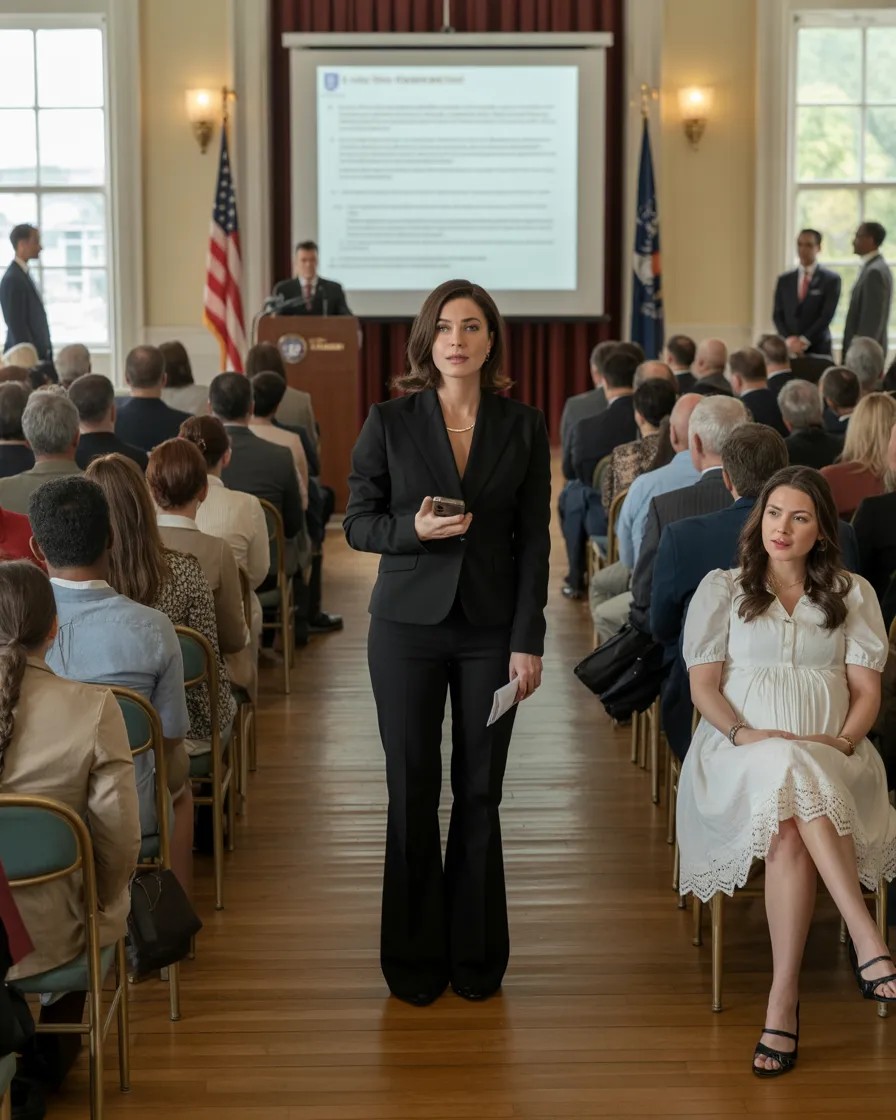
They demanded I give up my career to be an unpaid live-in nanny for my sister’s fourth baby. When I refused, they stole my identity. Now…
My name is Valerie Hayes.
I am 33 years old and my family considers my independence an absolute insult. I want you to think about what a family is supposed to be in a normal world. For most people, a family is a safety net.
It is a place where you are loved for simply existing, where your achievements are celebrated, and where your boundaries are respected. But in the Hayes family, love was always a currency, and I was always the one expected to pay the bill. I learned very early on that my worth was directly tied to my usefulness.
I work as an emergency operations director for a major pediatric hospital network. It is a demanding high-stakes career. My daily life is governed by strict protocols, crisis management, and making split-second decisions that actually matter.
I manage bed shortages, ambulance reroutes, and facility power failures. My brain is wired for structure and logic. Because of this, my own life is incredibly organized.
I have a beautiful, quiet apartment, a solid savings account, and a peaceful routine. So, whenever I was forced to attend one of my family’s gatherings, the sheer chaos of their lives felt like walking into a burning building where everyone was complaining about the heat, but actively refusing to use a fire extinguisher. It was a Sunday afternoon in early spring.
The air was warm, and the smell of cheap lighter fluid and grilled meat hung heavily in the backyard of my parents’ suburban house. We were gathered for a family cookout. Or at least, that was what the group text message claimed.
I stood near the edge of the patio holding a plastic cup of iced tea, watching the familiar, exhausting performance play out. My mother, Sylvia, and my father, Roland, were hovering. They always hovered, but never around me.
Their entire universe orbited around my younger sister, Bianca, and her husband, Marcus. Bianca was 29, the undisputed golden child of the family. She was sitting in a cushioned patio chair in the shade, complaining about the humidity, while my parents treated her like she was a fragile piece of royalty holding court.
Marcus stood beside her, scrolling through his phone, completely checked out of his surroundings. Meanwhile, Bianca’s three kids, Clara, Julian, and Hazel, were tearing through the yard like feral animals. Clara, who is seven, was screaming at Julian.
Julian, who was five, was hitting the family dog with a plastic baseball bat. Hazel, barely three years old, was wandering dangerously close to the hot grill while her parents did absolutely nothing to intervene. They just sat there, ignoring the chaos they had created.
This dynamic was my entire childhood wrapped into one single afternoon. Growing up, I was what psychologists call a glass child. I was the responsible one, the quiet one, the one who required zero maintenance because I never demanded attention.
My parents assumed I simply did not need any. Every single ounce of emotional and financial resources went directly to Bianca. If Bianca failed a class, she got a private tutor and a pep talk.
If I got a perfect grade, I was met with a distracted nod. When I turned 16, they completely forgot my birthday because Bianca had a minor breakup with a high school boyfriend and needed to be consoled with a weekend shopping trip. As I grew older and established my own life, my role shifted from the invisible child to the emergency backup plan.
I was the one they called when Bianca maxed out her credit cards and needed rent money. I was the one expected to cancel my weekend plans when Marcus decided he wanted to go on a golf trip and Bianca claimed she could not handle her own children alone. But over the last two years, I had started stepping back.
I stopped answering the phone on the first ring. I stopped offering my credit card. I had built a massive invisible wall between my hard-earned peace and their constant self-inflicted emergencies.
As I stood there on the patio, watching Julian throw a fistful of dirt into his little sister’s hair, I felt a familiar cold knot tightening in my stomach. Nobody throws a mandatory family barbecue on a Sunday afternoon just to eat cheap hot dogs. There was a hidden agenda.
I could see it in the way my mother kept glancing at me out of the corner of her eye, sizing me up, checking to see if I was in a compliant mood. I took a slow sip of my tea, bracing myself. I did not know exactly what they were going to ask for, but I knew without a shadow of a doubt that I was going to be the one expected to pay the ultimate price for whatever mess they had made this time.
The chaotic noise of the backyard suddenly went dead quiet as my mother clapped her hands loudly together. Sylvia always needed a captive audience before she delivered her lines. She stood next to Bianca and Marcus, a massive, unnatural smile plastered across her face.
She looked around to ensure every single person was paying attention. “Listen up, everyone,” my mother announced, her voice overly loud and theatrical. “Bianca and Marcus have some truly wonderful news to share with the family today.”
I set my plastic cup down on a nearby patio table and crossed my arms.
Bianca stood up slowly, deliberately placing a hand over her perfectly flat stomach. She looked around the yard to make sure all eyes were locked on her. Marcus puffed out his chest, looking incredibly proud of himself for absolutely no logical reason.
“We are pregnant again,” Bianca said, beaming a thousand-watt smile. “Baby number four is arriving this November.”
My mother gasped dramatically, as if she had not been secretly plotting this announcement for weeks. She threw her arms around Bianca, kissing her cheek, while my father walked over to give Marcus a firm congratulatory handshake.
There was scattered cheering, applause, and a sickeningly sweet atmosphere of celebration. I stood there, polite but frozen in place. Four children.
They already could not afford or emotionally manage the three they currently had. Marcus bounced between temporary sales jobs and unemployment. And Bianca’s part-time attempts at selling handmade baby blankets on the internet barely covered her daily expensive coffee habit.
They were drowning in debt. Their kids lacked basic discipline, and their solution was to bring another human being into the mess. I forced a tight smile, fully prepared to offer a standard generic congratulation and leave within the next 30 minutes.
But then the script flipped in a way I could never have anticipated. My mother pulled away from Bianca, wiped a completely non-existent tear from her eye, and turned directly to face me. The warm, grandmotherly expression instantly vanished from her face.
It was immediately replaced by the sharp, authoritative, uncompromising look she used whenever she was giving out orders that she expected to be followed blindly. “Valerie,” my mother said, stepping toward me, cutting through the lingering applause. The entire patio went dead silent.
“We have been talking, and we have figured everything out for the new baby.”
I felt the hairs on the back of my neck stand up. “We?” I asked, keeping my voice carefully neutral, refusing to give her an inch of emotional reaction. “Yes,” my mother continued, waving her hand dismissively as if my input was entirely irrelevant.
“Bianca is going to need a massive amount of rest. Her pregnancy is going to be high stress, and Marcus works so hard to provide. You know exactly how demanding three kids are, let alone four.”
She paused, looking at me expectantly, waiting for me to nod along like a good, obedient servant.
I did not move a single muscle. I just stared at her. “So,” my mother smiled, a cold, tight stretch of her lips that did not reach her eyes.
“Your apartment lease is up for renewal at the end of next month, right? We decided it makes the most sense for you not to renew it. Bianca has that guest room in her basement.
You are going to pack up and move in with them.”
The air in my lungs just evaporated. I stared at her, waiting for the punchline, waiting for someone to laugh and say it was a terrible joke. But her face was completely, terrifyingly serious.
“You will live rent-free, of course,” my mother added generously, as if she was offering me a winning lottery ticket. “In exchange, you will be there to get the older kids ready for school every morning, handle the daily cooking and cleaning, and take all the night shifts when the new baby comes so Bianca can finally get some sleep. It is the perfect solution for everyone.
You are single. You do not have a family of your own yet, and frankly, this will be great practice for you if you ever manage to settle down.”
I looked from my mother to Bianca, who was nodding in eager agreement, and then to Marcus, who was grinning like he had just scored a free full-time maid. They had actually sat down behind my back, discussed my private life, my home, and my demanding career, and decided they had the absolute right to reassign me.
They wanted me to give up the beautiful, quiet apartment I worked 70 hours a week to afford. They wanted me to pack up my entire independent life and move into a damp, unfinished basement to be an unpaid 24-hour live-in nanny. Before I could even process the absolute, mind-boggling audacity of the request, my father spoke up.
Roland always used a low, quiet, gravelly voice when he wanted to sound intimidating and shut down any potential arguments before they started. “It is a done deal, Valerie,” my father said, crossing his arms over his chest. “Family steps up when family needs them.
You have it incredibly easy right now. It is time you pulled your weight and helped your sister out. Do not make this a difficult transition for everyone.
We need you to do what you are told.”
They were not asking for a favor. They were issuing a military command. They looked at me not as a 33-year-old professional woman, but as a public resource, an asset they owned and could deploy whenever Bianca’s poor life choices required a safety net.
I looked at the three adults standing in front of me, so completely disconnected from reality, so deeply entitled to my existence, and I felt something deep inside my chest finally snap. The silence on the patio stretched on for what felt like hours. Every single eye in the backyard was locked on me.
They were waiting for me to lower my head. They were waiting for the familiar guilt to wash over me, for the lifelong psychological conditioning to kick in and force the word yes out of my mouth. They expected me to swallow my pride, sacrifice my future, and thank them for the opportunity to serve.
Instead, I looked directly into my mother’s eyes. “No.”
I said it was just one word. It was spoken softly, but it was razor sharp, carrying enough weight to shatter the delusional bubble they had built around themselves.
My mother blinked rapidly, her polite, demanding smile faltering. “Excuse me?” she asked, leaning forward slightly, as if she had genuinely misheard me over the sound of the wind. “I said no,” I repeated, my voice steady, completely devoid of emotion.
“I am not canceling my lease. I am not moving into Bianca’s basement. And I am absolutely not becoming an unpaid live-in nanny for her children.
That is not my responsibility.”
The reaction was instantaneous and explosive. Bianca’s face twisted into an ugly, furious scowl. She stepped out from behind our mother, her hands resting aggressively on her hips, completely abandoning the fragile pregnant woman act.
“Are you kidding me right now, Valerie?” Bianca snapped, her voice rising to a shrill, piercing pitch. “I am pregnant. I am exhausted.
You have literally nothing tying you down. You sit in an office all day and come home to a pathetic, empty apartment. What else are you going to do with your life?
You should consider this a favor. It is training for when you finally manage to find a man who can tolerate you.”
The sheer, unfiltered audacity of her words hung in the air. She was actually trying to insult me into submission.
She thought my career, my financial independence, and my hard-earned peace were pathetic simply because they did not serve her. I did not raise my voice. I did not throw a tantrum or try to defend my life choices.
I just looked at her with pure, unadulterated pity. “My life is full, Bianca,” I said calmly, making sure every word landed perfectly. “And my apartment is empty because I planned it that way.
I enjoy the quiet. If you and Marcus cannot afford or manage four children, you should not have created a fourth child. Your total lack of planning does not constitute an emergency on my part.
I will not pay for your mistakes with my life.”
Marcus stepped forward, his face turning an angry shade of red. “Do not talk to my wife like that.”
He pointed a threatening finger at me. “You are being completely selfish.
We offer you a place in our home, and this is how you repay us.”
My father’s deep voice cut through the noise, attempting to regain control. “Enough. Valerie, you are embarrassing this family.
You will pack your things next month. You will move into that basement, and you will help your sister. That is the end of this discussion.
You do not get to walk away from us.”
He looked at me with that old, familiar glare. The exact same glare that used to make me shrink into myself when I was a terrified 10-year-old girl. But I was not 10 anymore.
I was a woman who managed massive hospital crises for a living. I dealt with screaming surgeons and life-or-death logistics. A disappointed father throwing a temper tantrum in a backyard held absolutely no power over me anymore.
“Actually, Roland,” I said, watching his eyes widen in pure shock as I used his first name for the first time in my life. “The discussion ended the exact moment I said no. I am going home now.”
I turned around, picked up my purse from the lawn chair, and started walking toward the side wooden gate.
“If you walk out that gate, you are turning your back on this family,” my mother screamed, her voice cracking with desperation and rage. “You will regret this, Valerie.”
I did not stop. I did not look over my shoulder.
I pushed the gate open, walked to my car, and drove away without looking back. That night, my phone did not stop buzzing. It was a relentless, coordinated assault of text messages.
My mother texted me massive paragraphs about how I had broken her heart, how I was a cold, unnatural sister who lacked basic human empathy. Marcus texted me, calling me an arrogant career woman who would die alone with her money. Bianca sent me a long voice note crying hysterically, claiming the stress I was causing was going to hurt her unborn baby and that it would be entirely my fault.
I sat on my sofa in my quiet, clean, perfectly peaceful apartment, reading every single word. I did not reply to a single one. I did not try to defend myself or explain my side.
I knew that replying would only give them the emotional ammunition they craved. In their twisted minds, they were the ultimate victims, and I was the cruel villain who had denied them the free labor they were entitled to. I turned my phone on silent, poured myself a glass of cold water, and went to bed.
I thought the worst of it was over. I thought that by walking away, I had drawn a permanent line in the sand that they would eventually respect out of sheer embarrassment. I was entirely wrong.
I severely underestimated the terrifying depths of their entitlement. They were not going to accept my refusal. Instead, they were going to try and force my hand in the most despicable, illegal way possible.
The next morning, I woke up in my own bed, wrapped in a heavy, comfortable quilt, listening to the quiet, steady hum of my air conditioning. It was a Monday. My apartment was spotless.
My schedule for the week was perfectly organized, and my mind felt incredibly clear. There is a very specific kind of luxury in waking up and knowing that your day belongs entirely to you. That no one is waiting to drain your energy, your money, or your time before you have even managed to brush your teeth.
I walked into my kitchen, started the coffee maker, and picked up my phone from the counter. There were 14 unread messages from the family group chat, all sent in a frantic burst between midnight and 3:00 in the morning. I swiped them away without reading a single word.
I had established my boundary, and I was not going to negotiate my freedom with people who treated me like property. I was pouring my first cup of coffee, enjoying the morning silence, when the phone suddenly rang. It was 7:00 a.m.
exactly. The number flashing on the screen was local, but I did not recognize it. Given my high-level position at the hospital, I had a strict rule to answer unknown local numbers early in the morning in case of an emergency protocols update or a facility crisis.
I swiped the screen to accept the call. “Valerie Hayes speaking,” I said, keeping my tone crisp and professional. “Good morning, Miss Hayes.
This is Officer Briggs with the County Police Department,” a calm, heavy, authoritative voice replied. My heart skipped a painful beat. In my line of work, receiving a call from the police department at 7 in the morning never meant good news.
“Yes, officer. How can I help you this morning?” I asked, gripping the edge of the kitchen counter. “Are you the aunt of Clara, Julian, and Hazel?” he asked, his voice giving nothing away.
“Yes, I am,” I replied, my mind instantly racing through terrifying possibilities. “Is everything okay? Was there an accident?
Are they hurt?”
“They are physically unharmed, ma’am,” Officer Briggs said, though his tone remained carefully guarded. “I am calling because the three children were left at the Lake View Community Center about 20 minutes ago. The staff arrived to unlock the building for the day and found them sitting alone on a concrete bench near the front doors with all their belongings.
There was absolutely no adult with them.”
My brain struggled to process the words he was saying. “Left there?” I repeated, my voice dropping to a whisper. “What do you mean they were left there?
Where are Bianca and Marcus? Where are their parents?”
“We have been completely unable to reach either parent by phone,” the officer explained patiently. “However, the eldest child had a handwritten note pinned directly to her backpack.
The note specifically states that you, Valerie Hayes, are their designated caregiver and that you would be arriving shortly to take full custody of them for the foreseeable future.”
The blood drained rapidly from my face. A cold, heavy wave of physical nausea washed over me. I felt the air completely leave my lungs.
They actually did it. They took three small, helpless children, drove them to a closed building in the early morning chill, dumped them outside, and used them as literal pawns to trap me. They knew perfectly well that I worked near the Lake View area.
They calculated that if the police called me about abandoned crying children, my conscience and my fear would force me to show up and surrender. It was a sick, twisted psychological game of chicken, and they were using their own innocent kids as the stakes to win a free nanny. “I need you to come to the community center immediately, Miss Hayes,” Officer Briggs continued, misinterpreting my stunned silence as confusion.
“I am leaving right now,” I said, my voice dropping to a low, hard, emotionless register. “I will be there in exactly 14 minutes.”
I hung up the phone. I did not panic.
I did not cry. The initial shock instantly burned away, leaving behind a cold, incredibly focused fury. I walked calmly to my entryway, grabbed my car keys, and locked my door behind me.
The drive to the Lake View Community Center took exactly 14 minutes. I drove strictly the speed limit, following every traffic law. My hands were perfectly steady on the leather steering wheel, but my mind was running through a hundred different legal scenarios.
I understood exactly what my sister and my parents were trying to do. They genuinely thought that if they created a massive public crisis involving law enforcement, I would be so deeply embarrassed, so overwhelmed by the police presence and the crying children, that I would just pack the kids into my car and give up. They thought I would accept the role of the live-in nanny just to avoid a family scandal.
They thought I was still the fragile glass child who would break under the pressure and do whatever it took to keep the peace. I pulled my car into the community center parking lot. I saw the flashing red and blue lights of two police cruisers illuminating the brick wall of the building.
And there, sitting on a cold concrete bench in the morning fog, were my nieces and nephew. They did not know it yet, but my family had just made the single biggest mistake of their lives. I parked my car, turned off the engine, and stepped out into the crisp morning air.
My heels clicked loudly and rhythmically on the asphalt as I walked toward the entrance of the community center. As I got closer, the full reality of the scene became clear, and it absolutely broke my heart. Clara, the seven-year-old, was sitting rigidly on the very edge of the concrete bench, her arms wrapped fiercely and protectively around her little sister, Hazel, who was half asleep and visibly shivering in a thin denim jacket.
Julian was standing a few feet away near a police officer, kicking aimlessly at the dirt, his face red and streaked with dried tears. Lined up perfectly beside them on the pavement were three large school backpacks and two massive stuffed black trash bags full of clothes and toys. They had actually packed them up.
They had packed up their own children’s entire lives to forcefully move them into my apartment. A tall officer with graying hair and a deeply tired expression stepped forward to meet me, blocking my path to the children. “Miss Hayes?” he asked, looking me up and down, assessing my professional attire.
“Yes, I am Valerie,” I replied, keeping my voice incredibly level and calm. “I am Officer Briggs,” he said, gesturing back toward the bench with a heavy sigh. “Thank you for coming so quickly.
The kids are a bit shaken up. A staff member found them sitting here at 6:45 this morning. The doors were locked, the lights were off, and the temperature was in the low 50s.
They have been out here alone.”
He reached into his uniform pocket and pulled out a clear plastic evidence bag. Inside the bag was a crumpled piece of lined notebook paper. He held it out and handed it to me.
“This was safety pinned to the older girl’s backpack,” he said flatly, watching my face closely for a reaction. I looked through the plastic bag. The handwriting was unmistakable.
It was Bianca’s large, bubbly, overly stylized script. It read verbatim:
Valerie Hayes has agreed to take the kids. She is moving in to be their live-in nanny and will be picking them up here.
Family helps family. We will be back to check on them later. I stared at the note, feeling a cold rage settling deep in my bones.
It was not just a pathetic lie. It was a deliberate, highly calculated trap dressed up as a simple misunderstanding. They knew exactly how the law worked.
If I took those children right now, if I put those trash bags into the trunk of my car and drove them to my home, I would be legally accepting responsibility for them. I would be validating Bianca’s written lie in the eyes of the police, making it incredibly difficult to legally separate myself from the situation later. I handed the plastic bag straight back to the officer.
“Officer Briggs,” I said clearly, making absolutely sure the community center staff member standing nearby could hear every single word I said. “That note is a complete fabrication. I did not agree to take these children.
I did not agree to become their live-in nanny, and I have absolutely no intention of taking legal custody of them today, tomorrow, or any other day.”
Officer Briggs frowned heavily, his thick eyebrows pulling together in frustration. “Ma’am, if this is some sort of petty family dispute, you really need to work it out on your own time. But right now, these children are sitting on the cold concrete and they need a legal guardian.
Are you telling me you are refusing to take them?”
“I am refusing to be legally kidnapped into a guardianship I explicitly and forcefully rejected less than 24 hours ago,” I said firmly, not backing down an inch. I reached into my blazer pocket, unlocked my phone, and opened my text message history. I scrolled to the conversation from the previous night, highlighting the group chat with my mother and my sister.
“Please read this,” I said, holding the glowing screen up directly in front of his face. Officer Briggs leaned in, squinting slightly. He read my mother’s long text demanding I cancel my lease, move into the basement, and become the live-in nanny.
He read the transcript of Bianca’s voice note, viciously insulting my career and my single status. And then he read my final response, the very clear, legally unambiguous refusal I had delivered in person and reiterated in text. That is not my responsibility.
I am not moving in. I am not taking your children. I stood in total silence and watched the officer’s eyes scan the screen twice over.
When he finally finished, his expression changed completely. The slight annoyance of dealing with what he thought was a stupid family squabble vanished instantly. It was replaced by the grim, focused professionalism of a veteran officer who realized he was actively handling a crime.
He took a slow step back, looked over at the three shivering children, and then looked down at the stuffed black trash bags. “They dropped them off here, knowing full well you had explicitly declined,” Officer Briggs said, almost whispering to himself, the realization dawning on him. “Yes,” I said, nodding slowly.
“They abandoned them at a closed public facility, relying entirely on the fact that you would call me, and that I would be far too embarrassed by the police presence to tell you the actual truth.”
“I want you to formally note on your official report,” I continued, my voice steady and commanding, “that I have not consented to take custody. I am here only to ensure their immediate physical safety until you resolve this. I also want the staff member who found them to give a formal written statement that they were dropped off completely unsupervised before operating hours.”
Officer Briggs nodded slowly, a hard look entering his eyes.
He pulled out a small black notepad and a pen and began writing rapidly. “This is no longer a civil misunderstanding, Miss Hayes. This is an official child abandonment report.”
I looked over at Clara.
She was watching me with wide, terrified eyes, clinging to her sister. My heart ached for her, but I knew with absolute certainty that if I folded now, she would spend the rest of her life trapped in a family system that taught her this kind of severe emotional manipulation was normal. I walked over, knelt down on the cold pavement in front of her, and forced a gentle smile.
“You did absolutely nothing wrong, sweetheart,” I told her softly, brushing a piece of hair from her face. “But mom said you were coming to get us,” Clara whispered, her bottom lip trembling violently. “Mom said you wanted us to live with you.”
“Mom made a very big mistake,” I said, looking her directly and honestly in the eye.
“But you are safe right now. I am right here. The police are right here, and we are going to fix it.”
I stood back up, brushing the dirt from my knees, just as a dark gray SUV pulled aggressively into the community center parking lot.
The tires screeched as it parked diagonally across two handicapped spaces. The doors flew open, and the final act of the ambush officially began. Marcus stepped out of the driver’s side of the SUV first, aggressively, leaving the engine running and the door wide open.
He was wearing expensive designer sunglasses and a smug, victorious expression, walking toward us like he owned the entire parking lot. Bianca climbed awkwardly out of the passenger side, immediately putting a hand dramatically on her stomach and contorting her face into a deeply practiced mask of exaggerated distress. Right behind their SUV, my parents’ silver sedan pulled in, parking just as recklessly.
Sylvia and Roland jumped out, rushing forward to firmly flank Bianca. They had perfectly coordinated this entire performance. They dropped the kids off in the freezing cold, waited at a coffee shop nearby for the police to call me, and then arrived exactly when they thought I would be most vulnerable, ready to apply the final layer of pressure in public.
“There she is,” Marcus announced loudly, pointing an accusing finger directly at me as he confidently approached the officers. “The crazy aunt who calls the cops on little kids. You see this, officer?
This is exactly what we have to deal with. A completely unhinged, selfish woman making a massive public scene over a simple favor.”
Bianca let out a loud, theatrical sob that echoed across the parking lot and leaned heavily against my mother for support. “This stress is so incredibly bad for the baby,” she wailed, clutching her stomach.
“Valerie, how could you do this to us? You promised you would pick them up. You promised you would help me.
You are trying to destroy my family.”
My father stepped forward, attempting to take immediate control of the narrative, just as he had done for his entire life. He approached Officer Briggs, extending his hand with his best, most authoritative community leader smile. “Officer, I am Roland Hayes, the grandfather of these children.
I deeply apologize for the waste of city resources today. This is just a silly family misunderstanding. My daughter here,” he gestured toward me with a dismissive, condescending wave of his hand, “gets a bit emotional and confused sometimes.
She agreed to take the kids for a few days to help out, and she must have gotten her wires crossed about the location and time. We will just pack the kids into her car right now. She will take them home, and we will get out of your hair.”
I did not scream.
I did not argue with them. I did not try to defend my sanity. I simply turned my head to Officer Briggs and spoke in a clear, carrying voice that cut through my father’s lies.
“Officer, please make sure to add his exact statement to your official report. He is actively attempting to force me to take custody of children I have legally, verbally, and textually refused to supervise.”
My father’s confident smile dropped instantly. He looked at me, his eyes narrowing in genuine anger.
“Valerie, stop this nonsense right now. Pick up those bags, put them in your trunk, and take the children.”
Officer Briggs did not reach out to shake my father’s extended hand. Instead, he took a large, deliberate step forward, physically putting himself between my family and the three children sitting on the bench.
“Sir,” the officer said, his voice hard, flat, and completely uncompromising. “Leaving young children entirely unsupervised at a closed public facility and falsely listing an unconsenting adult as their caregiver is not a family misunderstanding. It is reckless endangerment.”
The silence that fell over the parking lot was absolute perfection.
It was the sound of decades of manipulation hitting a solid brick wall of legal reality. Bianca’s fake, theatrical crying instantly stopped. Marcus slowly lowered his pointing finger, his mouth falling slightly open in shock behind his sunglasses.
My mother looked at Officer Briggs as if he had just spoken to her in a completely alien language. She was so entirely used to her husband bullying everyone in their suburb into submission that seeing a man in uniform shut him down completely short-circuited her brain. My father’s face turned an ugly, mottled shade of purple.
“Now wait just a minute. Officer, you do not understand the dynamic here.”
“I am not finished,” Officer Briggs interrupted sharply, his hand resting casually near his utility belt. “Miss Hayes has provided written, timestamped proof that she explicitly declined to take these children last night.
You knowingly and willingly abandoned minors. The only reason I am not putting someone in handcuffs right now is because the children are currently safe. But this incident is being formally documented.
You will take your children home immediately. And I highly suggest you do not pull a stunt like this again, or child protective services will be paying your home a visit.”
I watched the toxic machinery of my family break down in real time. They did not need the truth.
They only ever needed everyone to believe I was difficult. But they had dragged a police officer into their private theater, and the law does not care about family dynamics or golden children. I walked right past my father, stopping directly in front of Bianca and Marcus.
They looked at me, panic finally setting in as they realized they had completely lost control of the situation. “I want to make this very clear,” I said, keeping my voice low, cold, and precise so only they could hear me. “From this second forward, every single request goes through text or email.
No surprise drop-offs, no written notes, no assumptions. If you ever leave your children somewhere and put my name on them again, I will not call you to come get them. I will let the state handle it.”
Bianca hissed at me, her face pale and furious.
“You are punishing me for being a mother.”
“No,” I replied, my voice dead calm. “I am refusing to become one without my consent.”
Marcus leaned close, trying to salvage his shattered pride by looking intimidating. “You think this makes you look strong?
You just look bitter and pathetic. You are destroying this family.”
I smiled at him. It was a cold, empty smile that offered zero forgiveness.
“Then make sure you spell my name right when you tell everyone how terrible I am.”
I turned around, thanked Officer Briggs for his time, and walked back to my car. I got in, locked the doors, and drove away, leaving them standing in the parking lot with their garbage bags, their crying children, and a formal police report. I felt a massive, suffocating weight lift off my shoulders.
I had survived the ultimate ambush. But when I got back to my apartment and started making phone calls to ensure they could not pull a stunt like this with the kids’ schools, I realized the parking lot was just the beginning. The physical abandonment was only a distraction.
The real, legally devastating betrayal was already sitting in a filing cabinet waiting for me to find it. I drove back to my apartment in complete silence, leaving the radio off. The adrenaline from the parking lot confrontation was beginning to wear off, replaced by a cold, deeply unsettling feeling in the pit of my stomach.
My family was entitled, delusional, and manipulative. But dumping three children at a closed community center was a massive escalation. It required a level of bold, reckless planning that they usually reserved for their financial scams.
It did not make sense. They had to know that abandoning the kids would involve the police. So why were they so confident that I would just quietly take them home?
I walked into my kitchen, poured the cold coffee down the sink, and sat at my island counter with my laptop. My mind kept looping back to the handwritten note pinned to Clara’s backpack. Valerie Hayes has agreed to take the kids.
She is moving in to be their live-in nanny. Why write a note? The police were already going to call me.
The note was not for me. The note was a physical piece of evidence they were trying to establish. They were trying to create a paper trail.
A sudden wave of nausea hit me so hard I had to grip the edge of the counter. If they were willing to fake a handwritten note to the police, what else had they written my name on? I opened my laptop and immediately searched for the phone number of Clara’s elementary school.
I dialed the front office and waited as the phone rang. When the secretary answered, I identified myself, provided Clara’s date of birth to verify my identity as an emergency contact, and asked a simple question. I asked if there had been any recent updates to Clara’s authorized pickup list.
The secretary clicked a few keys on her keyboard. “Yes, Miss Hayes,” she said cheerfully. “Your sister actually submitted a comprehensive update form just last Thursday.
We have you moved from the emergency contact list to the primary pickup designation.”
I closed my eyes. Primary pickup. That meant if Clara was sick, if she had a behavioral issue, or if school simply let out early, they would call me first, not her parents.
Me. “Could you please email me a copy of that form?” I asked, keeping my voice perfectly steady. “I just need to verify the scheduling details for my own records.”
“Certainly,” the secretary replied.
“It should be in your inbox in five minutes.”
I hung up and immediately called Julian’s preschool. I asked the exact same question. The response was identical, but with a terrifying addition.
“Yes, Valerie,” the preschool director said. “We received the updated forms. You are now listed as the primary authorized caregiver and the primary financial guarantor for Julian’s tuition account, effective the first of next month.”
I stopped breathing.
“Financial guarantor?” I asked softly. “Yes,” she confirmed. “The form states that you are assuming responsibility for the monthly tuition payments as part of a live-in guardian arrangement.
We have your signature right here on the second page.”
They did not just forge my name to pick him up. They forged my signature on a financial contract to make me legally responsible for his preschool tuition. I asked her to email me the documents immediately.
My hands were shaking as I made the final call to the pediatric clinic where all three children were registered. The receptionist there confirmed my absolute worst fear. I was not just listed as a medical proxy.
I was listed under a newly submitted form titled live-in guardian medical authorization. The form falsely claimed I resided at Bianca’s address and had full authority to authorize medical treatments and assume medical billing responsibilities while the mother was on bed rest. By 9:00 that morning, my email inbox had three separate PDF files waiting for me.
I opened the first one from the elementary school. I scrolled down to the signature line. There it was.
Valerie Hayes. It was written in handwriting that desperately tried to look like mine, but failed miserably. The loops were entirely wrong.
The pressure was completely uneven, and whoever signed it had clearly traced individual letters rather than signing it in one fluid motion. It was Bianca’s handwriting, trying to disguise itself as mine. They were not just trying to pressure me into being a nanny.
They had spent the entire previous week systematically building a fraudulent legal paper trail. They were submitting forged documents to schools, daycares, and medical facilities to legally bind me to their children. They wanted to trap me in a web of financial and legal obligations so tight that walking away would seem impossible.
The sadness I felt for my nieces and nephew vanished completely. It was replaced by a pure, terrifying, hyperfocused anger. My family had crossed the line from toxic emotional abuse to outright criminal fraud.
And I was going to burn their entire house of cards to the ground. I did not call the police back immediately. An officer like Briggs might take an abandonment case seriously, but identity theft and forged signatures within a family often got brushed off by local precincts as a civil matter or a simple domestic dispute.
I needed someone who specialized in taking emotional family chaos and turning it into devastating, unavoidable legal consequences. I needed a lawyer. I spent an hour researching family law attorneys in my city who specialized in harassment, fraudulent custody boundaries, and false authorization documents.
That was how I found Naomi Lynn. Her firm’s website was entirely devoid of the usual warm, fuzzy family imagery. There were no pictures of smiling parents holding hands with children.
Her entire page was strictly about asset protection, firm boundaries, and aggressive litigation against toxic family members. She was exactly what I needed. I called her office, explained the situation briefly to a paralegal, and was put through to Naomi within 10 minutes.
She listened to me recount the backyard barbecue demand, the community center drop-off, the police report, and finally, the three forged PDF documents sitting in my email inbox. When I finished, there was a brief silence on the line. Then Naomi sighed, a sharp, highly professional sound.
“Valerie,” she said, her voice crisp and no nonsense. “Do not meet them alone. Do not speak to them on the phone unless you are recording the conversation in accordance with state laws.
Do not accept those children into your care for even a single hour because right now your sister has planted fraudulent documents that claim you are their primary financial and medical guardian. If you take them, a court might look at your actions as implied consent to those forged documents.”
“I understand,” I said. “I have not replied to any of their messages since yesterday.”
“Good,” Naomi said.
“People like your sister and your parents survive entirely on confusion. They intentionally blur the lines between love, family duty, guilt, and legal paperwork until the person being used can no longer tell where the obligation ends. We are going to strip all the emotion out of this.
We are going to make the boundaries incredibly boring, entirely official, and legally terrifying. That is how you beat emotional chaos.”
Naomi instructed me to forward her every single text message, the audio file of Bianca’s voice note, the police incident report number, and the forged PDFs. That afternoon, Naomi’s office drafted and sent out four separate legally binding cease and desist letters by certified mail.
They were sent directly to Bianca, Marcus, Sylvia, and Roland. The language in the letters was flawlessly polite, clinically clean, and sharp enough to cut through steel. The letters stated clearly that I had never agreed to any ongoing child care.
I had never authorized anyone to list me as a primary caregiver, a live-in guardian, or a financial guarantor. It formally demanded that my name be immediately removed from all school, daycare, medical, and activity forms. It explicitly stated that the signatures on the current forms were fraudulent, and that any future attempt to forge my name or leave children with me without written consent would result in immediate police involvement and civil lawsuits for fraud and harassment.
The certified letters were delivered the very next morning. I knew exactly what time the mail carrier arrived at my parents’ house because my phone screen absolutely exploded. My mother called my phone 12 times in the span of 10 minutes.
When I did not answer, she left a voicemail where she was hyperventilating, screaming that I was destroying the family name by bringing lawyers into private family business. My father sent a massive text message calling me a traitor, demanding I call off my attack dog lawyer and come to their house immediately to apologize to my pregnant sister. Marcus sent a text that simply said, “You are dead to us.
We will make sure everyone knows exactly what kind of psychotic, selfish woman you really are.”
I did not respond. I sat at my kitchen counter watching the messages roll in, taking screenshots of every single threat and forwarding them directly to Naomi’s office. I was not scared.
I felt a strange, profound sense of relief. For 33 years, I had been fighting a ghost. I had been fighting an unspoken system of expectations and guilt.
Now the ghost was real. The fight was on paper. I muted their numbers, closed my laptop, and went to work.
I almost allowed myself to believe that the legal threat had finally worked. I almost believed that the fear of public exposure and legal consequences had finally forced them to back down. I should have known better.
Toxic people do not retreat when you set a boundary. They escalate. And Marcus was about to escalate in the worst possible place.
Three days passed in absolute, glorious silence. The group chat remained dead. There were no missed calls from blocked numbers.
My apartment was quiet. My routine was uninterrupted. And I started to feel the tension leaving my shoulders.
It was a Thursday afternoon. I was at the hospital completely immersed in my work. The hospital environment is the exact opposite of my family’s chaos.
It is a place built entirely around urgency, precision, and protocol. When people come to a pediatric hospital, time truly matters. Every single hallway, every department, and every staff member is dedicated to keeping systems running smoothly because children’s lives actually depend on it.
I was sitting in my office preparing a logistics report for an upcoming emergency operations meeting regarding a potential severe weather reroute when my desk phone rang. It was the main security desk down in the front lobby. “Valerie,” the receptionist said, her voice sounding incredibly tight and uncomfortable.
“I am so sorry to bother you, but there is a man in the main lobby right now with three small children. He is being very loud, and he is demanding that you come down to collect your kids.”
My blood ran completely cold. I dropped my pen onto the desk.
The sheer audacity of it was paralyzing. They were not satisfied with abandoning the kids at a quiet community center. Now Marcus had brought them to my place of employment.
He had brought them to a major medical facility. “I will be right there,” I said. “Please have security stand by and under no circumstances allow him to leave those children alone in the building.”
I clipped my hospital badge to the lapel of my blazer, grabbed my notepad, and walked out of my office.
I kept my face entirely blank, but inside, a massive fire was raging. There are places where messy family drama is just embarrassing. A hospital lobby is not one of those places.
A hospital is dangerous. People are grieving. People are terrified, and the staff is overworked.
Marcus had decided to turn a place of healing into his own personal theater of revenge. The elevator doors opened to the main lobby, and I heard him before I even saw him. Marcus was standing right in the center of the waiting area, completely ignoring the dirty looks from nurses and exhausted parents.
He had Clara, Julian, and Hazel clustered tightly around his legs. Hazel was crying, rubbing her eyes with one of her shoes untied. Julian was aggressively coughing into his sleeve, looking flushed and sick.
Clara looked utterly mortified, old enough to fully understand that the adults around her were staring in disgust, but entirely powerless to stop any of it. Marcus had his phone held high in the air, angled to record himself, the children, and the security desk. He was live streaming.
As soon as he saw me walking toward him, his face lit up with a vicious, triumphant grin. He turned his phone camera directly toward me. “Look, everybody!” Marcus practically shouted, his voice echoing off the high ceilings.
“There she is, Aunt Valerie, the big important career woman who has all the time in the world to walk around in fancy suits, but absolutely refuses to help her own pregnant sick sister with three little kids for a few hours.”
He was putting on a massive show for whatever pathetic audience was watching on his social media page. He thought public shame was my ultimate weakness. He thought that if he embarrassed me in front of my colleagues and my patients, I would completely fold.
I would take the children, apologize, and surrender my life to their demands just to make the public spectacle stop. He had wildly miscalculated. He forgot entirely where he was standing.
He forgot he was in a highly secure building with dozens of security cameras, strict access logs, professional witnesses, zero tolerance policies for disruptions, and a staff trained to document every single incident precisely because lawsuits were a daily reality. I walked right up to the security desk, completely ignoring Marcus and his phone. The security guard, a large, serious man named David, looked at me sympathetically.
“These are not my children,” I told David, keeping my voice low and professional. “I did not agree to watch them. This man has already been sent formal legal notice by my attorney to cease this exact behavior.
He is attempting to abandon minors in a medical facility.”
Marcus laughed loudly, a sharp, ugly sound, and shoved his phone closer to my face. “Say that again for the camera, Valerie. Tell the internet how you hate your own blood.”
I did not look at the camera.
I looked at David. “Please call the hospital operations supervisor,” I said calmly. “And prepare to initiate a trespass protocol.”
Marcus’ triumphant smile faltered for a fraction of a second.
His eyes darted around the lobby, suddenly noticing the sheer number of security cameras mounted on the ceiling, all pointed directly at him. “You cannot hold me here,” Marcus sneered, puffing his chest out. “I am dropping them off.
You are their family. You figure it out. I am leaving.”
He took a step backward toward the sliding glass exit doors.
“No, you cannot be held here,” I replied, my voice steady, carrying clearly over the ambient noise of the hospital. “But you absolutely cannot abandon three minor children in a public medical facility and pretend that I accepted legal responsibility for them. If you walk out those doors without these children, David will immediately dial emergency services and you will be arrested for child abandonment before you even reach the highway.”
Marcus froze.
He looked at the heavy glass doors, then back at me. He was trying to figure out if I was bluffing. I was not.
Two minutes later, my direct supervisor, Sarah, arrived in the lobby. Sarah was a fierce, incredibly competent woman who had seen me handle massive power outages, critical bed shortages, and terrified, screaming parents. She knew exactly how I operated under pressure.
She had never, however, met my family. David quickly briefed her on the situation. Sarah looked at the three miserable children, then at Marcus holding his phone, and finally at me.
Her expression hardened into pure professional ice. Marcus immediately tried to charm her. He lowered his phone slightly and put on his best, most victimized face.
“Ma’am, I am so sorry for the noise,” Marcus said, gesturing to me. “This is just a private family matter. My wife is at home extremely sick with a difficult pregnancy.
Valerie here promised to help us out with child care, and now she is throwing a tantrum and overreacting at her workplace. We just need her to step up.”
Sarah did not even blink. She looked him up and down with absolute disdain.
“Sir,” Sarah said, her voice ringing with authority. “This is a working pediatric hospital. This is not a daycare center, and this is certainly not a dumping ground for your personal disputes.
You are actively disrupting medical operations. You are filming without consent in a private healthcare facility, which is a massive violation of patient privacy laws, and you are involving minor children in a deeply inappropriate adult conflict.”
Marcus tried to interrupt. “But my wife—”
“I do not care about your wife,” Sarah cut him off sharply.
“Your children clearly need responsible, stable arrangements. That responsibility belongs entirely to you, not to my staff. You need to gather your children and exit this building immediately, or you will be physically escorted out by security and banned from the premises.”
Marcus looked completely defeated.
The bravado vanished. For the first time in his entirely privileged life, his manipulative charm had hit a brick wall. He lowered his phone, his face turning a deep, embarrassed red.
“Fine,” he muttered angrily. “Come on, kids. Let’s go.
Your aunt does not care about you.”
He aggressively grabbed Julian’s hand and started walking toward the doors. Clara looked back at me as she followed him. Her face was not angry.
It was just deeply, profoundly confused. That look hurt me more than any of Marcus’ pathetic threats ever could. I wanted to run after her, pull her into a hug, and tell her that none of this was her fault.
I wanted to explain that the adults who were supposed to protect her were failing her in ways she would not fully understand until she was much older. But I stayed exactly where I was. I knew that rescuing her now meant entering the exact same trap I had just fought so hard to escape.
After they finally left, the hospital administration moved swiftly. Security completed a comprehensive incident report. The high-definition lobby cameras had perfectly recorded every single second of the altercation.
Marcus’ own idiotic live stream had captured him making false statements and attempting to abandon the children. I walked back to my office, locked the door, and called Naomi Lynn. When I told her what had just happened, Naomi let out a sound that was dangerously close to a cheerful laugh.
“He actually did this at your primary place of employment?” Naomi asked, her voice practically buzzing with excitement. “With multiple witnesses, a supervisor, and hospital security cameras rolling?”
“Yes,” I confirmed. “Valerie,” Naomi sighed happily.
“That man did not just dig his own grave. He bought the headstone and gift wrapped the legal evidence.”
By 4:00 that same afternoon, Naomi’s office sent out the second round of letters. This time, there was absolutely no polite legal phrasing.
It was a brutal, overwhelming threat of litigation. The letter explicitly outlined Marcus’ actions at the hospital, demanding a permanent cessation of all direct contact. It warned that any further conduct, including posts, videos, or public statements implying I had abandoned children, would result in immediate, devastating civil lawsuits for harassment, defamation of character, and intentional interference with my employment.
They had tried to destroy my career. In response, I was going to destroy their reputation. You would think that a threat of severe financial ruin and a formal hospital security report would force a normal family into hiding, but my family was completely immune to shame.
They operated entirely on the belief that if they played the victim loudly enough, the world would eventually hand them what they wanted. Since they could no longer force me to provide free labor and they could no longer use my name to secure child care loans, they pivoted to their next favorite strategy. Grifting.
Three days after the hospital incident, I was sitting on my sofa scrolling through social media when a post from a mutual acquaintance popped up on my feed. It was a digital flyer for an event at the massive community church my parents had attended for over 20 years. My father was a former elder, and my mother was heavily involved in the women’s ministry.
The flyer was decorated with soft pastel balloons, tiny gold footprints, and an elegant script font. The title of the event made me physically sick. It read, “It Takes a Village: A Baby Sprinkle and Financial Fundraiser to Support Bianca and Marcus Through a Difficult Season of Betrayal.”
I clicked on the details.
The description was a masterpiece of emotional manipulation. It claimed that Bianca’s high-risk pregnancy required immediate full-time child care assistance. It stated that the family had experienced a sudden, heartbreaking abandonment by a trusted family member who had promised to help, leaving them in a desperate financial crisis.
The goal of the fundraiser was to collect $3,000 to hire a professional luxury nanny for the remainder of the year. They were using the church congregation. They were actively lying to hundreds of well-meaning people, painting me as a monster who broke a promise just so they could fund a luxury nanny because they were too lazy to parent their own children.
I did not call my lawyer this time. A cease and desist letter takes days in the mail. A lie travels instantly.
If I let this fundraiser happen, that lie would become the official truth in my hometown forever. I drove to the church that Sunday afternoon. I parked two blocks away and walked, my heart pounding a steady, furious rhythm against my ribs.
I wore a sharp black suit. I carried my phone, a small adapter cable, and absolutely nothing else. I walked through the heavy wooden doors of the fellowship hall about 20 minutes after the event had started.
I stood quietly at the very back of the massive room near the coat racks, entirely unnoticed in the shadows. The setup was nauseating. There was a massive dessert table covered in expensive pastries.
In the center of the room sat a large white wooden donation box with a slit in the top, surrounded by framed ultrasound photos. My mother, Sylvia, was standing near the cake, accepting hugs and sympathetic pats on the arm from church members, acting as if she were the one carrying the child and bearing the heavy burden of the world. My father, Roland, stood proudly beside the donation table with his best, most pious church smile plastered on his face.
He was aggressively shaking hands, shaking his head in mock sorrow, letting everyone assume his noble family had been deeply wounded by my unspeakable cruelty. Bianca was seated in a specially decorated cushioned chair at the front of the room. She was wearing a soft, flowing pink dress, keeping one hand delicately placed on her stomach.
She looked like the absolute perfect, tragic picture of fragile motherhood. Marcus was moving through the crowd like a sleazy political campaign manager, loudly thanking people for their financial support and making absolutely sure the donation envelopes were highly visible in everyone’s hands. After a few minutes, Pastor Miller, a kind but easily manipulated man, stepped up to the front podium and cleared his throat into the microphone.
“Welcome, everyone,” Pastor Miller began, his voice echoing through the speakers. “We are gathered here today to talk about community. We are here to talk about sacrifice.
And sadly, we are here to acknowledge that sometimes the people closest to us, the people who share our blood, are the ones who fail us the most profoundly.”
I watched as several heads in the crowd turned slightly, looking around awkwardly. They did not say my name out loud, but every single person in that room knew exactly who the pastor was talking about. “Today,” Pastor Miller continued, placing a hand over his heart, “we are here to step up where others have selfishly walked away.
We are here to financially support a growing, faithful family in a very difficult season.”
That was my cue. I stepped out of the shadows and began walking straight down the center aisle. My high heels sounded incredibly loud against the polished hardwood floor of the fellowship hall.
The rhythmic clicking cut right through the quiet murmur of the crowd. My mother saw me first. The tragic, sorrowful expression on her face vanished in an instant, replaced by absolute naked terror.
“Valerie,” she whispered, taking a panicked step backward, nearly knocking over a tray of cupcakes. “What are you doing? Do not do this here.”
I did not look at her.
I kept my eyes locked on the front podium. “I am not here to ruin anything, Sylvia,” I said clearly as I walked. “I am simply here to correct the public record.”
Marcus lunged forward, stepping directly into my path to block the aisle.
His face was red with anger. “You need to leave right now,” he hissed aggressively. “You are not welcome here.”
I stopped, looked him dead in the eye, and did not move an inch.
“You can either step aside, Marcus, or I can call the police, and we can discuss the hospital security footage again.”
He hesitated, his jaw clenching, but he stepped aside. I walked past him and approached the podium. Pastor Miller looked deeply uncomfortable.
He gripped the edges of the wooden stand. “Valerie,” he said gently. “This is a private church event.”
“Pastor Miller,” I said, keeping my voice incredibly calm and respectful.
“Before these good people donate a single dollar based on the tragic story they have just been told, I would like exactly two minutes of their time. Just two minutes.”
The entire fellowship hall went dead silent. You could have heard a pen drop.
Pastor Miller looked at my father, then at Bianca, and finally at me. Reluctantly, he stepped back and handed me the microphone. I did not let my voice shake.
I looked out over the crowd of faces. “My name is Valerie Hayes,” I began. “I deeply love my nieces and my nephew.
Over the last five years, I have bought their school supplies. I have paid for their summer camps. I have covered their emergency dental bills, bought their groceries when times were tough, and shown up for every single birthday and recital.”
I paused, letting the truth hang in the air.
“What I did not do,” I continued, my voice hardening, “was agree to cancel my apartment lease, move into a basement, and become the unpaid full-time live-in nanny for baby number four simply because their parents refused to manage their own finances.”
Bianca instantly started crying, burying her face in her hands. “She is lying,” she wailed into the microphone stand. “She abandoned us.”
I did not argue.
I pulled my phone from my pocket, grabbed the adapter cable connecting the pastor’s laptop to the massive projector screen behind the podium, and plugged it in. “Then let us use the documents,” I said. I mirrored my phone screen to the massive projector.
The first image that popped up was a high-resolution screenshot of the text message from my mother. The massive font displayed perfectly for the entire room to read. Your lease is up.
You are moving into Bianca’s basement to be the nanny. It is a done deal. Do what you are told.
A collective gasp rippled through the church pews. I swiped to the next slide. It was the official police incident report from the Lake View Community Center, with the children’s sensitive details redacted.
I highlighted the officer’s notes in bright yellow. Suspects knowingly abandoned three minor children at a closed facility. Falsely listed unconsenting adult as caregiver.
The murmurs in the crowd turned into loud, shocked whispers. My father was staring at the floor, his face completely pale. I swiped again.
The projector displayed the fraudulent preschool contract side by side with a real copy of my signature. The forgery was glaringly obvious. “This,” I said into the microphone, “is where my sister forged my signature to legally obligate me to pay her children’s tuition without my knowledge.”
I swiped one last time.
It was a simple, clean spreadsheet. It was a categorized financial breakdown of exactly how much money I had spent on Bianca’s children over the last five years. Groceries, uniforms, repairs, camps.
The total number at the bottom was massive. It was enough money to buy a luxury car. The mask of the poor, unsupported, betrayed family shattered into a million pieces right there on the church floor.
An older woman sitting in the front row stood up slowly, clutching her purse. “Bianca,” she said, her voice shaking with disgust. “You told us your sister left your kids starving on the street.
You told us she never gave you a dime.”
Marcus panicked. “This is private family business,” he shouted at the crowd. A man near the back row shouted back.
“Then why are you collecting our public money for it?”
Pastor Miller walked swiftly over to the white donation box. He placed both of his hands firmly on top of it. “This fundraiser is officially suspended,” Pastor Miller announced, his voice stern and deeply disappointed.
“The church will not be accepting or distributing any funds today. Anyone who has already placed an envelope in this box may see the treasurer immediately for a full return of their money.”
Bianca stood up so fast her chair scraped loudly against the floor. “I hope you are happy,” she screamed at me, tears streaming down her face.
“You humiliated a pregnant woman in front of everyone.”
I looked at her, and for the first time in my entire life, I felt absolutely nothing. No guilt. No obligation.
Just total freedom. “No, Bianca,” I said smoothly into the microphone. “I simply gave everyone the accurate information they needed to stop blaming me for your terrible choices.
I stopped letting you use your pregnancy as a shield for your dishonesty.”
I handed the microphone back to the pastor, unplugged my phone, and walked out the exact same way I came in. The silence that followed me out the doors was the most beautiful sound I had ever heard. The consequences of that afternoon did not stay contained within the four walls of the church.
When you finally pull the rug out from under professional manipulators, the entire house of cards collapses rapidly. By Monday morning, the daycare director had called me, sounding incredibly embarrassed. She informed me that they had reviewed their internal files and discovered multiple other documents where my signature had been clearly forged by Bianca.
The daycare instantly removed my name from all accounts and demanded that Marcus and Bianca appear in person to settle their past-due balance, or their children would be expelled. By Tuesday, Marcus’ employer found out about the hospital incident. Marcus had made the incredibly stupid mistake of using his official company email address to correspond with the preschool regarding the forged financial guarantor forms.
When Naomi’s law firm sent the formal notice of potential litigation to his office, human resources launched an immediate investigation. They discovered he had been using company time and office equipment to conduct personal fraud. Within 48 hours, Marcus was officially terminated.
He blamed me, of course. People like Marcus always blame the mirror for showing the ugly stain. Bianca’s pathetic online mommy blogger presence completely disintegrated.
A few people from the church had taken photos of the projector screen during my presentation and shared them in local community groups. Her followers, who had loved the carefully edited, inspirational aesthetic of a struggling mother, were completely disgusted by the police reports and the forged signatures. A small baby clothing brand immediately dropped her from their affiliate program.
She was forced to turn off the comments on all of her posts after hundreds of people started calling her a scam artist. My parents suffered a different, quieter kind of devastation. My mother was quietly asked to step down from her role as the church event coordinator after Pastor Miller announced strict new rules and background checks for all personal fundraisers.
My father, who had spent decades building his reputation as a pillar of the community, was forced to resign from the local homeowners association board. His neighbors had started asking highly uncomfortable questions about why a respected community leader had actively pressured his daughter into financial servitude while completely ignoring forged legal documents. The man who had once been able to silence an entire room with one intimidating look now actively avoided eye contact with people in the grocery store aisle.
But the most satisfying consequence of all was also the most simple. They were finally forced to raise their own children. There was no Valerie to call.
There was no automatic emergency pickup. There was no quiet, invisible money appearing in their bank accounts when their terrible financial planning failed. One month later, we met for a final legal mediation.
Naomi sat on one side of a long, polished oak table with me. Bianca, Marcus, Sylvia, and Roland sat on the exact opposite side, huddled next to a cheap lawyer who looked like he had already repeatedly told them to keep their mouths shut. They did not listen to him.
Marcus immediately tried to argue that the forged signatures were just a silly misunderstanding about permission. Naomi calmly slid the forensic copies of the PDFs across the table side by side with the preschool’s financial contract. Bianca tried to cry, claiming that because I had always helped in the past, she naturally assumed I would just keep helping forever.
Naomi looked at her over her glasses and stated, “Past generosity does absolutely not create future legal consent for financial fraud.”
In the end, they had absolutely no leverage. They signed every single document Naomi put in front of them. They signed a legally binding agreement stipulating zero direct contact with me for 12 months, except through verified email for absolute emergencies.
They agreed to never post my name or image on any social media platform. They agreed to never use my name on any child-related document, medical form, or financial contract ever again. Marcus was forced to agree to a payment plan to reimburse my legal fees.
As she signed the final piece of paper, Bianca looked across the table at me with red, swollen eyes. “You changed, Valerie,” she whispered, her voice dripping with venom. I looked back at her, feeling lighter than I had in 33 years.
“No, Bianca,” I said. “I did not change. I just became incredibly inconvenient to use.”
She flinched violently as if I had reached across the table and slapped her.
I almost felt sorry for her. Almost. That same evening, after the mediation was officially closed, I received an email from my hospital network’s corporate office.
A senior regional emergency operations director position had opened up at our sister facility in Raleigh, North Carolina. It offered significantly higher pay, a better administrative schedule, and a chance to live in a completely new city. Six months earlier, I would have immediately deleted the email because I would have felt too guilty about leaving my family behind.
That night, I accepted the interview request before my toxic guilt even had time to wake up. Two weeks later, I got the official job offer. The night before the moving trucks arrived, my phone rang from a number I did not recognize.
Against my better judgment, I answered it. It was my mother. Her voice sounded incredibly small, exhausted, and sharp all at the exact same time.
“Are you really going to move out of state and leave your family behind over a few petty babysitting arguments?” she asked, refusing to let go of her delusion. I looked around my half-empty apartment. I looked at the cardboard boxes labeled books, kitchen, office, and freedom.
“No, Sylvia,” I said softly. “I am leaving because I finally understand that they were never just babysitting arguments. They were a demand for my life.”
I hung up the phone, blocked the new number, and went back to packing.
Raleigh was beautiful, and it was quiet in a way that felt entirely unreal at first. The first morning in my new apartment, I woke up an hour before my alarm went off because my body was still deeply trained for a crisis. I reached for my phone, instinctively expecting to see 20 missed calls, manufactured emergencies, demands for money, demands for rides, and apologies I absolutely did not owe.
There was nothing. Just one automated email from my new hospital supervisor welcoming me to the regional team and a local weather alert about afternoon rain. I made a cup of coffee and stood by the massive floor-to-ceiling window in my living room, watching the city move and breathe without needing a single thing from me.
It felt strange at first. The peace felt heavy. But then it just felt beautiful.
I learned that peace can feel incredibly boring when your entire nervous system is used to surviving chaos. And then one day you wake up and realize that boring is the most luxurious, expensive feeling in the entire world. I still cared about Clara, Julian, Hazel, and the new baby.
That never changed. What changed was the form my love was allowed to take. I sent them birthday gifts through a secure delivery service.
I contributed to a locked college fund that Naomi helped me structure so their parents could never touch a single dime of the money. But I never babysat again. I never became the emergency backup plan.
The adults who created those children were finally required to arrange their own care, pay their own invoices, adjust their own schedules, and live with the heavy, unglamorous cost of their own life choices. I was sitting on my balcony one evening when a soft silver rain started falling over Raleigh. The street lights reflected beautifully on the wet pavement.
My phone was face down on the glass table. For the first time in my entire adult life, I did not feel a knot of fear in my stomach about what might be waiting for me on the glowing screen. I thought about that Sunday cookout.
I thought about the way they had laughed and smiled when they confidently told me my entire life was just a training ground for someone else’s happiness. I thought about the community center, the hospital lobby, the church projector, and the cold mediation table. I thought about how many times I had confused being needed with being loved.
The hardest lesson of my life was not learning how to say the word no. It was surviving the vicious, explosive anger of the people who had spent decades benefiting from my yes. Family should be a place where love is freely shared, not a rigged system where one person is endlessly drained so everyone else can stay comfortable.
Helping is only meaningful when it is chosen freely. When it is demanded, manipulated, or forced through heavy guilt, it stops being love and instantly becomes control. My story taught me that strict boundaries are not an act of cruelty.
Boundaries are an education. They teach other people exactly where respect begins. And more importantly, they teach us that our own peace has immense value.
You can deeply love people and still completely refuse to be used by them. You can care about children and still know they are not your responsibility to raise. You can walk away from a toxic family pattern and still become a much better, happier person because of it.
That night, I turned my phone completely off, listened to the sound of the rain hitting the balcony, and smiled. For the first time in my life, no one was waiting for me to rescue them from the consequences of their own choices. And for the first time, I did not mistake that beautiful silence for loneliness.
I recognized it exactly for what it was. If you came here from Facebook because this story pulled you in, please go back to the Facebook post, hit like, and comment exactly “Well told” to support the storyteller. That small action means more than you know and helps give the writer the motivation to keep bringing more stories like this.