After my son died, I tried to hold on to the one part of him I still had left: my grandson. But as grief hardened into distance and a new man began reshaping our family around his own rules, I started to realize that memory itself had become something fragile, contested, and worth fighting for.
People talk about silence like it’s peaceful. It isn’t.
Silence can sit at your kitchen table while the coffee goes cold and remind you who isn’t coming back.
My son Daniel died in December.
He was 32. He left behind a seven-year-old son named Noah, a wife named Rachel, and me.
For months after the funeral, I kept thinking I heard him at my back door. Daniel never used the front.
He’d come in carrying groceries, calling for food, with Noah racing in behind him.
After Daniel died, the back door stayed shut.
The only living piece of him I had left was Noah.
He had Daniel’s eyes, the crooked smile, and the same way of trying not to cry, like he could hold his feelings in place if he frowned hard enough.
In those first months, Rachel still let me help.
I brought casseroles nobody tasted. I folded laundry that never seemed to end. I picked Noah up from school when Rachel said she was too tired to drive.
Noah still ran to me then.
“There is my brave little boy.”
He loved that phrase because Daniel had loved it first.
One afternoon in my car, Noah asked, “Did Daddy really say that all the time?”
“All the time.”
“Especially then.”
He looked out the window.
“Was Daddy brave?”
“Yes.”
“Even when he was scared?”
“That’s when it matters most,” I said.
“Being brave means you keep loving anyway.”
He nodded like he was storing the answer somewhere safe.
At home that night, Rachel leaned against the counter while I stirred noodles.
“He asks about Daniel every night,” she said.
“Of course he does.”
“He cries if I say too much.”
“He cries because he misses his father.”
She rubbed her forehead.
“And then he can’t sleep.”
“Rachel, he’s seven. Missing his father isn’t a mistake.”
She laughed without humor.
“Everyone says that like it helps.”
“It doesn’t help,” I said. “It just explains why everything feels impossible.”
For a while, that was our rhythm.
Then spring came, and Rachel met Brent.
By late spring, his shoes were beside the door where Daniel’s boots used to sit.
The first visit after Brent started spending most nights there, Noah ran toward me on instinct.
“Grandma!”
Before I could bend down, Rachel said, “Noah.
We talked about this.”
He stopped so fast he looked afraid.
Brent stood in the kitchen, easy and confident.
“Listen to your mom, buddy,” he said.
Rachel looked at Noah, then at me.
“You need to stop calling her that.”
“Calling me what?” I asked.
“Grandma.”
The room went still.
She crossed her arms.
“Brent and I are trying to build something stable. It confuses Noah when everything keeps circling back.”
Noah stared at the rug.
“I’m not confused,” he said softly.
Brent laughed.
“Kids do better when adults don’t make everything so heavy.”
I looked at him.
“Daniel wasn’t heavy. He was Noah’s father.”
I brought dinner anyway, but Rachel said they had already ordered.
Noah asked if I could stay for one story.
She said no.
His face folded in that quiet way Daniel’s used to.
I wanted to reach for him.
Rachel stepped closer.
“Please don’t make this harder,” she said.
I left with the casserole still warm in my hands.
After that, everything got smaller.
Visits became 10 minutes on the porch. Then five. Then Rachel stopped opening the door all the way.
“Is Noah home?” I would ask.
“He’s tired.”
“We already ate.”
“Can I just tell him I love him?”
“Not today.”
One afternoon, I heard Brent say from inside, “Rachel, we said boundaries.”
I looked past her.
“Boundaries from his grandmother?”
She flinched.
“From anything that keeps him stuck,” she said.
Then I saw a photo online.
Brent stood behind Noah in the yard, both of them wearing matching baseball caps.
The caption said, “My boys. New beginnings.”
I shut my laptop and stood in my kitchen with nowhere to direct my anger.
Two weeks later, I ran into Noah’s music teacher, Mrs. Alvarez, at the grocery store.
She smiled, then hesitated.
“We’re excited about the school play Friday,” she said.
“Noah’s been practicing his solo.”
My hand tightened around a can of soup.
“The school play?”
Her face changed.
“I thought you knew.”
“No.”
She lowered her voice.
“I’m telling you because he got upset in music class today. Another child mentioned Father’s Day songs, and Noah asked whether people disappeared for good if nobody said their names anymore.”
“What did you tell him?” I asked.
“I told him names are always allowed in a music room.”
She touched my arm.
“I thought someone in his family should know.”
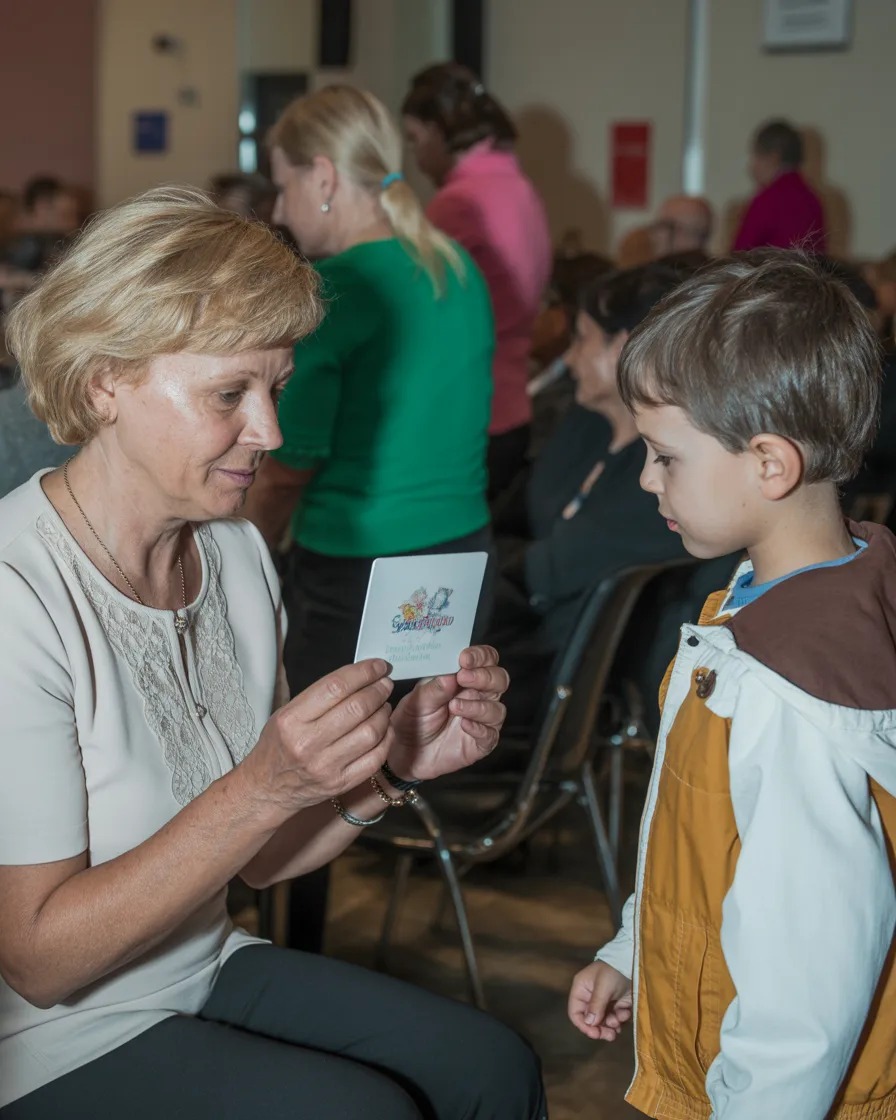
So I went to the play.
I sat in the back row with my coat still on and my hands locked in my lap.
When Noah walked onto the stage, he scanned the crowd, found me, and smiled.
It was small, but real.
His solo started shaky, then grew stronger, as if seeing me had brought him confidence.
Afterward, the children rushed into waiting arms.
Noah ran straight to me.
I caught him before I lost my balance.
“I’m here, sweetheart.”
“I knew you would come.”
“I’ll always come if I can.”
Before Rachel reached us, he pressed something folded into my palm.
“Please don’t let Mommy see this,” he whispered.
Rachel’s heels clicked down the hall.
“Noah, come here. Brent is waiting.”
He stepped back, but his eyes stayed on my hand.
“What did he give you?” she asked.
I closed my fingers around the paper.
“A program.”
“Let me see it.”
From farther down the hall, Brent called for her.
Rachel took Noah’s hand.
“We’ll talk about this later.”
Noah looked back at me.
I gave him the smallest nod I could.
I didn’t open the note until I was in my car with the doors locked.
My hands shook so hard I could barely unfold it.
In Noah’s uneven handwriting were six words:
Grandma, I want to come home.
I turned the paper over.
On the back, he had written:
He says I can’t talk about Daddy anymore.
I leaned against the steering wheel and whispered, “Home.”
I knew he didn’t mean a house.
He meant the place where Daniel was still allowed to exist.
I called Rachel that night.
She picked up already angry.
“What?”
“Noah gave me a note.”
Silence.
“What note?”
“He wrote that he wants to come home.”
Her voice went cold.
“You had no right to corner him at school.”
“He ran to me.”
“You showed up where you weren’t invited.”
“I showed up because I found out from his teacher, not from you.”
“That should tell you something.”
“It tells me you’re keeping him from people who love him.”
She exhaled sharply.
“You think love fixes this?
You come in with your stories and casseroles, then I’m the one left up all night with a child crying for a man I can’t bring back.”
“Who told him he can’t talk about his father anymore?”
She didn’t answer.
“Rachel.”
Finally she said, “Brent said structure would help. He said every time Daniel comes up, Noah spirals.”
“Silencing Daniel isn’t help,” I said. “He survives by telling the truth, not by pretending his father never lived.”
She started crying.
“You don’t live here.”
“No,” I said.
“But Daniel did. Noah’s father did.”