“Oh, Mom,” Sebastian said, shaking his head as if I were some confused old woman wandering into the wrong room. “Always so lost. How do you show up after everyone’s already finished?”
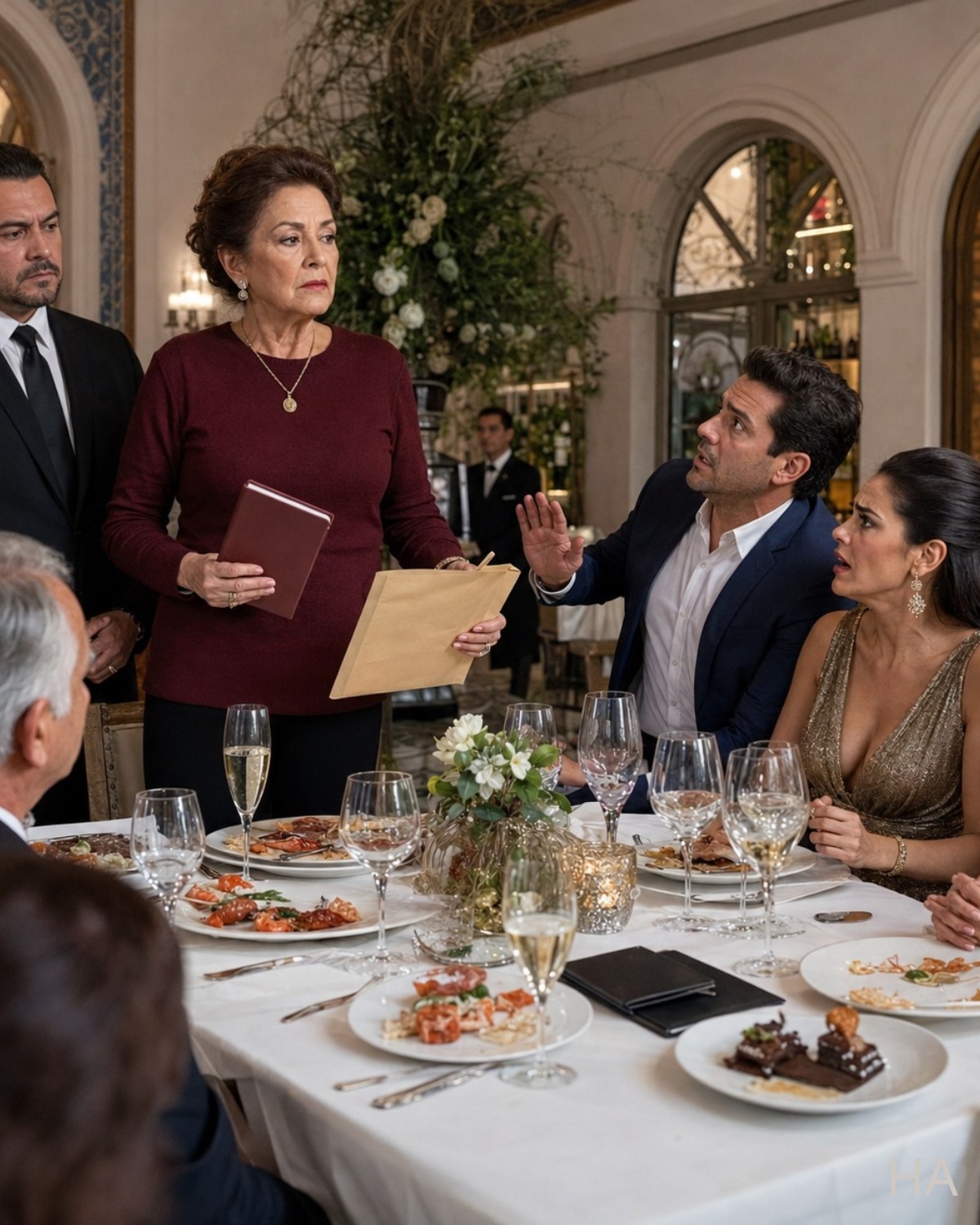
Elena Robles stood at the entrance of The Garden House, one of the most elegant restaurants in downtown San Antonio, holding her brown purse against her chest while nine people stared at her from a long table covered in empty plates, stained napkins, lobster shells, steak knives, and half-finished glasses of wine.
It was exactly 8:30 p.m.
Not 8:31.
Not 8:45.
Exactly the time Vanessa had sent in the message.
Elena opened her phone with trembling fingers and showed the screen.
Anniversary dinner, 8:30 p.m., The Garden House. Don’t be late, Mother Elena.
The message was there, clean and cruel.
Vanessa tilted her head. Her black dress sparkled under the chandelier, and her smile carried the lazy confidence of a woman who believed she had already won. Her mother, Patricia, sat beside her wearing oversized pearls and a face full of satisfaction. Vanessa’s sister, two cousins, an aunt, and several people Elena barely knew watched silently, waiting for the old woman to pay and disappear.
No one offered her a chair.
No one asked whether she had eaten.
No one apologized.
A waiter appeared beside Elena holding a black leather bill folder.
“The check, ma’am.”
Elena opened it.
$3,842.17.
For one dinner.
Champagne. Imported steak. Lobster. Caviar appetizers. Three bottles of French wine. Two birthday-style dessert platters for an anniversary she had not been allowed to attend.
Vanessa leaned back in her chair. “Don’t worry. Sebastian told us you always help. That’s what family is for, right?”
Sebastian looked down.
That hurt more than the laughter.
Elena Robles was sixty-eight years old. She had spent nearly forty years as a senior accountant at an audit firm in Houston before retiring. She had raised Sebastian alone after her husband, Armando, died of pancreatic cancer when their son was thirteen.
She paid for his school.
She paid for his braces.
She sold her gold earrings to cover his first semester at the University of Texas.
She worked weekends through migraines, holidays, and loneliness because she believed a mother’s duty was to lift her child high enough to stand without her.
But that night, sitting beside his wife, Sebastian was not standing.
He was hiding.
“Are you paying or not?” Vanessa asked, sweet as poison. “Because we already finished, and we have plans after this.”
That was when Elena understood.
It had not been a mistake.
They had made the reservation for 6:00 p.m. They had eaten for more than two hours. They had ordered like royalty and then summoned her at the end, not as family, not as guest, but as the wallet.
Elena took one slow breath.
Then another.
Something inside her that had been sleeping for years opened its eyes.
She did not reach for her credit card.
She did not open her purse.
She lifted one hand and called across the dining room.
“Michael, could you come here for a moment?”
Vanessa’s smile weakened.
Only for a second.
But Elena saw it.
Michael Bennett, the general manager of The Garden House, approached in his navy suit, polished and calm. He had known Elena since he was a waiter years ago, back when his mother worked with her at the audit firm. When Michael’s family nearly lost the restaurant after his father’s stroke, Elena helped restructure the debt, negotiate with lenders, and quietly invest enough to keep the doors open.
“Good evening, Mrs. Robles,” Michael said, lowering his head with real respect.
The table went silent.
Vanessa blinked. “You know her?”
Elena did not answer.
She looked at Michael. “Please tell me what time this table was reserved for.”
Michael glanced at the seating record on his tablet. “Six o’clock, Mrs. Robles.”
A silence dropped over the table.
Vanessa’s sister stopped smiling.
Sebastian lifted his head sharply.
“And what time was I told to arrive?” Elena asked, holding up her phone.
Michael read the message. “Eight-thirty.”
“Thank you.”
Vanessa laughed too loudly. “It was just a mix-up. Let’s not make this dramatic.”
Michael did not move.
“Also, Mrs. Robles,” he said, “your private dining room was ready at six, as always. We expected you in the side room.”
Patricia frowned. “Her private dining room?”
Michael looked at the older woman politely. “Yes. Mrs. Robles has been a minority partner in The Garden House for eleven years. She owns eighteen percent of the business.”
Every face at the table changed.
Vanessa’s color drained first.
Sebastian’s mouth opened slightly. “Partner?”
Elena sat slowly in the empty chair they had left for her, the chair meant to make her humiliation complete. From her purse, she pulled out a burgundy notebook.
For three years, she had written everything down.
Every loan.
Every promise.
Every “temporary” emergency.
Every insult swallowed for the sake of keeping access to her son.
“I will not pay this check,” Elena said.
Vanessa gave a nervous little laugh. “What do you mean you won’t?”
Elena opened the notebook.
“Because tonight, I didn’t come here to pay. I came here to settle accounts.”
Sebastian swallowed. “Mom, please…”
Elena lifted her eyes.
“No, Sebastian. Tonight, I speak.”
For the first time in years, her hands were not shaking from fear.
They were shaking from strength.
Michael stood beside her, silent and watchful.
The waiter stepped back.
Other diners had begun to notice the tension, but Elena did not care. She had spent too many years protecting her son’s image while he allowed his wife to turn her into a joke.
Not anymore.
Elena turned the first page.
“January 12, three years ago. Five thousand dollars for what you called emergency home repairs.”
Sebastian closed his eyes.
Vanessa crossed her arms. “That has nothing to do with dinner.”
Elena continued as if she had not spoken. “There were no home repairs. I later learned the money paid for Vanessa’s birthday weekend in Aspen.”
Patricia’s face tightened.
Elena turned another page. “March 4. Twelve thousand dollars to cover Sebastian’s medical conference in Boston. There was no conference. There was a couples’ resort package in Napa Valley.”
Vanessa leaned forward. “Are you seriously going to embarrass your own son in public?”
Elena looked at her. “You invited me here to be embarrassed in public. I’m simply using the venue.”
A small sound came from a nearby table.
Someone almost laughed.
Vanessa’s face hardened.
Elena turned another page. “June 19. Eight thousand dollars for private school registration for Liam and Sophie.”
At the mention of the children, Sebastian flinched.
Elena’s voice softened for one second, then became steady again. “The school never received that money. The children’s tuition was two months late, and I paid it directly when the office called me.”
Sebastian whispered, “Mom…”
“No.”
One word.
Sharp enough to stop him.
“You used my love for your children to pull money out of me, and then you used the children to keep me quiet.”
Vanessa slammed her hand on the table. “This is insane. You’re bitter because we have a life.”
Elena smiled sadly. “You have a lifestyle. You do not have a life.”
Patricia stood. “We are leaving.”
Michael stepped forward. “Of course. Once the check is settled.”
Patricia looked offended. “She said she was paying.”
“No,” Michael said. “Mrs. Robles said she was not.”
Vanessa’s cousin muttered, “This is ridiculous. Just split it.”
Vanessa shot him a murderous look.
Elena turned to Michael. “Who made the reservation?”
Michael checked the tablet. “Vanessa Robles.”
“Under whose card?”
Michael glanced up. “A card ending in 4418.”
Vanessa froze.
Elena looked at her daughter-in-law. “Your card.”
Vanessa’s jaw tightened. “That card won’t go through.”
“I know,” Elena said.
Sebastian stared at her. “What do you mean you know?”
Elena slowly closed the notebook.
“I mean that while you two were laughing at me, I already knew Vanessa’s cards were near their limits. I knew your home equity line was maxed out. I knew the lease on the Mercedes was two months behind. I knew you used my name as a personal reference for three loans I never authorized. And I knew you were planning to ask me next week to co-sign a refinance on your house.”
Vanessa’s confidence finally broke.
“How did you—”
“I was an auditor for forty years,” Elena said. “Did you think I forgot how to read?”
The table went dead quiet.
Sebastian rubbed both hands over his face.
Elena looked at him and felt the old maternal reflex rising, the one that wanted to protect him even now, even in the middle of his shame. But she forced herself to sit still. She had mistaken rescue for love for too long.
“Three months ago,” Elena said, “a loan officer called me to verify a document. It had my signature on it.”
Sebastian looked up.
Elena held his gaze.
“It was not my signature.”
Vanessa’s lips parted.
Elena reached into her purse and pulled out copies of the paperwork.
“Home equity application. Private lender application. A credit line tied to a company called VSR Lifestyle Consulting.”
Michael’s expression shifted.
Patricia sat back down slowly.
“That company belongs to Vanessa,” Elena said. “And the listed guarantor was me.”
Sebastian’s face went pale. “I didn’t know about that.”
Vanessa snapped toward him. “Don’t you dare.”
Elena watched them.
There it was.
The crack.
For months, she had wondered whether Sebastian was the planner or the coward. Now she realized something worse. He was both. He may not have forged every form, but he had enjoyed every benefit. He had let the lies feed him, clothe him, house him, and excuse him.
Michael cleared his throat. “Mrs. Robles, would you like me to call security?”
Vanessa shot to her feet. “Security? For what?”
Elena looked at Michael. “Not yet.”
Then she turned to the table.
“You have two choices. Pay the bill now, or Michael will charge the card on file. If it declines, the restaurant will proceed as it does with any unpaid check.”
Patricia scoffed. “You would let your own family be treated like criminals?”
Elena looked at the ruined table, the expensive wine, the lobster shells, the people who had ordered greedily because they thought she would pay for their cruelty.
“No,” she said. “I am letting adults be treated like adults.”
Vanessa grabbed her purse and pulled out a card. “Fine.”
The card declined.
Her second card declined too.
The silence after the second decline was almost beautiful.
Sebastian finally took out his wallet. His hand shook as he gave the waiter his card. Elena wondered whether he was afraid of the total or afraid of the truth finally moving faster than he could manage.
That card declined.
Vanessa whispered, “Sebastian.”
He did not look at her.
Michael spoke gently. “Would anyone else at the table like to provide payment?”
For the first time all night, the people who had laughed at Elena became fascinated by their laps.
Patricia, red-faced and furious, eventually paid half with her card. Vanessa’s aunt paid another portion. The cousins pooled what they could. Sebastian stood there, humiliated, as the people he had tried to impress paid for the meal he had used to humiliate his mother.
Elena did not enjoy it.
That surprised her.
She thought revenge would taste sweeter.
Instead, it tasted like grief with sharper edges.
When the bill was finally settled, Vanessa leaned close to Elena and whispered, “You just lost your son.”
Elena looked at Sebastian.
He stood beside his wife, pale and silent.
Then Elena looked back at Vanessa.
“No,” she said quietly. “I lost him years ago. Tonight, I stopped paying for the funeral.”
Vanessa recoiled as if slapped.
Elena stood and took her notebook.
Michael walked her to the entrance.
At the door, he spoke softly. “Mrs. Robles, do you want me to have someone escort you to your car?”
Elena glanced back at the table.
Vanessa was arguing with her mother. Sebastian stood motionless. The others were leaving quickly, eager to escape a humiliation they had happily attended until it turned toward them.
“No,” Elena said. “I’m not afraid of them anymore.”
Outside, the Texas night was warm and damp. Streetlights reflected on the restaurant windows. Elena reached her car, sat inside, and finally let her hands tremble.
Her phone buzzed before she even started the engine.
Sebastian.
She let it ring.
Then came the texts.
Mom, we need to talk.
You humiliated me.
Vanessa is crying.
This wasn’t the way to handle it.
Elena stared at the screen.
For almost forty years, every crisis in Sebastian’s life had become her responsibility. Bad grades. Lost jobs. Failed investments. Marital fights. Credit card debt. Forgotten birthdays. Even his cruelty arrived at her door expecting a meal and forgiveness.
This time, she wrote only one sentence.
Call me when you’re ready to tell the truth.
Then she turned off the phone.
The next morning, Elena went to the bank.
Not the branch where Sebastian knew the manager. Not the one near his house. She went downtown, where her longtime financial advisor, Denise Carter, met her in a private office with black coffee and a folder already waiting.
“I reviewed the documents you sent,” Denise said. “Elena, this is serious.”
“I know.”
“Your signature was forged on at least two applications. Possibly three. Someone attempted to use your assets as implied collateral.”
“My daughter-in-law?”
“Her company submitted the paperwork. But your son’s email appears in the chain.”
Elena closed her eyes.
There are betrayals a mother expects from outsiders. There are betrayals she fears from spouses. But when betrayal carries the voice of her child, something ancient inside her refuses to accept it.
Denise lowered her voice. “You need an attorney.”
“I have one.”
Elena had called him before the dinner.
Samuel Price was a quiet elder-law and financial fraud attorney with silver hair, a bow tie, and the patience of a surgeon. He had handled one of Elena’s former audit cases years earlier, and she trusted him because he never looked surprised by human greed.
Samuel met her that afternoon.
He reviewed the documents, the notebook, the messages, and the loan applications. Then he removed his glasses and looked at her with sad clarity.
“Elena,” he said, “you have been financially exploited.”
She almost laughed.
Such a clean phrase.
Financially exploited.
It sounded bloodless. Professional. Like something that happened in reports, not at family dinners where grandchildren’s photos still hung on the refrigerator.
“What happens now?” she asked.
“We protect you first. Freeze any shared authorizations. Remove Sebastian from emergency access. Notify creditors that any use of your name requires direct verification. File fraud alerts. Then we decide whether to pursue civil action, criminal complaints, or both.”
Elena stared at her purse on the chair beside her.
In the side pocket was a drawing from Sophie, her eight-year-old granddaughter. A crooked house, a yellow sun, and three stick figures labeled Nana, Me, and Liam. No Sebastian. No Vanessa. Just the children and her.
“If I report him,” Elena said, “Vanessa will keep the children from me.”
Samuel’s expression softened. “She may try.”
“She already has.”
That was the oldest wound.
For years, Vanessa had controlled access to the grandchildren like a faucet. If Elena paid for summer camp, she could have them for a weekend. If she said no to money, plans changed. If she questioned anything, Vanessa told her the kids were “busy.”
Sebastian never stopped it.
Sometimes he sounded ashamed.
Never enough to act.
Samuel leaned forward. “Do you believe the children are safe?”
Elena’s answer did not come quickly enough.
That told them both everything.
Three days later, Elena received a call from Liam, her eleven-year-old grandson.
He used the old tablet she had given him two Christmases ago.
“Nana?” he whispered.
Elena stood in her kitchen, one hand gripping the counter. “Liam? Honey, are you okay?”
“Mom and Dad are fighting.”
Her heart dropped. “Where are you?”
“In my room. Sophie is with me.”
“What happened?”
Liam’s voice shook. “Mom said you ruined everything. Dad said he didn’t know she used your name. Mom threw a glass. Dad left. Then Mom told Sophie that if we ever asked to see you again, she’d send us away to boarding school.”
Elena closed her eyes.
Not from weakness.
From focus.
“Listen to me,” she said. “Are you hurt?”
“No.”
“Is Sophie hurt?”
“No. She’s scared.”
“Lock your bedroom door. Stay on the call with me.”
Elena used her landline to call 911 while keeping Liam on the cell. Then she called Samuel. Then she called Sebastian.
He answered on the fourth ring, breathless.
“Mom, not now.”
“Your children are locked in Liam’s room because Vanessa is throwing glass and threatening them.”
Silence.
Then, “What?”
“I called the police. You need to get home.”
“Mom, you don’t understand—”
“No, Sebastian. You don’t understand. If you do not protect your children today, I will.”
He hung up.
Police arrived before Sebastian did.
The official report later described the house as “disturbed but not structurally damaged.” That meant the dining room chair was overturned, a wineglass had shattered in the hallway, and Sophie was found crying under Liam’s desk.
Vanessa told officers Elena was manipulating the children.
But Liam had kept the call connected.
Every threat was recorded.
That changed everything.
A temporary safety plan was put in place. The children stayed with Sebastian that night at a hotel. Vanessa was told to leave the home pending further review. Child services opened an inquiry.
Elena did not sleep.
At 2:00 a.m., Sebastian called.
His voice sounded younger than it had in years.
“Mom,” he said. “What have I done?”
Elena sat at her kitchen table, the same table where she had once helped him with algebra and college applications.
“You want the truth?” she asked.
“Yes.”
“You let someone make cruelty look normal.”
He began to cry.
The sound reached for the mother in her.
She let it reach.
But she did not let it take over.
“You laughed at me, Sebastian.”
“I know.”
“You let your wife invite me to a dinner that was already over so I could be mocked and handed the bill.”
“I know.”
“You used your children to keep me obedient.”
His crying stopped.
“I didn’t—”
“Yes,” Elena said. “You did. Maybe Vanessa sharpened the knife, but you held the door open.”
The silence on the line was long.
Then he whispered, “I’m sorry.”
Elena looked at the burgundy notebook on the table.
Sorry used to be enough. When Sebastian was little, sorry came with scraped knees, broken cups, and fear of losing her love. But grown men cannot use childhood words to erase adult harm.
“I hope you are,” she said. “But sorry is not a plan.”
The following weeks pulled the family apart and revealed what had been rotting underneath.
Vanessa’s lifestyle consulting company was mostly fake. She had used it to move money, disguise personal spending, and apply for credit through exaggerated assets. She had forged Elena’s signature at least twice, and investigators later found she had copied it from old birthday cards Elena had given the grandchildren.
Sebastian claimed he did not know about the forgeries.
The truth was more complicated.
He had known money was appearing. He had known bills were being paid through channels he did not understand. He had known Vanessa was using Elena’s name in conversations with lenders. He had chosen not to ask because not asking allowed him to keep enjoying the benefits.
That was not innocence.
It was cowardice with clean hands.
Samuel filed civil claims to protect Elena. Fraud reports were submitted. Creditors were notified. Vanessa’s company accounts were frozen pending investigation. The house, already drowning in debt, was placed under court review during the divorce proceedings Sebastian finally filed.
Yes.
Divorce.
It took him six weeks to say the word.
It took Liam’s recording to make him act.
It took Sophie refusing to leave Elena’s arms during a supervised visit to make him understand what his silence had cost.
Vanessa fought viciously.
She told friends Elena was a bitter old woman jealous of a younger wife. She posted vague messages online about toxic mothers-in-law and “financial abuse disguised as help.” Patricia repeated the story to anyone who would listen, conveniently omitting the restaurant bill, the forged signatures, and the threats.
Then Michael from The Garden House released the reservation record to Elena’s attorney.
Not publicly.
Legally.
The timeline was undeniable.
6:00 p.m. reservation.
8:30 p.m. invitation to Elena.
Card on file under Vanessa.
Security footage showing the table laughing when Elena arrived.
It was small compared to financial fraud, but it mattered.
Because cruelty has patterns, and sometimes the smallest pattern helps people understand the larger one.
During mediation, Vanessa’s attorney tried to frame Elena as controlling.
Samuel placed the burgundy notebook on the table.
Page after page.
Date after date.
Amount after amount.
Then he placed the forged applications beside it.
Then he placed Liam’s recording transcript.
By the end of the session, Vanessa’s attorney asked for a private break.
Elena sat outside the mediation room beside Sebastian.
For a long time, neither spoke.
He looked exhausted. His hair was messy, his tie loose, his eyes red. Without Vanessa beside him, he seemed less like a cruel man and more like a weak one who had allowed cruelty to become his language.
“I wanted to impress her,” he said finally.
Elena looked straight ahead.
“She made me feel like I was never enough. Not successful enough. Not rich enough. Not strong enough.”
Elena’s voice was quiet. “So you made me feel small instead.”
He flinched.
“Yes.”
That was the first honest answer he had given her.
Elena let silence sit between them.
Then she said, “Your father died when you were thirteen. I know that left a hole in you. I know I overfilled it. I gave too much, fixed too much, protected too much. But my mistakes do not excuse yours.”
Sebastian nodded slowly.
“I know.”
“Do you?”
He turned toward her. “I’m trying to.”
Elena studied him.
For the first time in years, she saw not the son she had invented, not the boy she had rescued, not the man Vanessa had polished into arrogance. She saw a person at the beginning of consequences.
It was not forgiveness.
But it was a beginning.
The court case against Vanessa took nearly a year.
She pleaded guilty to reduced fraud charges after the forgeries were confirmed. She avoided prison but received probation, restitution obligations, mandatory financial monitoring, and restrictions related to Elena’s identity and credit. Patricia stopped wearing pearls to court after a judge scolded her for rolling her eyes during testimony.
Sebastian was not criminally charged, but the divorce left him financially bruised and morally exposed. The house had to be sold. The Mercedes disappeared. The country club membership ended. He moved into a modest rental with the children on the weeks he had custody.
For the first time in his adult life, he had to budget.
Elena did not rescue him.
When he asked for a loan to stabilize his finances, she said no.
He looked hurt, then ashamed, then strangely relieved.
“Okay,” he said. “I understand.”
That was new.
The children adjusted slowly.
Liam became quiet for a while, watching adults carefully. Sophie had nightmares about her mother yelling. Elena took them to therapy, paid directly, and made sure no one could use the bills as leverage. She also made Sundays sacred.
Every Sunday afternoon, the children came to her apartment.
No drama.
No bargaining.
No guilt.
They baked cinnamon cookies, played cards, watered her balcony plants, and sometimes talked about hard things only when they were ready.
One Sunday, Sophie asked, “Nana, why did Mommy not like you?”
Elena rolled dough slowly.
“I think your mom wanted to feel important,” she said. “And sometimes people try to feel bigger by making someone else feel small.”
Sophie thought about that.
“Did it work?”
Elena smiled gently. “For a little while.”
“Not anymore?”
“No, sweetheart. Not anymore.”
Liam looked up from the table. “Dad says he was wrong.”
Elena’s heart pulled.
“What do you think?”
Liam shrugged. “I think he was. But he’s different now. He cooks bad spaghetti.”
Elena laughed.
Bad spaghetti was not redemption.
But it was effort.
Months passed. Then a year.
Sebastian kept showing up to therapy. He took parenting classes without being ordered to. He apologized to Michael at The Garden House in person and paid back his portion of the infamous bill, even though it had already been settled. He began taking the children to Elena’s without making her ask.
One evening, he came to her apartment carrying a grocery bag.
“I made dinner,” he said.
Elena looked into the bag. Burnt lasagna, salad, and store-bought bread.
She raised an eyebrow.
“Made is a generous word,” he admitted.
For the first time in a long time, she laughed with him.
Not because everything was fixed.
Because not everything was destroyed.
They ate at her kitchen table. The lasagna was terrible. The bread was good. Sebastian washed the dishes without being asked.
Before leaving, he stood by the door.
“Mom?”
“Yes?”
“I don’t expect you to trust me yet.”
Elena folded the dish towel.
“Good.”
He nodded, accepting the word without flinching.
“But I want to earn it,” he said.
Elena looked at him for a long moment.
“You earn it in inches,” she said. “Not speeches.”
“I know.”
“Start with your children.”
“I am.”
She nodded.
That was all.
Two years after the dinner at The Garden House, Michael invited Elena to a private anniversary event at the restaurant. The business had expanded beautifully. The dining room glowed with soft light, fresh flowers, and the kind of warmth that made people feel welcome instead of judged.
Elena arrived at 6:00 p.m.
This time, the room was waiting for her.
Michael had reserved the side dining room, the one she had been expected in that terrible night. At the table sat Liam, Sophie, Samuel, Denise, Michael’s mother, and Sebastian. No Vanessa. No Patricia. No vultures dressed as family.
Sebastian stood when Elena entered.
So did everyone else.
For a moment, she could not move.
The memory of that other night flashed through her: the empty plates, the cruel laughter, the bill folder, her son’s lowered eyes.
Then Sophie ran to her.
“Nana! We saved you the best seat.”
Elena hugged her granddaughter and felt the past loosen its grip.
Dinner was simple by request. Roast chicken, vegetables, warm bread, chocolate cake. No champagne towers. No imported extravagance. No one ordered to impress anyone else.
At the end, Michael came in holding a small framed document.
Elena looked confused.
“What is this?”
Michael smiled. “A formal recognition from the ownership group. The Garden House would not exist without you. We wanted this room named after you.”
Elena stared at the plaque.
The Elena Robles Room.
Her eyes filled.
Sebastian stood and cleared his throat.
“I need to say something,” he said.
Elena’s body tensed automatically.
Old pain has reflexes.
Sebastian noticed and spoke gently.
“Two years ago, in this restaurant, I let my mother be humiliated. I laughed when I should have stood up. I stayed silent when silence was betrayal. I can’t undo that night.”
His voice shook.
“But I can tell the truth about it. Mom, you didn’t embarrass me that night. You exposed me. And I needed to be exposed before I became someone my children couldn’t trust.”
Liam looked down.
Sophie reached for Elena’s hand.
Sebastian continued, “I’m sorry. Not because my life fell apart. Because I helped make yours painful after everything you sacrificed for me.”
Elena’s tears slipped free.
The room was quiet.
She looked at her son, then at her grandchildren, then at the plaque in Michael’s hands.
There was a time she would have forgiven instantly just to end discomfort. That version of her had been generous, but she had also been tired and afraid. The woman sitting there now understood that forgiveness did not mean pretending a wound had not happened.
It meant deciding what kind of future, if any, could grow around the scar.
“Thank you,” Elena said.
Sebastian nodded.
That was enough for that night.
After dinner, Elena stepped outside onto the restaurant patio. Downtown lights glittered beyond the planters. The warm Texas air smelled faintly of rain and rosemary from the kitchen.
Liam came out first.
Then Sophie.
They stood beside her, one on each side.
“Nana,” Liam said, “are you happy?”
Elena looked through the window at the room named after her, at Michael laughing with his mother, at Sebastian helping clear plates even though the staff told him not to.
“I’m peaceful,” she said.
Sophie leaned against her. “Is that better?”
Elena smiled.
“Sometimes, yes.”
Years later, people would still tell the story as if it were only about a restaurant bill.
They would say a daughter-in-law invited her mother-in-law late, made her pay for a dinner she never ate, and then discovered the older woman owned part of the restaurant.
That version was satisfying.
But it was too small.
The real story was about a woman who had spent her life confusing sacrifice with love. A mother who paid every bill because she feared losing the son she had already lost to entitlement. A grandmother who finally understood that being needed is not the same as being respected.
Elena did not pay the $3,842.17 check that night.
But she paid attention.
And attention saved her.
It uncovered the forged signatures, the fake loans, the emotional blackmail, the danger to the children, and the truth her heart had avoided for too long.
When she walked into The Garden House at 8:30, they expected a confused old woman with a purse and a guilty conscience.
What they got was Elena Robles.
Accountant.
Investor.
Mother.
Grandmother.
Woman who had finally closed the account on humiliation.
And this time, the balance was in her favor.
The End