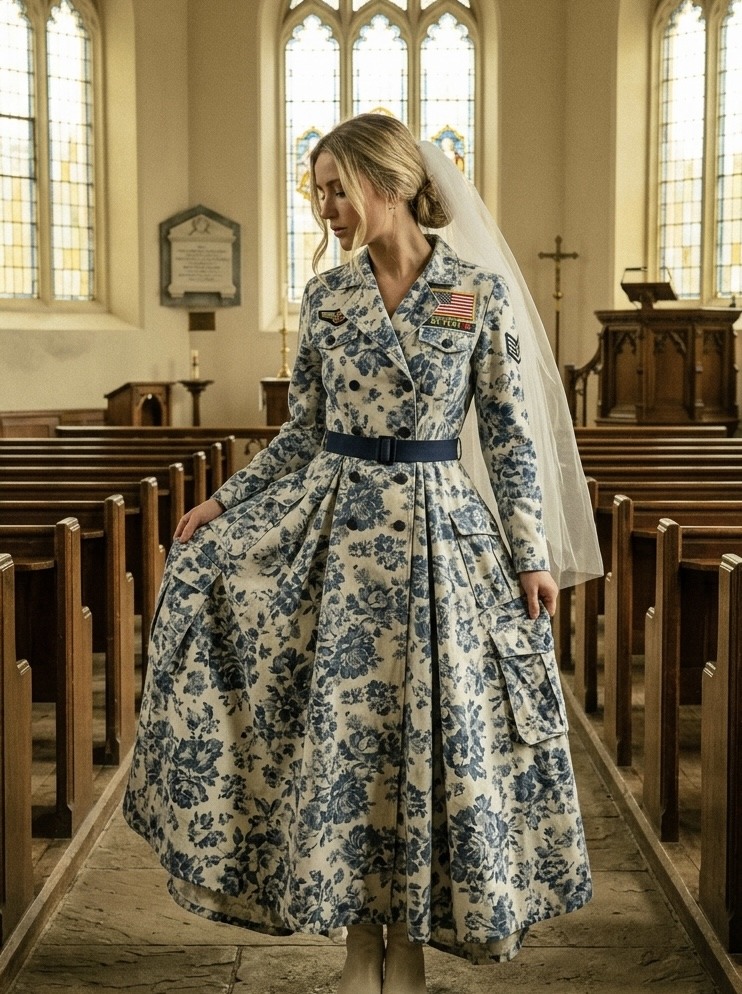
When the church doors opened, my fiancée wasn’t wearing white — she was in a wedding dress made from army shirts. The room went silent. Then she stopped halfway down the aisle, looked at me, and said something that made me think the wedding was over.
For months, my fiancée, Clara, had been acting strangely.
Every night after dinner, she disappeared into the spare room at the end of the hall, which she’d converted into a sewing room. We were getting married in six weeks, and she’d decided to make her own dress, so I didn’t think much of it at first.
“How’s the dress coming along?” I asked one night. She smiled.
“It’s going to be really special.”
Then she went down the hall and shut herself in.
A few minutes later, the sewing machine started. The low, steady hum of the sewing machine became like a second heartbeat behind the walls. Once, I woke up at four because I thought I heard rain.
It wasn’t rain — it was the machine, still running.
The next morning, she came into the kitchen with a ponytail half falling out and shadows under her eyes. I stared at her.
“Did you even sleep?”
“A little.” She kissed my forehead. “I’m okay.”
I didn’t believe her.
Any time I asked about the dress, she got light and evasive.
“You haven’t let your bridesmaids see it?” I asked once. “No.”
“My mom is going to faint over that.”
“She’ll survive.”
That was another thing. My mother and Clara had always been polite, but never easy.
My mother liked order and tradition.
Clara handled her patiently, but once Clara’s patience ran out, she went quiet, seethed, and then exploded. And as the wedding date drew closer, I couldn’t help but wonder if Clara was planning something sweet like a dramatic entrance, or something more explosive.
I should have pushed harder. I know that now.
The morning of the wedding, I woke up feeling weirdly calm.
At the church, everybody was already in motion. My parents sat in the front row, composed as ever. My mother looked perfect, and my father had the same unreadable expression he wore at board meetings and funerals.
I stood at the altar with my hands clasped in front of me and tried not to think too hard.
Then the doors opened. Clara stepped inside, and nothing in me was ready for what I saw.
She wasn’t wearing white. The dress design was still breathtaking, but it was made from olive-drab army shirts.
Not new ones either.
The fabric was weathered and worn. At first, the church made this soft collective sound, a rustle more than a gasp. Then it went dead quiet.
Clara kept walking, one hand lightly holding the skirt, chin lifted.
When she reached the middle of the aisle, she stopped. She turned to face the guests.
“I know this isn’t the dress people expected,” she said, her voice trembling. “But love isn’t always satin and pearls.”
A few guests murmured.
“My dad couldn’t be here today.” She smoothed her hands over the dress.
“So I made sure he still walked me down the aisle.”
Guesst sniffled and started crying softly. My knees felt like they might give out. Her father had died when she was 16, killed in action overseas.
Everything in me loosened then.
I thought this was her big surprise. Then she looked at me, and the combination of fear and sadness I saw in her eyes frightened me.
I frowned. “Clara?”
“Mark,” she said quietly, “I’ll understand if, after what I’m about to say, you want to call off the wedding.”
My stomach dropped.
“What?”
She reached inside the lining of her dress and pulled out a folded paper.
“There’s one more reason I made this dress,” she said. “Something I discovered while I was altering my dad’s shirts. A letter…”
Then she looked at my parents.
Mom shifted in her seat.
Dad’s expression didn’t change, but he averted his gaze. “Susan, Carl.
When were you planning to tell me that you knew my father?” Clara asked in a dangerous tone. “Or did you think you could hide the truth about your relationship and what you did to him forever?”
My heart beat a crazed rhythm.
I stepped down from the altar.
“Mom, Dad?”
“My dad wrote this,” Clara lifted the letter. “He wrote it before he deployed, but for some reason, it was never sent. In it, he wrote that he had given everything he could to your business.
That he believed in it.
That he believed in you.”
I looked at my parents. “What is she talking about?”
Neither of them answered.
“Do you want to hear more?” Clara marched up the aisle. “He says here: ‘I’m doing this for my daughter, Clara.
If something happens to me, I need to know she’ll be taken care of.
I can’t tell you what a relief it is to know that you’ll ensure she gets her rightful share of the company if it ever comes to that.’”
Whispers started. Small at first, then spreading and growing louder. Clara reached the front of the church and stopped.
She stared at my parents.
“My rightful share of the company?” Clara asked softly. My mother stood halfway, then sat again.
“This is not the time.”
“Is it true?” I asked. “Mark,” my father said sharply.
I looked at him.
“Is it true?”
Clara’s voice came from behind me, steady and clear. “I didn’t come here to humiliate anyone. I came because I found out the life we’re standing in front of was built on something hidden from me.”
The church listened.
I was listening, too.
I turned to her and nodded. “Please… I want to hear this.”
My mother finally found her voice.
“Clara, you are being wildly unfair.”
Clara laughed once, and there was no humor in it. “Unfair?”
“That letter is being taken out of context.”
My mother looked at the crowd, at the pastor, at me, at everyone except Clara.
“Certainly, but it’s a private matter, and this is hardly the place.”
“It’s too late for that,” I said.
“It’s not private, and this has become the place. So, please, start explaining. I want to know the truth.
Did you know Clara’s father?” I looked at my father.
“Did he invest in the company?”
He kept his eyes on Clara. “He was a partner in the early stages.”
“Partner?” I repeated.
My father exhaled. “Informally.”
My vision almost blurred.
“Did you buy him out?”
Clara’s face didn’t change.
“Because he trusted you to transfer his portion of the company to me.”
I looked between them and felt something inside me tearing down the middle. Then Clara said, softer now, “I can’t marry into this unless it’s named.”
I stepped back. A sound moved through the church, one long breath of shock.
People thought I was leaving.
I know they did. For one second, maybe Clara thought it too.
Her shoulders tightened, just barely, but I saw it. And the truth is, for that one second, I didn’t know what I was doing.
I only knew I couldn’t stand where I was anymore.
Then I looked at her.