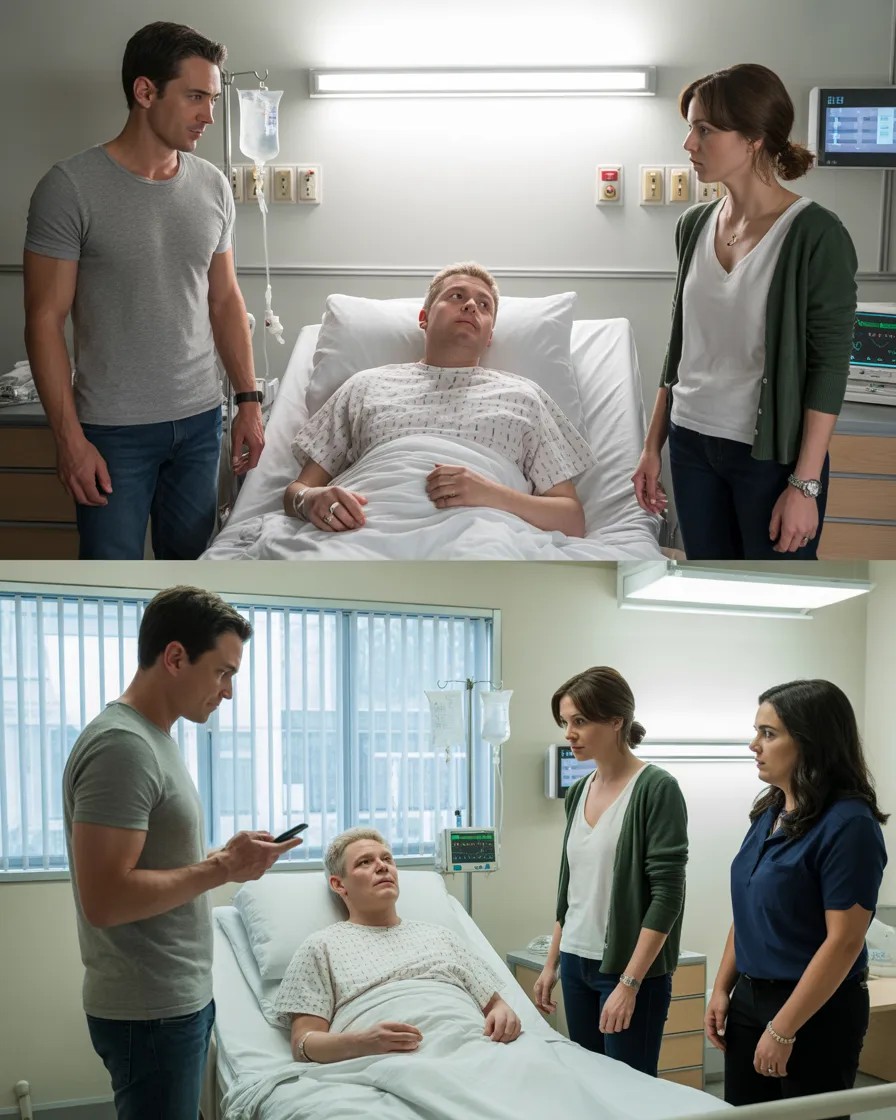
Camila Torres stared at the medical report until the words blurred in front of her. Twelve weeks. Pregnant. The numbers were clean, clinical, impossible to argue with, yet they shattered the quiet life she had started rebuilding in Charleston, South Carolina. Across the kitchen island, Matthew Rivera looked up from the wedding menu and immediately knew something had changed.
He did not rush her. He did not demand an answer. He simply put down the pen, crossed the room, and waited until Camila found the courage to hand him the phone. When his eyes moved across the screen, his face went still, but not cold.
For several seconds, the only sound in the kitchen was the soft hum of the refrigerator and the rain tapping against the windows. Camila expected pain. She expected disappointment. Maybe even anger. Instead, Matthew looked at her with a kind of sadness that felt almost too gentle to survive.
“The baby is his,” Camila whispered.
Matthew closed his eyes for one brief second, then opened them again. “You didn’t know.”
“No,” she said quickly. “I swear I didn’t know. When I signed those papers, when I left New York, when I met you… I had no idea.”
“I know,” Matthew said.
Those two words broke her more than accusation would have. Camila covered her mouth and turned away, ashamed of something she had not chosen. She had spent months trying to escape the Aranda family, their money, their cruelty, their ability to make people feel like furniture to be moved out of the way. Now, without meaning to, she had carried the most dangerous piece of them into her new life.
Matthew stepped closer, but he did not touch her until she nodded. Then he wrapped his arms around her and held her as she trembled. He was not pretending it was simple. He was not pretending it did not hurt. But he was still there.
That was the first difference between him and Sebastian Aranda.
Sebastian had always loved Camila most when she was convenient. Matthew loved her while she was standing in the middle of a disaster. And in that kitchen, with a wedding half-planned and a child neither of them had expected, Camila understood that peace was not the absence of storms. Sometimes peace was the person who stayed when the storm finally arrived.
The next morning, Camila called an attorney in Boston named Evelyn Grant. She had been recommended by one of Matthew’s colleagues, a woman known for handling high-profile family disputes without leaking so much as a comma to the press. Evelyn listened silently as Camila explained the divorce settlement, the confidentiality clause, the payout, the property transfers, and the pregnancy timeline. When Camila finished, Evelyn asked one question.
“Did the agreement mention pregnancy?”
Camila froze.
“No,” she said. “They were too busy protecting Jimena’s twins.”
Evelyn was quiet for a moment. “Then they may have bought your silence, but they did not buy your child.”
Those words followed Camila for the rest of the day. She repeated them while looking at the ultrasound image hidden inside a folder. She repeated them while Matthew stood beside her at the doctor’s office, steady and silent. She repeated them that evening when she removed her engagement ring, placed it in Matthew’s palm, and told him she would understand if he needed time.
Matthew stared at the ring as if she had handed him something breakable.
“Camila,” he said softly, “I asked you to marry me because of who you are, not because your past was clean and easy. But this baby deserves truth. You deserve protection. And I need to decide whether I can stand inside this fire with you without resenting an innocent child.”
It was the most honest thing anyone had said to her in years.
So they paused the wedding.
Not canceled.
Paused.
But in New York, the Aranda family was not pausing anything.
Sebastian Aranda had become the perfect redeemed husband in public. At charity galas, he stood beside Jimena with one hand on her lower back and spoke warmly about fatherhood. His mother, Rebecca Aranda, gave interviews about legacy, family values, and the future of Aranda Global Holdings. His father, Ernesto, smiled for cameras with the pride of a man who believed the family name had survived its only inconvenience.
That inconvenience was Camila.
To them, she was gone.
Paid.
Silenced.
Erased.
Jimena, meanwhile, had grown comfortable inside the role Camila once occupied. She wore white to foundation luncheons, smiled at board wives, and allowed society magazines to photograph her nursery in the Aranda penthouse. The headline was exactly what Rebecca wanted: “A New Generation for One of America’s Most Powerful Families.”
Sebastian tried to enjoy it.
He told himself he had made the practical choice. He told himself Camila had accepted the money because, deep down, she had wanted freedom too. He told himself Jimena’s pregnancy proved everything had happened for a reason.
But sometimes, late at night, he remembered Camila’s face when she signed the settlement papers. Not broken. Not begging. Calm. Almost distant. As if she had already walked out of his life before her body left the room.
That look haunted him more than tears would have.
The first crack appeared six weeks later.
Rebecca received a call from the family’s private medical consultant. The doctor’s voice was strained, careful, and far too formal. Jimena had undergone additional prenatal testing after a minor complication, and something about the results did not match what had been previously assumed.
Rebecca did not like assumptions.
She liked documents.
“Send me the report,” she said.
When the file arrived, she read it once and felt her stomach tighten. Then she read it again. By the third reading, her hands were cold.
The twins were not twelve weeks behind the affair.
They were older.
Much older.
Rebecca called Sebastian into her office at the Aranda estate in Greenwich, Connecticut. He arrived annoyed, already late for a meeting, but the look on his mother’s face stopped him at the door. Rebecca did not panic. She did not tremble. So when Sebastian saw fear in her eyes, his own confidence began to collapse.
“What happened?” he asked.
Rebecca slid the report across the desk.
Sebastian picked it up, scanned the first page, and frowned. “I don’t understand.”
“You will,” Rebecca said.
By the time he reached the dates, his face had lost color. Jimena’s twins had been conceived before she claimed. Before Sebastian had started seeing her regularly. Before the weekend in Miami when she had told him she was pregnant. Before the night she cried and said he had to choose her because she was carrying his children.
Sebastian shook his head. “This has to be wrong.”
Rebecca’s mouth hardened. “Medical timelines are not gossip.”
“She wouldn’t lie about this.”
Rebecca looked at her son with a bitterness he had never heard from her before. “A woman who sleeps with a married man and accepts a penthouse from him is not exactly allergic to strategy.”
For the first time in years, Sebastian had no answer.
Jimena denied everything at first. She cried in the nursery, one hand on her stomach, accusing Rebecca of trying to control her. She said doctors made mistakes. She said stress could affect calculations. She said Sebastian was letting his mother poison their family before the twins were even born.
But Rebecca had built an empire by never trusting tears.
Within forty-eight hours, she had investigators reviewing Jimena’s travel records, bank statements, hotel bookings, and deleted messages recovered from an old phone backup. What came back was not a mistake. It was a map.
Jimena had been seeing another man.
Not just any man.
A venture capitalist named Logan Price, who had quietly invested in a competitor trying to weaken Aranda Global’s energy division. Jimena had met him at a private club in Miami, then again in Chicago, then again in Napa. The dates aligned perfectly with the revised conception window.
When Sebastian saw the photos, something inside him seemed to cave in.
There was Jimena in a navy dress, laughing with Logan in a hotel lobby. There was Jimena leaving a private residence at dawn. There were messages that turned Sebastian’s stomach.
“He thinks the twins are his.”
“Once I’m inside the family, everything changes.”
“Rebecca is awful, but she’s predictable.”
And the final message, sent the morning Camila signed the divorce papers:
“By tonight, the wife is gone.”
Sebastian threw the phone across the room.
Rebecca did not flinch.
“You destroyed your marriage for a woman who used you,” she said.
Sebastian turned on her. “You pushed this. You wanted Camila gone more than anyone.”
Rebecca’s face sharpened. “Because you told us those children were yours.”
“And if they had been?” Sebastian demanded. “Would that make what we did right?”
The question hung between them like smoke.
Neither answered.
Because both knew the truth.
No baby, no scandal, no family legacy had forced them to humiliate Camila in that conference room. They had chosen cruelty because they had the money to make it look legal. They had mistaken a signature for surrender.
Now, the woman they erased was the only one whose dignity remained intact.
While the Arandas were unraveling in Connecticut, Camila was learning how to breathe through fear. Her pregnancy became real in small, startling ways. A wave of nausea in the morning. A sudden hatred of coffee. A heartbeat on a monitor that made her cry so hard the nurse had to bring tissues.
Matthew was there.
Always.
Not as a replacement father. Not as a hero performing goodness for applause. He showed up because he had decided love was not only romance, but responsibility chosen freely.
One evening, while Camila sat on the porch wrapped in a blanket, he joined her with two mugs of tea. The air smelled like salt and rain, and the streetlights glowed through the oak trees. For a while, neither spoke.
Then Matthew said, “I don’t know if I can marry you next month.”
Camila nodded, even though it hurt.
“But I know I don’t want to leave,” he continued. “I want to be here while we figure out what truth requires from us.”
She looked at him. “Truth may bring them back into my life.”
“I know.”
“They’ll come with lawyers.”
“I know.”
“They’ll say the baby belongs to their family.”
Matthew’s jaw tightened. “The baby belongs first to himself or herself. Not to an empire.”
Camila’s eyes filled. “You make it sound simple.”
“It isn’t,” he said. “But some things can be complicated and still be clear.”
Three days later, Evelyn Grant received a letter from Aranda Global’s legal team.
It was polite.
Formal.
Threatening.
They had discovered, through undisclosed medical information that Evelyn immediately flagged as suspicious, that Camila might be pregnant with Sebastian Aranda’s child. They requested confirmation. They demanded disclosure. They referenced the settlement agreement and warned that failure to cooperate could result in legal action.
Camila read the letter twice.
Then she laughed.
It was not a happy laugh. It was the sound of a woman who had finally seen the full shape of the monster and realized it was wounded. Months ago, they had paid her to disappear because another woman’s babies were more valuable. Now they wanted access because her baby might be the one thing their money had failed to control.
Evelyn sent back a response so sharp Camila almost framed it.
“My client has no obligation to disclose private medical information to individuals who attempted to contractually erase her from a family while failing to account for the existence of a child. Any further contact must come through this office. Any attempt to intimidate, surveil, defame, or coerce my client will be met with immediate legal action.”
Rebecca Aranda read the response in silence.
Sebastian read it standing by the window, gripping the paper so tightly it bent in his hand.
“She’s pregnant,” he said.
Rebecca did not answer.
“She was pregnant when we made her sign.”
Again, silence.
Sebastian pressed his hand against his mouth. Suddenly the memory returned with unbearable precision: Camila sitting alone across the table, Jimena’s hand resting on her stomach, Rebecca calling the unborn twins his obligation. Camila asking how many weeks. Camila doing the math before any of them did.
Had she known then?
No.
He remembered her face.
She had not known.
That made it worse.
The first time Sebastian called, Camila did not answer. The second time, Evelyn called his attorney and warned him. The third time, he sent a handwritten letter to Camila’s Charleston address.
Matthew found it in the mailbox.
He did not open it. He handed it to Camila and stepped back, giving her a choice no one in the Aranda family had ever given her.
Camila held the envelope for a long time.
Then she opened it.
Sebastian’s handwriting was exactly the same: elegant, slanted, controlled. He wrote that he was sorry. He wrote that he had been lied to. He wrote that Jimena’s twins might not be his. He wrote that if Camila was carrying his child, they needed to talk.
The final line made her close her eyes.
“I know I failed you, but please don’t punish our baby for my mistakes.”
Camila folded the letter slowly.
Matthew watched her face. “What are you thinking?”
“I’m thinking he still believes everything begins and ends with him.”
She gave the letter to Evelyn the next morning.
No personal reply.
No emotional opening.
No crack for Sebastian to slip through.
But secrets do not stay still when billions of dollars are involved.
Two weeks later, the story broke.
At first, it appeared on a financial gossip site known for publishing rumors that Wall Street pretended not to read. Then a larger outlet picked it up. By noon, every business blog in America was asking the same question: had the Aranda family forced out Sebastian’s former wife to legitimize a pregnancy that was now under dispute?
By evening, Jimena’s name was trending.
So was Camila’s.
Rebecca issued a statement calling the reports “private family speculation.” That phrase lasted exactly six hours before an anonymous source leaked screenshots of Jimena’s messages with Logan Price. The internet did what the internet always does: it turned whispers into wildfire.
Jimena fled to her sister’s home in Palm Beach.
Logan denied everything.
Sebastian disappeared from public view.
Aranda Global’s stock dipped sharply after investors began questioning whether personal scandal had overlapped with corporate vulnerability. Then came another leak: Jimena had received confidential internal information through Sebastian’s home office account, information that may have benefited Logan’s firm. Suddenly this was no longer just betrayal.
It was potential fraud.
The FBI did not arrive with flashing lights, but their presence was felt immediately. Subpoenas landed. Executives panicked. Board members who had once praised Rebecca’s ruthless control began calling emergency meetings without her.
And Camila, the woman everyone had labeled greedy and barren and disposable, became the silent center of the storm.
Reporters camped outside Evelyn’s office. Strangers sent messages of support. Old acquaintances from New York suddenly remembered they had “always respected” Camila. Even Sebastian’s former friends began rewriting history to make themselves look less cruel.
Camila ignored all of them.
Her world had narrowed to doctor appointments, legal strategy, and the small, miraculous rhythm of the life inside her. She learned that the baby was a girl on a quiet Tuesday morning. Matthew was beside her when the doctor smiled and said it.
Camila cried.
Not because the baby was Sebastian’s daughter.
Because she was hers.
For the first time, Camila allowed herself to place both hands over her stomach without fear. This child was not a weapon. Not a legacy dispute. Not proof of victory or failure. She was a person, and Camila made a vow before leaving the clinic.
No one would buy her.
No one would erase her.
No one would teach her that love had to come with humiliation attached.
Sebastian finally saw Camila again at a private mediation in Boston. The meeting took place in a conference room less luxurious than the one where their marriage had ended, but the air inside felt heavier. Evelyn sat beside Camila. Rebecca came with two attorneys. Sebastian came alone.
That surprised Camila.
He looked thinner. Older. Not destroyed, exactly, but stripped of the expensive confidence that had once made him seem untouchable. When he saw Camila, his gaze dropped immediately to her stomach.
Matthew was not in the room. Camila had asked him not to come. This meeting was not about proving she had a new protector. It was about proving she no longer needed permission to stand alone.
Sebastian spoke first.
“Camila,” he said quietly.
She did not answer.
Evelyn opened a folder. “We are here to discuss boundaries, paternity protocol after birth, privacy protections, financial responsibility, and a non-disparagement agreement regarding my client and her child.”
Rebecca’s face tightened. “Her child may also be an Aranda.”
Camila looked at her for the first time. “My daughter is not a corporate asset.”
The room went silent.
Sebastian flinched slightly at the word daughter.
Rebecca recovered quickly. “No one said asset.”
“You said heir when it suited you,” Camila replied. “You said family when you wanted control. You said obligation when you wanted to replace me. I am telling you now, my daughter will not be raised inside that language.”
Sebastian swallowed hard. “A daughter?”
Camila looked at him, and for a moment she saw the man she once loved. Not the coward in the conference room. Not the husband who held another woman’s hand while his mother paid off his wife. Just a man facing the fact that his child existed outside the story he had written for himself.
“Yes,” she said. “A daughter.”
He lowered his head.
Rebecca tried to steer the meeting back toward legal demands. She wanted visitation language. She wanted a future trust. She wanted the baby’s last name discussed immediately. Evelyn stopped her at every turn with surgical calm.
“No decisions will be made before birth.”
“No unsupervised contact without court-approved terms.”
“No public announcement.”
“No Aranda surname unless my client agrees.”
Rebecca finally snapped. “This child has a right to her father’s name.”
Camila’s voice was quiet, but every person in the room heard it.
“Names did not protect me in your family. Character might protect her from it.”
Sebastian looked at his mother then, and something shifted. For the first time, he did not let Rebecca speak for him.
“Mother, stop.”
Rebecca turned sharply. “Excuse me?”
“I said stop.” His voice was rough. “You don’t get to walk into another room and decide another woman’s life. We did that already.”
Rebecca stared at him as if betrayal had finally reached her side of the table.
Camila did not feel triumph.
Only exhaustion.
The mediation ended without a dramatic agreement, but with one critical point established: Camila would remain in control of her pregnancy, her privacy, and her daughter’s immediate future. Sebastian would be allowed to request paternity confirmation after birth, through proper legal channels. Until then, there would be no press statements, no family visits, no nursery photos, no public claim.
Rebecca hated it.
Sebastian accepted it.
Camila walked out into the cold Boston afternoon and found Matthew waiting across the street, hands in his coat pockets. He did not ask what happened right away. He simply opened his arms, and she stepped into them.
For the first time in weeks, she felt her body unclench.
The months that followed were brutal for the Arandas.
Jimena gave birth early to twin boys in Miami. A court-ordered DNA test later confirmed what Rebecca already knew: Sebastian was not the father. Logan Price was. The news did not stay private for long, especially after Logan’s wife filed for divorce and named Jimena in the petition.
Jimena tried to sell her side of the story to a streaming documentary team.
Rebecca sued her into silence.
Logan’s firm collapsed under regulatory scrutiny.
Aranda Global survived, but barely. The board forced Ernesto into retirement and removed Rebecca from her executive advisory role. Sebastian remained at the company only after resigning from several leadership committees and agreeing to outside oversight.
For a man raised to believe image was everything, public shame became a slow education.
But shame alone did not make him better.
Camila knew that.
A broken man could still be selfish. A sorry man could still want access to what he had lost. So when Sebastian sent another letter months later, she almost gave it to Evelyn unread.
But something made her open it.
This one did not ask for anything.
He wrote that Jimena’s twins were not his. He wrote that the company was under investigation. He wrote that he had begun therapy, though he knew that sounded too late and too convenient. He wrote that he had replayed the settlement meeting every day and understood now that the cruelest thing he had done was not choosing another woman.
It was letting everyone in that room treat Camila like she had no soul.
The final line was different this time.
“I am not asking you to forgive me. I am asking for the chance, someday, to deserve being known by my daughter.”
Camila set the letter down.
Matthew read it later and said nothing for a long time.
Then he asked, “Do you believe him?”
Camila looked toward the nursery, where tiny folded clothes waited in soft yellow drawers. “I believe he is ashamed. I don’t know yet if he is changed.”
“That’s fair.”
“Does it hurt you?” she asked.
Matthew did not pretend not to understand. “Yes.”
Camila reached for his hand.
He held hers tightly. “But I don’t want to build our life on pretending biology doesn’t exist. If he proves he can be safe, then your daughter deserves truth. Not chaos. Not custody wars. Truth.”
“Our daughter,” Camila whispered before she could stop herself.
Matthew’s eyes softened.
Camila’s face flushed. “I mean—”
“I know what you mean,” he said.
But something had changed in the room.
Not legally.
Not officially.
But in the quiet place where families begin.
Camila went into labor during a thunderstorm in late October. The power flickered twice at the hospital, and rain hammered against the windows as if the sky itself were trying to enter the room. Matthew stayed at her side through every contraction, counting breaths, wiping her forehead, whispering that she was stronger than the pain.
After fourteen hours, her daughter arrived screaming.
Small.
Furious.
Alive.
Camila held her against her chest and sobbed with a kind of joy she had never known could hurt. The baby had dark hair, a stubborn little mouth, and fingers that curled around Camila’s thumb as if making a promise.
“What’s her name?” the nurse asked.
Camila looked at Matthew.
He nodded.
Camila smiled through tears. “Elena Grace Torres.”
Not Aranda.
Torres.
Grace, because Camila had survived what was meant to destroy her and somehow still found softness on the other side.
Sebastian learned of Elena’s birth through Evelyn, not through the media. To his credit, he did not violate the boundary. He did not post anything. He did not send flowers to the hospital. He did not appear in the hallway with cameras or lawyers or his mother.
He sent one message through his attorney.
“I am grateful she is safe. I will wait.”
Camila read the message while Elena slept against her chest.
For once, waiting was the right thing for him to do.
The DNA test was performed three weeks later. No drama. No courtroom scene. No shouting. Just a sterile office, a cheek swab, and a result that confirmed what everyone already knew.
Sebastian Aranda was Elena’s biological father.
Rebecca demanded a meeting immediately.
Camila refused.
Sebastian did not demand.
That mattered.
Months passed before Camila allowed him to see Elena. The visit took place in Evelyn’s office, under agreed conditions, with Camila present and Matthew waiting nearby. Sebastian arrived without his mother, without security, without expensive gifts.
He brought one thing.
A small children’s book.
Camila noticed his hands shaking when she placed Elena in the carrier on the table between them. Elena blinked up at him, unimpressed by wealth, scandal, bloodlines, and regret. She yawned.
Sebastian covered his mouth.
Tears filled his eyes.
“She’s beautiful,” he whispered.
Camila said nothing.
He did not try to touch Elena until Camila gave permission. When he finally brushed one finger gently against the baby’s tiny hand, Elena grabbed it. Sebastian broke.
Not loudly.
Not theatrically.
He simply bowed his head and cried like a man who had spent too long mistaking possession for love.
“I’m sorry,” he said.
Camila looked at him across the table. “Do not say that to me today. Say it to her every day by becoming someone she never has to recover from.”
Sebastian nodded, unable to speak.
That became the beginning, not of reconciliation, but of accountability.
The court arrangement was careful. Sebastian received supervised visits at first, then limited scheduled time as Elena grew older. Rebecca was not allowed contact without Camila’s approval, and Camila did not approve it for a long time.
Rebecca fought that restriction until a judge reviewed the settlement conference records, the intimidation letters, and the documented attempts to access Camila’s medical information.
After that, Rebecca became very quiet.
Two years later, Camila and Matthew married in Charleston beneath oak trees draped with Spanish moss. The wedding was small, warm, and nothing like the society performance she had once survived with Sebastian. Elena, wearing a cream dress and tiny gold shoes, threw flower petals in the wrong direction and made everyone laugh.
Matthew cried when Camila walked toward him.
Not because she looked perfect, though she did.
Because he knew exactly what it had taken for her to arrive there whole.
Sebastian did not attend the ceremony. He was not invited. But he sent a handwritten note the week before, addressed to Matthew.
It said, “Thank you for loving them in the places where I failed.”
Matthew showed Camila the note, then placed it in a drawer. They did not need to discuss it. Some apologies were not doors back in. Some were simply receipts for a debt that could never be fully repaid.
Years later, when Elena was old enough to ask why she had two men in her life who loved her differently, Camila told her the truth in pieces gentle enough for a child to hold.
She told Elena that families can begin with mistakes but do not have to be defined by them. She told her that love is not proven by money, last names, or grand promises made in beautiful rooms. Love is proven by who tells the truth, who protects your peace, and who stays kind when they do not get what they want.
Elena grew up knowing Matthew as the man who packed her lunches, taught her to ride a bike, and danced with her in the kitchen. She knew Sebastian as the father who arrived on time, listened carefully, and never spoke badly of her mother. He was not perfect, but he became patient. For Elena, that patience mattered more than the Aranda name ever could.
Rebecca met Elena only once when the girl was six.
It happened at a charity event in Boston, where Camila had been invited to speak about women rebuilding after financial abuse and coercive marriages. Rebecca looked smaller than Camila remembered. Still elegant, still sharp, but no longer powerful in the way she had once been.
Elena stood beside Camila holding a cookie.
Rebecca’s eyes filled when she saw her.
“She looks like Sebastian,” Rebecca said softly.
Camila placed a protective hand on Elena’s shoulder. “She looks like herself.”
Rebecca nodded, wounded by the boundary but unable to deny it.
Then Elena looked up and asked, “Are you my grandmother?”
Rebecca inhaled.
Camila waited.
For once, Rebecca chose humility.
“I am someone who should have been kinder before you were born,” she said.
Elena considered that with the seriousness only children possess. Then she offered Rebecca half her cookie.
Camila almost laughed.
Not because everything was forgiven.
It was not.
But because life had a strange way of making powerful people kneel before simple things.
A cookie.
A child.
A truth they could not buy.
By the time Camila stepped onstage that afternoon, the ballroom was full. She was no longer the abandoned wife from a scandal. No longer the woman paid to disappear. No longer the silent figure in someone else’s legacy war.
She was Camila Torres Rivera, founder of a national legal fund for women pressured into unfair divorce settlements by powerful families. The money the Arandas had given her to vanish had become seed funding for hundreds of women who needed attorneys, housing, medical care, and a way out.
That was the part Rebecca had never predicted.
Cruel people often believed money could bury the truth.
Camila used it to give the truth a microphone.
When she reached the podium, she saw Matthew in the front row with Elena on his lap. Sebastian sat several rows behind them, present but not central. That was the place he had earned: not erased, not glorified, simply accountable.
Camila looked out at the room and began.
“Years ago, I sat at a conference table while a powerful family placed a price on my absence. They believed they were buying my silence. They believed they were protecting their future. What they did not understand was that the future was not in their contracts, their bank accounts, or their last name.”
She paused, her eyes briefly finding Elena.
“The future was already leaving the room with me.”
No one moved.
Camila continued, steady and clear.
“I used to think betrayal ended a woman’s story. I know now it can begin the part where she finally belongs to herself.”
The applause rose slowly, then thundered through the ballroom.
Rebecca wiped her eyes.
Sebastian lowered his head.
Matthew smiled like a man who had known all along that Camila was not broken, only buried under people who feared what she would become if she stood up.
And Elena, too young to understand the full history but old enough to feel its power, clapped harder than anyone.
That night, after the event, Camila stood on the hotel balcony overlooking Boston Harbor. The city lights shimmered on the water. Matthew came up behind her and wrapped his coat around her shoulders.
“You were incredible,” he said.
Camila smiled. “I was terrified.”
“I know.”
She leaned into him. “That’s why it mattered.”
Inside the room, Elena was asleep with one arm around a stuffed rabbit Sebastian had given her after asking Camila’s permission first. It was such a small thing. Permission. Respect. Boundaries. Yet those were the things that had rebuilt the world.
Camila thought back to that cold conference room years ago. The folder. The gold pen. Jimena’s victorious smile. Rebecca’s command to do the right thing. Sebastian’s relief when Camila signed herself out of his life.
They had all believed that was the moment Camila lost.
But they had misunderstood the scene completely.
That was the moment she stopped begging to be chosen by people who only valued her when she was useful.
That was the moment she chose herself.
And because she chose herself, Elena was born into freedom instead of ownership. Because she walked away, Matthew found her in a life where love did not require humiliation. Because the Arandas paid her to disappear, she built something so visible they could never erase her again.
Camila looked toward the sleeping child inside and placed a hand over her heart.
The fortune had not bought her silence.
It had funded her voice.
The divorce had not ended her family.
It had revealed who deserved to be in it.
And the baby they never knew existed did not destroy the Arandas because she carried their blood.
She destroyed their illusion.
In the end, Camila did not get revenge by screaming, suing, or begging the world to believe her.
She got revenge by surviving beautifully.
By raising her daughter in peace.
By turning hush money into hope.
And by proving that the woman they paid to vanish was the one person they should have never underestimated.