The Day He Came Home Too Early
For most of his adult life, Russell Harlan had measured time through airport gates, hotel check-ins, and the soft glow of his phone in unfamiliar cities. He had built a successful consulting career that kept him traveling more than he ever intended when he first became a husband and father.

He told himself the long flights, endless meetings, and weeks away were all for his family. The beautiful house in Cedar Vale, Oregon, the quiet tree-lined street, the private school, piano lessons, and neatly stacked art supplies by the family room window—all of it came from that sacrifice. At least that was what he believed.
He was meant to return Friday evening, but a meeting in Seattle ended early, and he chose the first flight home on Thursday instead. He didn’t call ahead. He imagined surprising his daughter, Mara. He pictured her running to the door with her notebook, that soft, bright smile that always erased his exhaustion. Mara was eight and had never spoken a word, but silence never made her feel absent. She filled rooms with expression. Her eyes said everything. Her hands said more. And the small spiral notebook she carried completed the rest.
As Russell pulled into the driveway that afternoon, the house stood in warm golden light. Calm. Perfect. The kind of home seen in catalogs. Flowers along the path, curtains shifting in a gentle breeze from a slightly open kitchen window. Nothing seemed wrong.
But the moment he stepped inside, something tightened in him.
The house was too still.
Not peaceful stillness. Not the soft quiet of late afternoon. This was strained—like the walls themselves were holding their breath.
Russell set his suitcase by the stairs and listened.
No music. No television. No pencil scratching from Mara’s usual drawings at the dining table. No footsteps. Even their dog was missing.
Then he heard a voice.
Sharp. Controlled. Low, but edged with impatience.
It came from outside, near the back of the property.
And it belonged to his wife, Celeste.
“You are not coming out until you finish every bit of it.”
Russell stopped cold.
A second sound followed. Small. Fragile. Not quite a cry—more like a child who had already learned crying changed nothing.
His heartbeat shifted instantly.
He turned toward the backyard.
The Little Building Behind the Garden
The Harlan property sat on a wide lot with a trimmed lawn, stone path, and a small storage cottage near the rear fence. Years earlier it held tools and decorations. Over time, it became invisible—just part of the background behind hedges and ivy.
As Russell crossed the yard, he noticed the door.
A heavy latch hung outside.
The padlock was open, swinging slightly.
That detail made his stomach drop.
He stepped onto the wooden threshold and pulled the door open wider.
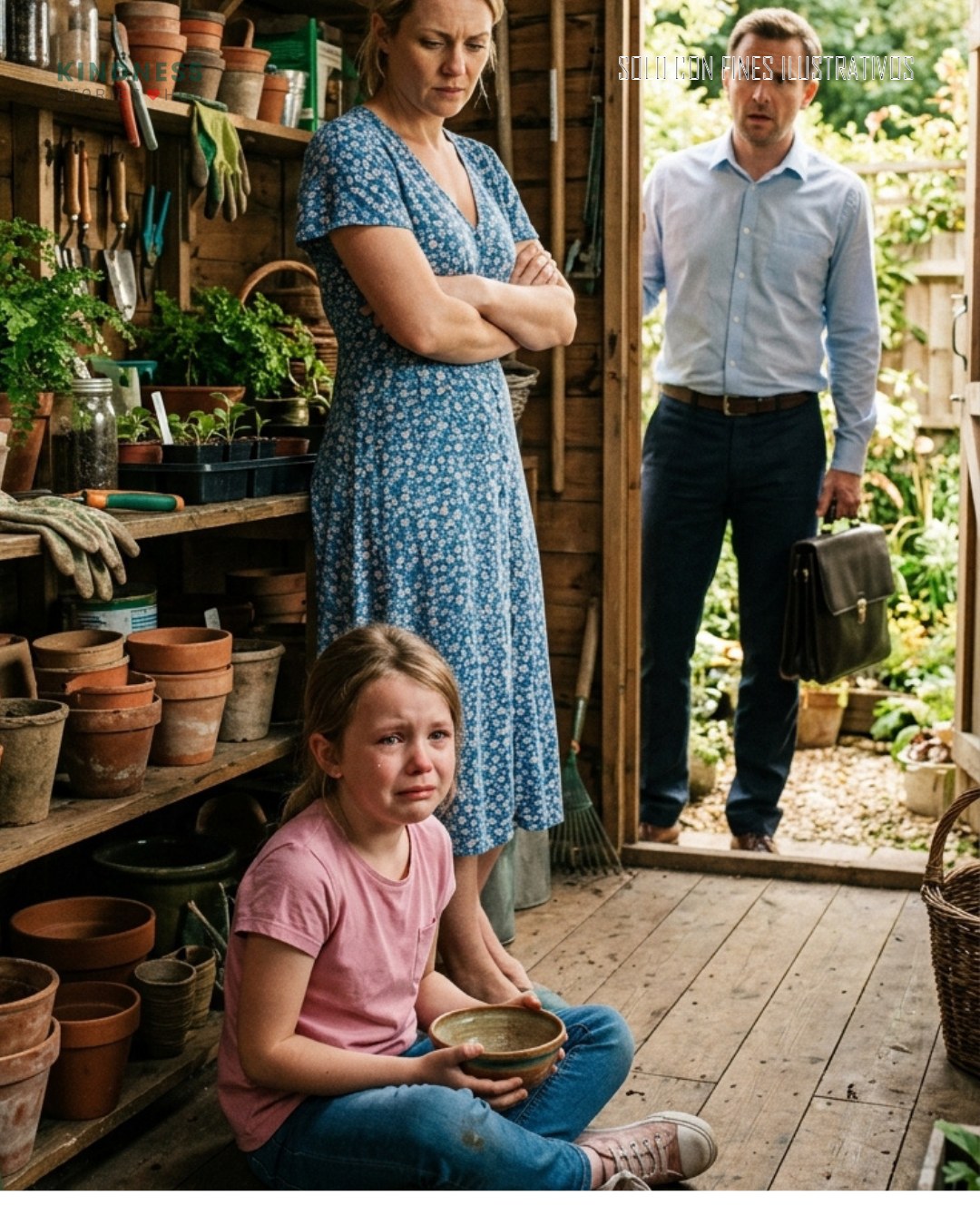
Inside, the air was stale and cold. Dust floated through thin beams of light from a narrow window. It smelled of old wood and neglect.
And there, against the far wall, sat Mara.
Knees pulled to her chest. A plate in her lap. Cold vegetables. Watery soup. Food left too long. Her hands trembled as she held the spoon. Her cheeks were wet, eyes swollen in a way he had never seen.
Standing over her was Celeste, composed in a cream blouse and tailored trousers, as if she belonged at a lunch meeting—not in a dusty room with a frightened child.
Her finger pointed at the plate.
“You don’t get to be stubborn with me,” she said. “Every bite.”
Mara tried again to lift the spoon.
Then she looked toward the doorway and saw her father.
Her expression broke something inside him.
Not just relief.
Recognition. Fear. Hope. Exhaustion. All at once.
“Celeste.”
Russell barely recognized his own voice.
His wife turned quickly. Annoyance flickered, then vanished behind practiced calm.
“Russell,” she said. “You’re early.”
He walked past her and knelt beside Mara. When he touched her shoulder, she flinched, then leaned into him with restrained desperation—as if she wanted to collapse but wasn’t sure she was allowed.
He lifted her carefully.
She was lighter than she should have been.
Too light.
Her fingers were cold.
“What is this?” he asked quietly.
Celeste exhaled, already composing her answer.
“She has been refusing meals again,” she said. “I’m trying to teach structure because you’re never home long enough to understand her.”
Russell looked at Mara. She clutched her notebook tightly, eyes fixed on him.
“Don’t talk about her like that,” he said softly.
Celeste folded her arms.
Then, as if ending the matter, she said,
“I’m expecting a baby.”
Silence fell.
Russell didn’t respond.
He carried Mara out of the building and back toward the house.
The Silence That Told the Truth
That evening, Russell stayed in Mara’s room until she fell asleep.
After a bath and a small meal, she was calmer, though she barely ate at first—as if eating itself needed permission. He sat on the bed while she drew. Her hand shook at first, then steadied. Eventually she showed him a page.
A door.
A dark space behind it.
A small figure inside.
Russell kissed her head quietly.
When she slept, he covered her more carefully and stayed a moment longer, listening to her breathing.
Then he went downstairs.
Years earlier, he had installed a full security system after a neighborhood theft. He rarely checked it afterward. He trusted his home. He trusted his life. He trusted the people in it.
Now he sat in his study, opened the footage, and watched.
The back garden camera showed Celeste leading Mara by the wrist. Mara resisted slightly, notebook in hand. Celeste stopped, said something sharp, then pulled her forward.
Russell froze the frame.
Mara’s posture said everything. Fear always reveals itself.
Celeste opened the cottage, guided her inside, then closed and locked it from outside.
Russell forced himself to continue.
Another camera angle showed inside. Limited, but enough. Mara sat on the floor, stared at the door, then slowly wrote a word in dust on the wood.
HELP.
Russell leaned back as if struck.
He replayed it.
Again.
The third time, he saw it wasn’t panic.
It was hope.
She had written it because she believed someone would come—eventually.
The Warnings He Had Missed
The next morning began with something heavy and unfamiliar. Not shock—something deeper. The realization that danger had been present while he believed absence was harmless.
He spoke first with Teresa, the housekeeper. When asked, her expression changed immediately. Relief and guilt mixed together.
“I did try,” she said quietly. “I didn’t know how to reach you.”
She played an audio recording—Celeste speaking harshly to Mara behind a closed door. Controlled. Cold. Dismissive.
Russell closed his eyes as he listened.
Later, he went to Mara’s school.
Her teacher, Mrs. Keating, brought out a folder—notes on weight loss, anxiety, withdrawal at pickup. There were also unanswered attempts to contact him during his trips.
“I thought you knew,” she said softly. “Or were too busy.”
Russell shook his head.
“No,” he said. “I just didn’t see.”
By the time he left, one truth was clear.
This hadn’t started recently.
It had been building for a long time.
And Celeste had ensured no one else could reach him.
The Story Celeste Tried to Control
Two days later, Celeste asked to speak with him. By then, Mara was staying with his sister whenever needed.
Celeste arrived composed, calm, almost rehearsed.
“I think this has gone far enough,” she said.
Russell sat across from her.
“Has it?”
She slid documents forward.
“She responds better to structure,” she said. “A specialist agrees.”
Russell didn’t touch them.
“You locked her in an outbuilding.”
Celeste’s tone tightened.
“You’re choosing the worst interpretation.”
“That’s what happened.”
Her voice sharpened.
“You’re never here. You don’t understand what this house is like.”
Russell looked at her steadily.
“She’s eight.”
“And if you continue this,” she said, “you’ll destroy everything.”
Russell answered simply.
“It was already being destroyed. I just came home in time to see it.”
She paused.
Then added,
“I’m pregnant.”
He didn’t react.
“That claim is being reviewed.”
Something shifted in her expression—calculation replacing emotion.
He understood then she still believed control could be regained.
She was wrong.
The Case That Unraveled
The investigation moved quickly. Detective Naomi Porter reviewed footage, recordings, school records, and communication logs. She was methodical and calm, never rushing Mara.
In time, Mara wrote:
“She acts nice when people are watching.”
“She says Dad won’t believe me.”
“I tried to be good.”
Russell had to leave the room after reading them.
Later, investigators found inconsistencies in Celeste’s pregnancy claim. What had seemed personal now looked constructed.
And piece by piece, denial collapsed under evidence.