“My papa had a ring just like that… and my cat won’t stop staring at you.”
He said it so quiet I almost missed it under the noise of the bowling alley lanes crashing behind us. But it landed on our table like a brick through a window.
Me and my crew were cutting through eastern Tennessee, killing time before we made our yearly trip to the memorial wall downtown. We do it every October for Salazar. He was the fifth man in our unit, the one who never walked out of that building.
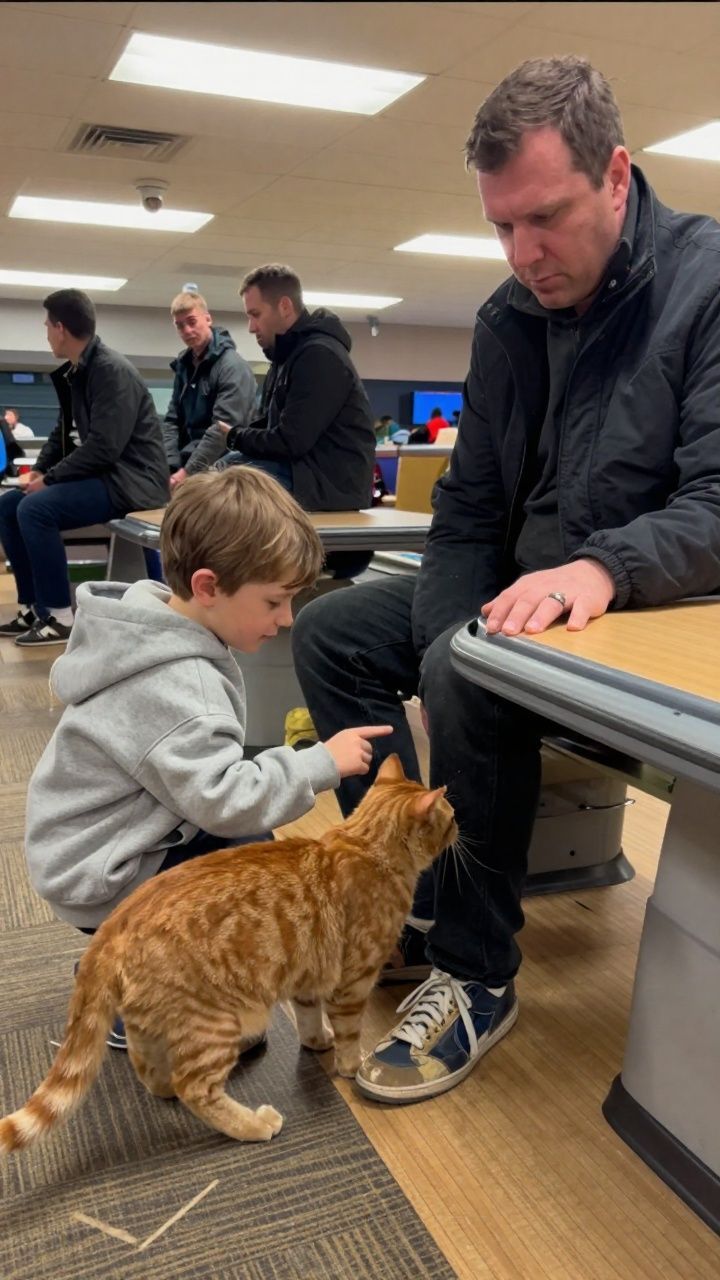
I had just picked up my beer, and my class ring caught the overhead light. The one from the academy, with our station number engraved inside the band. That’s what the boy was locked onto.
He was maybe five, six years old, wearing a too-big hoodie and sneakers with the soles peeling off. Beside him sat a massive, beat-up orange tabby missing half its left ear, just sitting there on the sticky carpet like it owned the place.
“What’d you just say, buddy?” I asked, and my throat closed up halfway through.
“My papa wore that ring,” he said again, pointing at my hand. “His name was Salazar. Diego Salazar.”
Nobody at the table moved. Terrance knocked his bottle off the edge. It shattered on the floor and not one of us flinched.
Salazar died six years ago going back into a collapsed warehouse for us. The department records listed him as having no next of kin. No partner. No children. Nothing. We buried an empty life along with a full casket.
Then the cat stood up.
It walked straight to my chair, pressed its scarred face against my shin, and let out this low, guttural sound I can only describe as grief. Its whole body trembled against my leg, this deep shuddering that you could feel in your chest.
I looked down at the mangled left ear, the burn scarring across its shoulder, and every hair on my body stood straight up. It was Fuego. Salazar’s station cat, the one our chief told us had died in the same collapse. Said they found remains. Said it was confirmed.
If the cat survived, and this kid existed…
“Mijo, leave those people alone,” a woman’s voice came sharp from behind the shoe rental counter.
The boy’s mother stepped around the partition, pulling off a pair of latex gloves. She froze the second she saw the four of us crammed into the plastic seats by Lane Twelve.
My whole body went numb. The stack of rental shoes she was carrying avalanched out of her arms, tumbling across the waxed floor in every direction.
I couldn’t speak. I couldn’t think. Because the woman standing there white-faced in that bowling alley polo wasn’t someone we’d never met. She was Carmen. Diego’s sister. The one who’d stood at the back of the funeral in dark glasses and left before we could reach her.
The Woman Who Disappeared
We’d tried to find Carmen for about eight months after the service.
Not in a formal way. No private investigator, nothing like that. Just four guys from a firehouse calling numbers, leaving voicemails that never got returned. The department had a mailing address in Knoxville that bounced back. She’d gone quiet, and eventually we stopped pulling on the thread because pulling on it hurt.
Terrance was the one who’d known Diego best. They’d come up through the academy the same year, carpooled for the first six months, had each other’s families’ phone numbers. He’d driven to the Knoxville address twice. Both times, nobody answered.
Now she was here. In a bowling alley in Erwin, Tennessee, wearing a green polo with a name tag that said CARMEN in block letters, which felt almost insulting in its plainness.
She looked at Terrance first. Then at me. Then at the ring.
The boy had gone back to her side and was holding the hem of her shirt with both fists.
“Mama,” he said, “they have Papa’s ring.”
She put her hand on the back of his head. Her jaw was doing something, working through some decision I couldn’t see. Fuego padded over to her feet and sat down like he was staking a claim on her too.
“You should go,” she said. Not mean. Just flat. The voice of someone who’d already rehearsed the sentence.
“Carmen.” Terrance stood up slow, both hands out, like she was something that might bolt. “We’ve been trying to reach you for six years.”
“I know.” She bent and picked up one of the fallen shoes. Set it on the counter. Picked up another. “I know you have.”
What Diego Kept From All of Us
Here’s what we didn’t know about Diego Salazar.
He’d been with a woman named Rosalind for three years before the collapse. Not Carmen’s mother, somebody else entirely. Rosalind had a son from a previous relationship, a kid named Marco, who Diego had been raising as his own since the boy was barely walking. They weren’t married. They weren’t even living together full-time. Diego had an apartment twelve minutes from the station, and he spent four nights a week at Rosalind’s place in Greeneville.
He never told us. Not one word.
Carmen knew. She was the only one. She’d kept Rosalind’s number, visited the baby once after the funeral, and then Rosalind had moved. New city, new number. Carmen had lost track.
Until Rosalind got sick, two years ago. And sent Marco to live with Carmen.
So the boy wearing the too-big hoodie wasn’t Diego’s biological son. He was the kid Diego had chosen, quietly, without making a thing of it, the way Diego did everything. Marco was six years old now and had exactly two memories of the man he called papa. One was of being carried on Diego’s shoulders in a parking lot somewhere. One was of the ring.
Carmen told us all of this standing behind the shoe rental counter while her manager shot looks from across the room and Marco sat on the floor feeding Fuego a piece of pretzel.
She didn’t cry. Her voice stayed steady the whole way through, and I had the feeling she’d told it so many times in her head that it had worn smooth. The sharp parts were still there. She just knew where they were now.
The Thing About Fuego
I had to ask.
“The chief told us they found his remains. In the collapse.”
Carmen looked at me for a long second.
“They found a cat,” she said. “Orange tabby. Burn injuries. They assumed.”
Fuego had gotten out. Nobody knew how. Diego had found him three weeks after the fire, two miles from the site, living under a dumpster behind a Waffle House. Thin and burned and missing most of his ear, but alive. Diego had taken him to a vet, then to Rosalind’s, because he couldn’t bring him back to the station without explaining that the cat the station had already mourned was not, in fact, dead.
He’d had Fuego for maybe five weeks before the warehouse call.
When Diego didn’t come home, Rosalind kept the cat. When Rosalind got sick, the cat went with Marco.
Fuego was nine years old. He walked with a slight hitch in his back left leg and he had a scar that ran from his shoulder to his ribs and he recognized Terrance’s voice when Terrance said Diego’s name out loud. The cat just stopped moving and turned his head.
Terrance had to sit back down after that.
Lane Twelve
Carmen’s manager, a guy named Phil who looked about twenty-two and deeply unprepared for whatever was happening at Lane Twelve, eventually brought us all coffee and pretended to be busy near the scoring machine.
We stayed for two and a half hours.
Marco showed us the photo on Carmen’s phone. Diego in a backyard somewhere, holding the boy up against a cloudless summer sky, both of them squinting into the sun. Diego looked younger than I remembered. Happier. Wearing the same class ring on his right hand.
Terrance had his own ring in his jacket pocket. He’d been carrying it to the memorial wall every October for six years, setting it at the base for an hour, then bringing it home. He put it on the counter in front of Marco without saying anything.
Marco looked at it, then at Terrance. “Is yours the same number?”
“Same station,” Terrance said. “Same class.”
“Can I hold it?”
Terrance nodded.
The boy picked it up with both hands and turned it over, reading the inside of the band out loud, sounding out the letters slowly the way six-year-olds do. Then he set it back down and pushed it gently back toward Terrance.
“Yours,” he said. Simple. Matter of fact. Like he’d just confirmed something.
We got Carmen’s number before we left. Real number this time. She put it in my phone herself.
She walked us to the door, Marco on her hip, Fuego trailing behind like a lopsided shadow. The parking lot was cold. October in Tennessee gets cold fast once the sun drops.
“He talked about you guys,” she said, at the door. “He didn’t say much. But he talked about you.”
None of us answered that. There wasn’t anything to say that didn’t feel too small.
We drove to the memorial wall and stood there in the dark for a while. Terrance put the ring down at the base of the panel like always, but this time he left it there longer. Maybe twenty minutes. Just standing with his hands in his pockets, not talking.
When he picked it back up, his face was different. Not better or worse. Just different.
What October Looks Like Now
We still go every year. That hasn’t changed.
What changed is that Carmen and Marco come too, sometimes. Not every year. Last October they did. Marco is eight now. He wore a jacket that was almost the right size, which felt like progress.
He asked me before we left the wall if firefighters were scared when they went into buildings.
I thought about lying. Giving him the clean version. Brave men, no fear, all that.
“Yeah,” I said. “Every single time.”
He thought about that for a second.
“Papa too?”
“Your papa more than any of us,” I said. “And he went in anyway. Every time.”
Marco nodded, slow, like he was filing it somewhere useful.
Fuego waited in Carmen’s car with the window cracked. When we got back he was sitting on Marco’s seat, which Marco complained about loudly and then let go of immediately, climbing in around the cat without actually moving him.
The cat put his chin on Marco’s knee and closed his eyes.
Marco put his hand on the scarred shoulder, gentle, the way you do with something old and a little broken that you love anyway.
Nobody said anything. Carmen started the car. The heater came on.
—