“FINAL WARNING!” I SAID – BUT THEY RUSHED ME ANYWAY.
Carrick laughed, the sound thick and condescending. He closed the distance and reached out, his meaty fingers locking hard around my forearm.
“Walk it off, darling. Time to clear the floor,” he said, jerking his chin toward the two heavies flanking him near the loading bay doors. “Boys. Help this one find the street.”
“Final warning,” I said. My voice came out almost bored. My pulse didn’t move an inch.
Carrick squeezed harder, grinding the bones together like he was making a point. The stockier one on the left surged forward to grab my collar.
They had absolutely no idea what they’d just started.
Trained reflex doesn’t deliberate. It just fires. I dropped my weight hard onto my right foot, rotating my whole center down and away. Carrick’s grip ripped clean off like velcro. Before his eyes could even track the shift, I drove the flat of my palm straight into the brachial plexus junction below his collarbone.
He folded like wet cardboard, mouth working open and shut, sucking at air his seized diaphragm refused to deliver.
The stocky one stumbled backward in confusion. The other one threw a looping overhand right.
I ducked under it, caught his wrist on the way past, torqued the joint hard past where joints are supposed to go, and kicked his ankles out sideways. A wet, ugly pop cracked across the concrete as his shoulder met the floor.
Six seconds. Three men. Combined weight probably pushing seven hundred pounds. All of them on the ground making sounds I won’t describe.
The whole warehouse floor went absolutely still. The forklifts stopped humming. Somewhere a radio cut to static and nobody moved to fix it.
Supervisor Brent, who’d been standing by the cage office with a clipboard, threw the clipboard down and came jogging over, his keychain slapping against his hip.
“Hey! STOP!” he shouted, one hand raised. “Somebody tell me what the hell just happened here!”
Carrick rolled onto his side, cradling his arm against his chest like it belonged to someone else. His face had gone the color of old chalk. “She attacked us!” he wheezed, chin trembling. “Get security. Get her out. She attacked us first!”
But Brent wasn’t looking at Carrick.
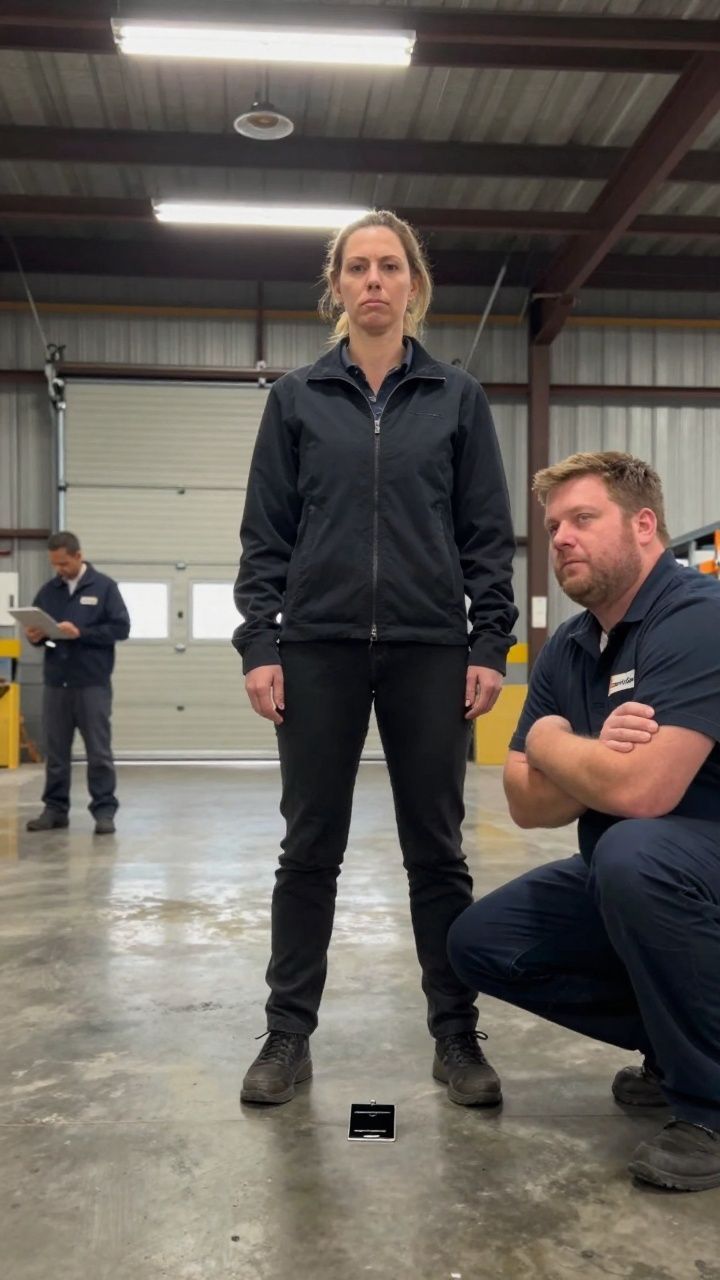
He was staring at the laminated black credentials card that had shaken loose from my jacket’s interior pocket during the sweep, landing face-up on the concrete between us.
Every bit of color left Brent’s face at once.
He didn’t call for security. He didn’t reach for his phone. He just went rigid, both arms dropping stiff to his sides, eyes locked onto that card like it was a live grenade, and then he said…
The Part Where Everything Changes
Nothing, for about four full seconds.
Then: “Oh. Oh, Jesus.”
He crouched down and picked up the card with two fingers, like he was handling something that might bite him. Read it once. Read it again. His jaw worked. He set it back on the concrete carefully, straightened up, and looked at me with the specific expression of a man doing rapid arithmetic on exactly how badly his morning had gone wrong.
“Are you,” he started, then stopped. Tried again. “Are you actually with the – “
“Yes,” I said.
He closed his mouth.
The card was black. Not dark blue, not navy, not corporate charcoal. Black. The kind of black that means the issuing agency doesn’t print these for middle management. The seal embossed on the lower left corner wasn’t something you’d recognize from a distance, which was the point. Three letters on the back, no full name, no title. A direct-line number that routes through a switchboard in a building that doesn’t appear on any public registry.
Brent had been in industrial logistics for twenty-two years. He’d dealt with OSHA, with union reps, with insurance adjusters and county fire marshals. He’d never seen one of these.
He’d heard about them.
Carrick was still on the floor, face the color of old chalk, trying to piece together what he was looking at. The stocky one, whose name I’d later find out was Dennis Prohl, had gone completely quiet, sitting against a pallet of shrink-wrapped cargo with his knees pulled up. The third one, the one with the dislocated shoulder, wasn’t moving much at all.
“Somebody get him medical,” I said, nodding toward the shoulder.
Brent snapped his fingers at a loading crew guy standing fifteen feet away with his mouth open. “Kowalski. Call the site medic. Now.” The guy disappeared at a jog.
What I Was Actually Doing There
I’d been in the building since 6:40 that morning.
Not as myself, exactly. As a woman named Gail Ferris who worked for a third-party inventory compliance firm out of Columbus. I had a badge, a hi-vis vest, a clipboard, and a pair of steel-toed boots that were a size too small because the quartermaster’s office had been out of my size and I hadn’t complained about it, which I was regretting.
The assignment had come down eleven days earlier. Not to me initially. To my supervisor, Walt, who had called me into his office on a Tuesday afternoon, slid a folder across his desk without preamble, and said, “Gail Ferris. You’ve done cold-embed before.”
I had.
“How long do you need?”
“Depends on what I’m looking for.”
He tapped the folder. I opened it.
The warehouse was a mid-size distribution hub outside of Dayton. Third-party logistics, contract fulfillment, about two hundred and forty employees on the main roster. On paper it moved consumer goods: appliances, hardware, seasonal stock. Three clients with long-term contracts, all legitimate, all audited clean through the last two annual reviews.
Except.
Fourteen months ago, a customs flagging algorithm caught a discrepancy on a container manifest. Not a big discrepancy. The kind a human reviewer would have waved through. A seven-pound weight difference across a pallet of boxed ceiling fans. The algorithm flagged it because it had been trained to notice that specific kind of small, and the analyst who caught the flag had been thorough enough to pull the full shipment history.
The weight discrepancies, when you stacked them across eighteen months of outbound manifests, totaled just under four thousand pounds of unaccounted mass. Moving through this one facility. In small increments. Consistently.
Four thousand pounds of something that wasn’t ceiling fans.
Walt had looked at me over his coffee cup. “We don’t know what it is yet.”
“That’s why I’m going.”
“That’s why you’re going.”
The First Two Warnings
I’d been on the floor for nine days before I found anything solid.
The work itself wasn’t hard. Inventory compliance is genuinely tedious, which makes it good cover, because nobody wants to hover over the person doing it. I counted stock. I cross-referenced manifests. I asked boring questions about receiving procedures and got boring answers. I ate lunch in the break room and heard about Denise’s custody situation and about the vending machine that had been broken since March and about how the overnight supervisor, a guy named Phil Carver, was sleeping with somebody in accounts receivable.
On day six I found the bay.
Loading Bay 9, at the east end of the building, was listed in the facility layout as a secondary receiving area, low-traffic, used for overflow. In practice it was locked, gated, and the only two people I ever saw use it were Carrick and a shift lead named Tom Gregg. Gregg drove a truck that was nicer than his salary explained. Carrick had a key on a separate ring from his facility keys, a ring he kept in his front pocket instead of clipped to his belt with the others.
I noted it. I didn’t move on it yet.
Day eight, I got close enough to the bay during a shift change to run a quick scan with the device in my clipboard. The clipboard is not a clipboard. The results went to Walt. Walt called me at 9 PM on a prepaid and said two words: “Confirm it.”
Day nine, I went back.
That was when Carrick noticed me.
He didn’t say anything the first time. Just watched me from across the floor, arms crossed, chewing on something. The second time, he walked over and told me, pleasantly enough, that Bay 9 was off-limits to compliance personnel and I should run my counts from the main floor only.
I told him I understood and thanked him.
That was warning one.
The next morning I came back and he was waiting. Less pleasant this time. He had Dennis Prohl with him and the other one, whose name turned out to be Marcus Webb. He told me I’d been given a courtesy yesterday and that courtesy was now expired, and that if I wanted to keep my contract I should pack my clipboard and go wait in the front office until someone came to walk me out.
“Final warning,” I said, giving him the last chance he didn’t deserve.
That was warning two.
He grabbed my arm. That was the last decision Carrick made for himself for a while.
Brent’s Problem
Brent’s problem was that he didn’t know.
That’s what he kept saying, standing there with his arms stiff at his sides while the medic worked on Marcus Webb’s shoulder. “I didn’t know. I had no idea what was in that bay. Carrick had keys, Carrick managed that section, I never – “
“Brent.” I stopped him. “I’m not here for you.”
He went quiet.
“But I need you to do exactly what I tell you for the next two hours. Can you do that?”
He nodded. Fast. The nod of a man who has just understood, with full clarity, that cooperation is the only direction worth walking.
I told him to lock the building. All exits, all bays, no outbound trucks until I said otherwise. I told him to put Carrick, Prohl, and Webb in separate rooms with no phones. I told him to find Tom Gregg and make sure Gregg didn’t leave the property, and to do it quietly, without explaining why.
Then I called Walt.
Walt picked up on the second ring.
“It’s confirmed,” I said. “Bay 9. You’re going to want to send the full team.”
A pause. “How contained is the situation?”
I looked at Carrick on the floor, still cradling his arm, still not quite believing what had happened to his morning. “Contained,” I said.
What They Found
I’m not going to walk through all of it. Some of it I can’t, and some of it isn’t mine to tell yet.
What I’ll say is that the team arrived at 11:20 AM in three unmarked vans. They were in the building for six hours. Bay 9 gave up a lot more than four thousand pounds of unaccounted weight. The ceiling fan boxes were real. The other cargo was not ceiling fans.
Gregg cooperated almost immediately, which surprised nobody. He had a daughter starting college in the fall and a second mortgage and the specific look of someone who had spent a year and a half telling himself he wasn’t really involved, not really, not in the part that mattered.
Carrick did not cooperate. Carrick asked for a lawyer, which was his right, and sat in a folding chair in the cage office with his jaw set and his eyes on the middle distance, not talking to anyone.
I left before the end. My part was done.
I turned in the hi-vis vest and the clipboard at the quartermaster’s office. I signed out the credentials card. I changed out of the too-small boots in the parking lot of a gas station two miles from the facility, sitting on the hood of my car in the November cold, and I thought about nothing in particular for a few minutes.
Then I drove back to Columbus.
Walt’s debrief was the following Monday. He read through my report without comment, asked two clarifying questions, and said, “Good work, Ferris.”
That’s the whole compliment. That’s all it ever is.
I said thanks and went to find coffee.
—
If this one hit different, send it to someone who’d get it.