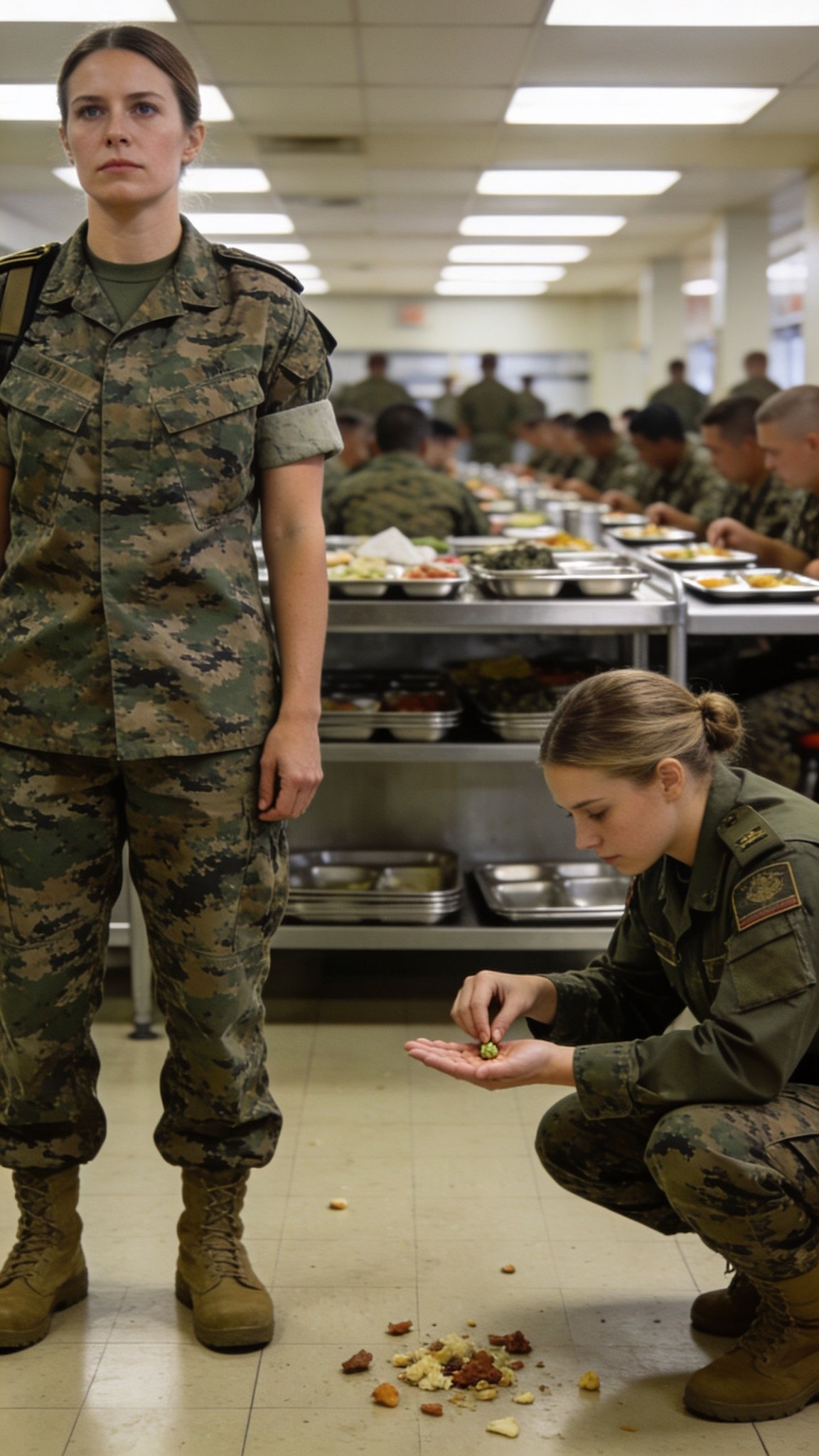
Quiet lunch line at Camp Ridgeway, just another forgettable Marine holding a tray – until a Gunnery Sergeant SLAMMED my food to the floor in front of fifty witnesses who had no idea who I actually was.
My name is Avery Callahan. I’m thirty-one years old.
On paper, I was a temporary admin attachment running logistics review. Boring. Forgettable. Exactly the way Naval Intelligence wanted it.
I’d spent six years learning how to disappear inside uniforms. The Horn of Africa. Eastern Mediterranean. Two rotations nobody could find on a record.
Camp Ridgeway was supposed to be the easy part. Domestic. Controlled. A two-week observation window inside my own country.
That was the mistake.
The dining hall was loud the way every chow hall is loud. Trays. Boots. Voices that never quite became words.
I held my place in line and watched the room the way I always watched rooms.
Then the air changed.
Heavy boots. The kind of walk that makes other people straighten without knowing why.
Gunnery Sergeant Cole Maddox stopped in front of me.
“You don’t belong in this section,” he said. “Leave. Now.”
I didn’t move. Not out of defiance. Out of training.
His hand came up and hit the underside of my tray.
The metal hit the floor so hard the sound bounced off the back wall.
Nobody moved.
“This isn’t a place for you to stand around and ignore instructions,” he said, leaning in close enough that I could smell coffee on his breath.
I kept my eyes forward. I kept my hands at my sides. I let him have the room.
Because the second that tray hit the floor, I’d already clocked something he hadn’t.
His name tape said MADDOX.
But three weeks earlier, in a sealed briefing room in Norfolk, I had sat across from a photograph of a man who was supposed to be DEAD SINCE 2019. Same jaw. Same eyes. Different name.
My stomach dropped.
I’d come to Ridgeway looking for a leak.
I had not come looking for HIM.
A young corporal knelt down to help me gather the food. She didn’t look at Maddox. She looked at me.
Then she pressed something small and folded into my palm and whispered, “He’s been waiting for someone like you to show up. You need to read this BEFORE he comes back.”
What Was In My Hand
I didn’t open it there.
You don’t open anything in a room where fifty people just watched a Gunnery Sergeant embarrass you. You thank the corporal. You pick up your tray. You find a table at the far end of the hall where your back is to a wall and you have a line on every door.
I ate. Or I moved food around a plate and watched Maddox walk to the NCO section and sit down with three other men I hadn’t properly catalogued yet.
He didn’t look at me again. That was either confidence or discipline. With someone like him, probably both.
The note was folded into quarters. Paper torn from something, not printed. Handwritten in small, cramped letters.
He runs the night inventory. Bay 7. He’s not alone. If you’re who I think you are, you already know what to do with this. If you’re not, burn it.
No signature.
I read it twice. Folded it back. Ate the rest of my food.
The corporal’s name tape had said PRUITT. She was maybe twenty-three. Short, solid, the kind of tired that isn’t from lack of sleep but from knowing too much and having nobody to hand it to. I recognized it because I’d worn that same tired for most of my twenties.
She’d taken a risk handing me that note. Either she’d read me right, or she’d just handed a piece of paper to a complete stranger and hoped for the best.
I needed to find out which.
The Man Who Died in 2019
His name in the Norfolk briefing had been Warren Doyle. Staff Sergeant, 2nd Reconnaissance Battalion. Killed in action, they’d said. Vehicle ambush outside Misrata. Body recovered, identified, buried with full honors at Arlington. His mother had been there. His sister. A girlfriend who’d driven down from Connecticut.
The photo I’d seen was from his service record. Thirty-four years old in the image, which would make him thirty-nine now.
The man who’d knocked my tray across a Marine Corps dining hall looked thirty-nine.
Same jaw. I’d thought that in the briefing room and I thought it again now, watching him from forty feet away. Square, slightly off-center, the kind of face that photographs as harder than it actually is. The eyes were the same too. Dark, fast, never fully at rest.
But dead men don’t make Gunnery Sergeant. Dead men don’t run night inventory in Bay 7. Dead men don’t wait for someone to show up.
The leak I’d been sent to find at Ridgeway was communications-based. Someone was funneling operational timelines out of the base’s logistics network. Small stuff, supposedly. Dates. Manifests. The kind of information that doesn’t look like intelligence until someone stacks it correctly.
Doyle, if this was Doyle, wasn’t small stuff.
Doyle had been part of a unit whose last confirmed mission had gone sideways in ways that the official report still didn’t fully explain. Three men dead. Two unaccounted for. One survivor who’d been medically separated and hadn’t spoken publicly since.
I’d read that file four times in the past month.
I had never expected to eat lunch across the room from it.
Pruitt
I found her at 1700, outside the vehicle bay, smoking a cigarette she clearly didn’t want. Just something to do with her hands.
I didn’t approach directly. I walked past, slowed, checked my watch like I had somewhere to be and had miscalculated. Standard.
“You gave me something at lunch,” I said, not looking at her.
She took a drag. “I give people things at lunch sometimes. Food. Napkins.”
“The paper kind.”
She exhaled. “I don’t know who you are.”
“Good.”
“But I know what you’re not.” She finally looked at me. “You’re not logistics review.”
“What makes you say that?”
“Because logistics review doesn’t stand still when a Gunny dumps their tray. They apologize. They look at the floor. They go red.” She dropped the cigarette and stepped on it. “You just watched him. Like you were taking inventory.”
I didn’t confirm it. I didn’t have to.
“How long have you known about Bay 7?” I asked.
She was quiet for a beat. “Three weeks. I do vehicle maintenance. I work late. I’ve seen him in there twice after midnight with someone I don’t recognize from this base. They carry cases. Not gear cases. The other kind.”
“You write any of this down anywhere?”
“Just what I gave you.”
“Good. Keep it that way.” I started to walk. Then stopped. “Pruitt. The man you’ve been watching. Has he ever looked at you? Like he’s noticed you noticing?”
She didn’t answer right away.
That was answer enough.
“Don’t change your schedule,” I said. “Don’t avoid him. Don’t be friendlier than usual. Just be exactly what you were yesterday.”
She nodded. I could see her working to keep her face neutral.
“One more thing,” I said. “The note said he’s been waiting for someone like me. How would he know anyone was coming?”
She looked at the ground where the cigarette had been. “Because two weeks ago, he asked me who the new admin attachment was. By name.”
My name.
He’d asked for me by name two weeks ago, which was three days before my orders had been cut.
Bay 7, 0130
I didn’t go in. Not that night.
You don’t walk into a space you haven’t mapped, at night, when the man inside already knows you’re there. That’s not tradecraft, that’s just sense.
I spent the next forty-eight hours doing the job I was supposed to be doing. Logistics review. Spreadsheets. Meetings with a supply captain named Greg Hatch who talked too much and meant nothing by it. I ate in the dining hall. I nodded at Maddox once, the way you’d nod at any senior NCO, and he nodded back the way a man nods at someone he’s already categorized.
He thought I was here for the comms leak.
He was right. But he thought that was all I was here for.
On the second night I walked the perimeter of Bay 7 at 0100, slow, no flashlight, just letting my eyes adjust. The bay was at the back of a maintenance cluster, the kind of building that gets overlooked because it’s always been there. The lock on the side door was newer than the door. That was interesting.
On the third night I went in.
The cases Pruitt had described were stacked behind a parts shelf, pushed back against the wall. Four of them. Aluminum, foam-padded interior, the latches worn in ways that suggested they’d been opened and closed a lot and recently. I didn’t open them. I photographed them. I photographed the shelf, the floor, the newer lock hasp on the wall bracket, and the single folding chair that sat in the middle of the space like someone used it to think.
Then I heard him.
Not footsteps. Breathing. The kind you hear when someone has been standing still for a while, waiting.
“I figured you’d come in on the third night,” he said, from the dark behind me. “First night’s reconnaissance. Second night’s nerve. Third night’s commitment.”
I turned around slowly.
He was standing at the far end of the bay, twelve feet back, no weapon visible. Just standing there in the dark like he’d been there for hours.
“Warren,” I said.
He didn’t flinch. “Nobody’s called me that in five years.”
“Your mother thinks you’re at Arlington.”
Something moved across his face. It wasn’t guilt exactly. More like a bruise that had been pressed on too many times to hurt the way it used to.
“My mother knows I’m alive,” he said. “She just can’t say so.”
What He Wanted
He wasn’t the leak.
That took me another hour to understand, sitting in two folding chairs in the middle of Bay 7 at 0200 while he talked and I listened and tried to work out which parts were true.
He’d faked his death with help. Not his own help, not the military’s official help, but the kind of help that comes from people who operate in the spaces between official and off-record. He’d been pulled out of Misrata not because the mission failed but because he’d gotten close enough to something that the people running it decided he was more useful disappeared than debriefed.
The cases weren’t weapons. They were drives. Documentation, he said. Years of it. Collected from the kind of places you can only reach when everyone thinks you’re dead.
The comms leak I’d been sent to find was real, but it wasn’t his. Someone else on this base was moving information out, and they’d been doing it in a pattern that, if you stacked it correctly, pointed back toward the same operation that had put Warren Doyle in the ground in 2019.
He’d come to Ridgeway to find the leak himself. And then my name had come across someone’s desk three days before my orders were cut, and he’d understood that either I was part of the problem or I was the only person he could hand this to.
So he’d knocked my tray on the floor.
To see what I’d do.
“If you’d apologized,” he said, “I’d have known.”
“Known what?”
“That you were trained to smooth things over. Manage the room. That’s not what I needed.” He looked at me. “I needed someone who’d just stand there and let it happen and already be thinking three moves ahead.”
I looked at the cases.
“I can’t take those through official channels,” I said.
“I know.”
“If what you’re saying is true, official channels are part of it.”
“I know that too.”
I sat with that for a minute. Outside, somewhere across the base, a vehicle started up and drove away.
“The corporal,” I said. “Pruitt. She’s not part of this.”
“No. She’s just sharp and unlucky. She saw things she shouldn’t have because she works late and keeps her head down and that combination gets people noticed.” He paused. “She’ll be fine if this moves fast.”
“And if it doesn’t move fast?”
He didn’t answer.
Which was its own kind of answer.
I looked at the cases one more time. Four of them. Foam-padded. Latches worn from opening and closing, opening and closing, carried from place to place by a man who’d been dead for five years and had spent every one of those years building toward a moment exactly like this one.
I thought about the dining hall. The tray hitting the floor. Fifty people watching me and seeing nothing.
Exactly the way Naval Intelligence wanted it.
“Alright,” I said. “Tell me where it starts.”
He told me.
It started a lot further back than 2019.
—
If this one got under your skin, pass it to someone who’d sit up reading it at midnight.