I never thought a pair of thick white cable-knit socks could make my blood run cold – but when my 12-year-old daughter climbed into my truck wearing KNEE-HIGH WOOL in 101-degree heat, something inside me started SCREAMING.
I’m Marcus. Forty-one. Single income, suburban dad, married eight years to Sarah, Lily’s stepmom.
Lily is my whole world. Her mom died when she was four, and Sarah came into our lives three years later like a gift I didn’t deserve. Or that’s what I used to think.
Lily was the kid who wore tank tops in October. The kid who complained when the AC wasn’t cold enough. My summer baby.
That Tuesday in Austin, the tarmac outside Oak Creek Middle was wavering with heat. Kids spilled out in shorts and tank tops. Then Lily came shuffling toward the truck, slouched, drowning in those socks.
“Everyone’s wearing them, Dad. It’s a style.”
She wouldn’t look at me. She flinched when I touched her arm.
At home, Sarah was slicing strawberries at the island, smiling that warm smile. “Isn’t it cute? Very 90s retro.”
“Sarah, it’s a hundred degrees.”
“Marcus, stop overthinking. She’s twelve.”
I wanted to believe her.
But then the socks didn’t come off. Not at dinner. Not at soccer under her shin guards. Not in bed. A black pair Wednesday. Gray pair Thursday morning.
I noticed Sarah doing the laundry herself now. She’d never done Lily’s laundry before.
I noticed the bathroom door locking.
I noticed Lily wouldn’t sit next to Sarah on the couch anymore.
Then Thursday, the landline rang.
“Mr. Vance, come to the school. Bring your wife. You both need to see this.”
Sarah’s knuckles went white on her purse the whole drive. Her breezy dismissals were gone.
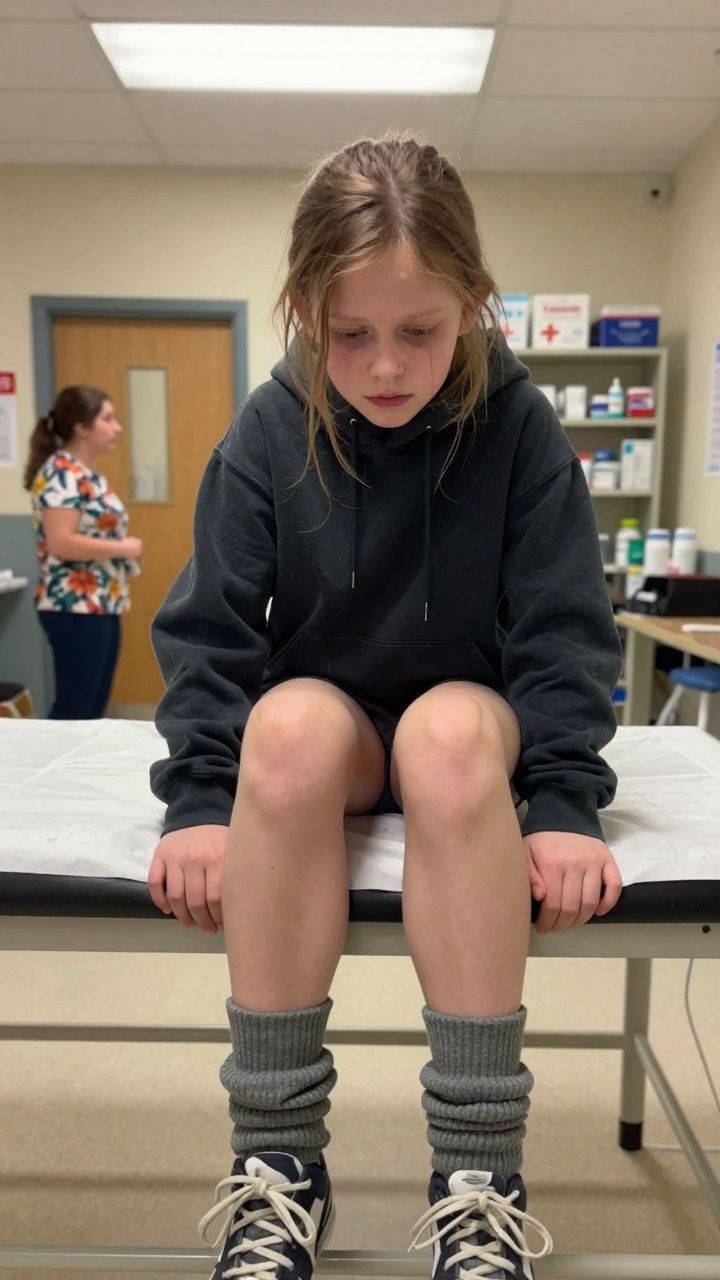
Nurse Gable locked the clinic door behind us. Lily sat on the table, pale, staring at the linoleum. The socks were bunched at her ankles.
I had to grip the counter to stay upright.
Sarah made a sound I’d never heard a human make.
“Oh my God. Lily… what happened to you?”
Lily didn’t look at her father. She looked straight at Sarah.
And then Nurse Gable stepped between them, holding out a folded piece of notebook paper with shaking hands.
“Mr. Vance,” she said quietly, “your daughter wrote down WHO DID THIS. And before you open it, I need you to sit down. Because the name on this paper… is already inside your house.”
The Paper
I didn’t sit down.
My legs weren’t going to do that. I stood at the counter with one hand flat against the laminate and I took the paper from Nurse Gable and I unfolded it.
Lily’s handwriting. The loopy, leftward slant she’d had since second grade. One name.
Donna.
I read it twice. Three times. My brain kept sliding off it.
Donna is my sister. She’s thirty-eight. She lives forty minutes north of us in Round Rock, and she’d been staying in our guest room since May because she was between apartments, between jobs, between whatever version of her life she was currently failing to hold together. She’d been there eleven weeks.
I looked up at Lily.
She was still looking at Sarah. Not at me.
And that’s when I understood that Lily had been trying to tell Sarah. Not me. She’d been trying to tell her stepmother, the adult woman in the house, the one she saw every single morning, the one who packed her lunch and drove her to soccer and tucked the sheets in the way Lily liked.
Sarah’s face had gone the color of old dishwater. She wasn’t looking at the paper. She was looking at Lily. And her mouth was doing something, opening and closing, but nothing was coming out.
“How long?” I finally said. My voice sounded wrong. Too flat.
Lily pulled one knee up to her chest on the exam table. “Since the second week she moved in.”
Eleven weeks.
Eleven weeks of my daughter covering her legs in a Texas summer.
What the Socks Were Hiding
Nurse Gable had already photographed everything. She was required to. She’d already called Child Protective Services before she called me. She walked me through it with the steady, practiced calm of someone who has had this conversation too many times and hates that she has to keep having it.
Lily had been scratching. Not cutting, not the way I first thought, but digging her nails into her own legs when she got scared or overwhelmed. Starting the week after Donna moved in. The scratches had layered over two months into something that looked worse than it was medically, Gable said, but psychologically.
Psychologically was the word she used.
“Your daughter has been managing significant anxiety,” Gable said. “The scratching is a coping response. It’s not uncommon when a child feels unsafe and doesn’t have language yet for what’s happening.”
What was happening was this: Donna had been getting into Lily’s room at night. Not touching her. Worse, in some ways. Sitting on the edge of her bed in the dark and talking. Telling Lily things. About me. About Sarah. About how neither of us actually wanted her, how she was a burden we’d inherited, how Donna was the only one who really understood her, how if Lily told anyone what Donna said, Donna would leave and then Lily would see how fast everyone else left too.
Eleven weeks of that.
My daughter scratching her own legs to get through the school day.
What Sarah Did
Here’s the part I didn’t expect.
Sarah lost it. Not the way I lost it, which was quiet and cold and full of a rage that didn’t have anywhere to go yet. Sarah came apart right there in that clinic. She sat down hard on the plastic chair next to Lily’s table and she put her face in her hands and she cried in a way that was ugly and loud and real.
And Lily, my twelve-year-old daughter who had just spent eleven weeks being slowly taken apart by my sister, reached over and put her hand on Sarah’s back.
Rubbed it in a small circle.
I had to look away.
I’d spent the drive over running through everything I’d missed. Every dismissed instinct. Sarah had told me I was overthinking. I’d believed her. But standing there watching Lily comfort the woman who’d told her the socks were cute, I couldn’t hold onto my anger at Sarah. She’d been fooled the same as me. She just had to live with the fact that Lily had tried to tell her and she’d handed it back with a smile and a comment about 90s fashion.
I think Sarah will carry that for a long time.
I know I will.
The Drive to Round Rock
I called my sister from the parking lot of Oak Creek Middle.
She picked up on the second ring. Cheerful. “Hey, what’s up?”
“Go to the hotel on 183. The Extended Stay. Take your stuff. Don’t be in my house when I get back.”
Silence.
“Marcus, what – “
“Lily told us.”
The silence after that was different. Longer. She didn’t say what did she say or I don’t know what you’re talking about. She didn’t say anything. That told me everything I needed to know about whether there was any version of this I’d misunderstood.
“The police will want to talk to you,” I said. “Cooperate.”
I hung up.
Sarah had stayed inside with Lily. I stood in the parking lot for four minutes looking at a crack in the asphalt. A fire ant was navigating it, dragging something three times its size. I watched it make the crossing.
Then I went back inside.
What Lily Needed
The CPS case worker, a woman named Patricia who had the kind of face that’s seen everything and still shows up Monday morning, came to the house that evening. She sat with Lily for about an hour while Sarah and I waited in the kitchen. I made coffee I didn’t drink. Sarah sat at the island where she’d been slicing strawberries two days ago, which felt like it was from someone else’s life.
“I thought she was just going through something,” Sarah said. Not to me specifically. Just to the air in the kitchen. “I thought it was middle school stuff.”
“I know.”
“I should have pushed harder.”
“Yeah.”
She looked up. “You’re not going to tell me it’s okay.”
“No.”
She nodded. That was the right answer and we both knew it.
Patricia came out and told us Lily was going to need a therapist, a good one, ideally someone who specialized in psychological manipulation in children. She gave us two names. She told us what the next few weeks would look like with Donna, legally. She told us to keep Lily’s routine as normal as possible. Soccer. School. Dinner at the table.
“She needs to know the structure is still there,” Patricia said. “That’s what was attacked. Her sense of whether the people around her were real and stable. You rebuild that with boring normal days.”
Boring normal days.
I wrote that down.
The Following Tuesday
Lily wore shorts to school.
Orange ones, the ones with the small white stripe down the side she’d gotten at Target in June. She came downstairs and grabbed a granola bar and her soccer bag and she looked like herself. Almost.
I was at the counter. I didn’t make a big thing of it. I just said, “You want me to drive you or you taking the bus?”
“Bus,” she said.
“Okay.”
She got to the door and stopped. Didn’t turn around.
“Dad.”
“Yeah.”
“I wrote Sarah’s name first. On the paper. I crossed it out.”
She left before I could figure out what to say to that.
I stood in the kitchen for a while. The granola bar wrapper she’d left on the counter. Her cleats by the door, one tipped over. The AC cycling on.
She’d tried to hand it to Sarah. And Sarah had smoothed it over without meaning to, without knowing, and Lily had crossed out her name and written Donna’s instead and folded the paper up and waited for a nurse she’d only met twice to ask the right question.
My daughter carried that for eleven weeks and then she trusted a stranger with it when she couldn’t trust us.
I picked up her cleats and set them both upright.
That’s all I could do right then.
—
If this one stayed with you, pass it to someone who needs to read it.