The Millionaire Hid Cameras to Protect His Paralyzed Son — Until He Saw What the Maid Did
Daniel Carter was sitting at the head of a long oak conference table on the twenty-third floor of a glass tower in downtown Chicago when his life, or what remained of it, began to crack open again. Beyond the wall of windows, the city looked frozen under a gray winter sky. The tops of the skyscrapers disappeared into low clouds.
Lake Michigan was somewhere beyond the haze, cold and steel-colored, and the streets below were crawling with traffic that looked silent from that height. Inside the boardroom, everything was polished, controlled, expensive. The table shone beneath the recessed lights.
The executives around him wore dark suits and careful expressions. A white screen at the far end of the room displayed growth charts, projected revenue, expansion plans, and multimillion-dollar figures. Daniel nodded whenever someone looked his way.
He had spent most of his adult life building Carter Holdings into the kind of company people whispered about in financial circles. He knew how to read a room before anyone spoke. He knew how to close a deal with one sentence.
He knew how to make men twice his age hesitate before disagreeing with him. But that afternoon, all the numbers on the screen blurred into pale lines. For six months, Daniel had been sitting in rooms like this every day, listening to discussions that had once defined his entire life.
Work had once been the only place where he felt strong. It had been the machine he could operate without thinking, the world where effort led to results and discipline could solve almost anything. Now it was merely shelter.
A temporary refuge from the house waiting for him every night. The phone in his suit pocket vibrated softly. Daniel frowned.
No one was supposed to interrupt him during meetings, especially not meetings like this. He slipped one hand into his pocket, intending to silence the notification without looking, but when his thumb brushed the screen, he saw the alert. The home security app.
For a second, he did not move. Then, as if something invisible had reached inside his chest and pulled, Daniel unlocked the phone. The screen opened to a live feed from his kitchen at home.
And Daniel Carter’s world stopped. His son, Leo, was sitting on the cold kitchen floor with his small legs stretched out in front of him, completely still from the waist down. He wore a beige hooded onesie, the one Emma had bought for him only weeks before the accident.
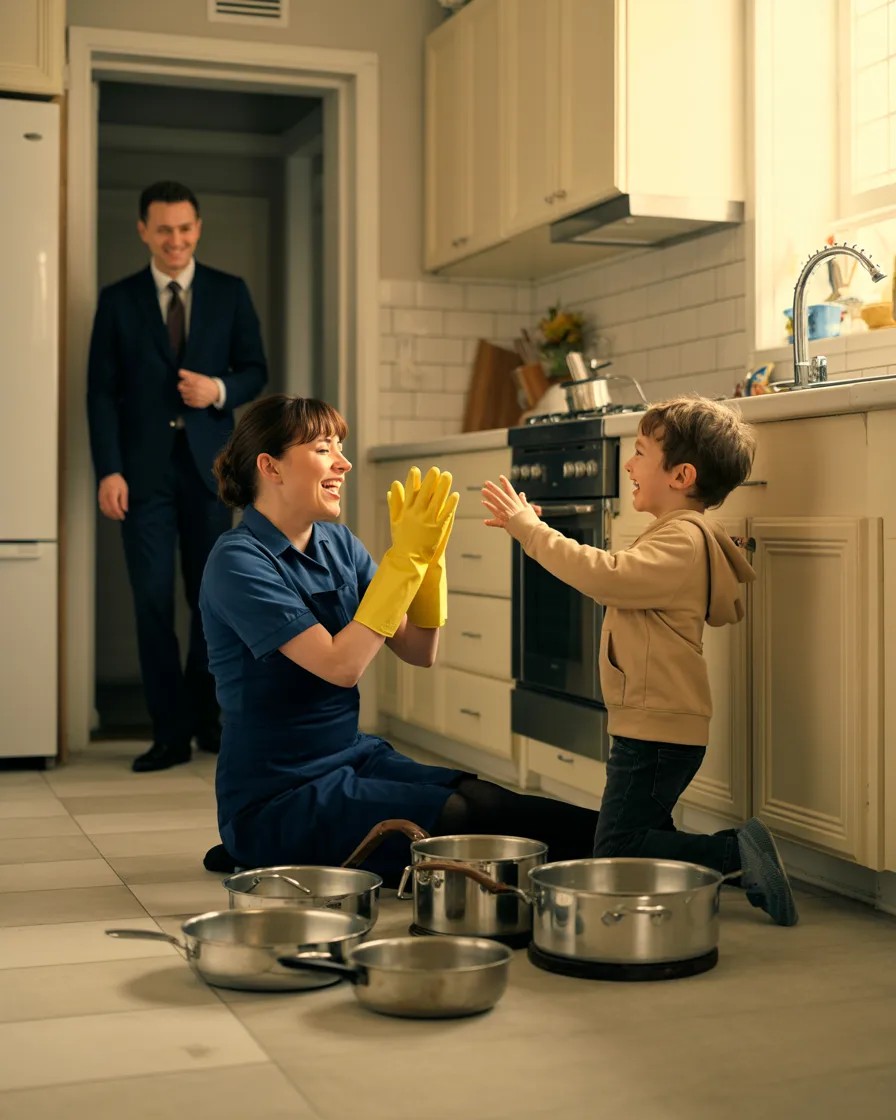
In Leo’s hands were two wooden spoons. In front of him, stainless-steel pots had been turned upside down and arranged in a rough semicircle. Leo was smiling.
Not a weak smile. Not the polite, thin little expression he sometimes made when adults tried too hard to cheer him up. This was wide and unguarded, revealing tiny baby teeth.
His brown eyes sparkled with a brightness Daniel had not seen in months. Then Leo struck the spoons against the pots. The sound came through the phone speaker in uneven bursts: loud, clumsy, chaotic, metallic, and overflowing with life.
Daniel stopped breathing. How long had it been since he had seen that smile? Six months.
Six months since the car flipped on the highway. Six months since Emma never opened her eyes again. Six months since Leo survived but could no longer stand.
Then Daniel saw her. Anna Morales, the housekeeper he had hired less than two weeks earlier, was lying flat on her stomach on the kitchen floor. Her blue uniform was wrinkled.
Yellow rubber gloves were still on her hands. She had propped her chin on her palms and positioned herself directly in front of Leo, at eye level. Every time Leo hit a pot with any kind of rhythm, Anna clapped as if she were watching the greatest performance in the world.
“Well done, Leo,” she said, laughing. “You’re the best drummer I’ve ever seen.”
Her voice came through the phone warm and bright, completely free of pity. Daniel tightened his grip on the phone until his knuckles turned white.
Around him, the meeting continued. Someone was talking about a new contract. Someone else asked for his opinion.
A man to his left cleared his throat. Daniel heard none of it. All he could see was his kitchen in the quiet suburbs north of Chicago, a place that had felt dead for half a year, and in the middle of it, a stranger was doing what he, Leo’s own father, had not been able to do.
She was making his son laugh. Something twisted inside Daniel’s chest. It was not anger.
It was not gratitude either. It was a tangled, aching thing with no clean name, the feeling of seeing a piece of life he had assumed was gone forever suddenly return through someone else’s hands. “Daniel?”
The CFO’s voice pulled him back.
Daniel lifted his eyes. Every face at the table was turned toward him. He had no idea what they had just asked.
He did not know how many minutes he had lost. He knew only one thing. He could not stay there for another second.
“I need to go home,” Daniel said. The words came out quiet, but final. He stood so abruptly that his chair rolled backward and struck the wall behind him.
He grabbed his coat and phone and walked out, ignoring the stunned looks around the table. No explanation. No apology.
Because in that moment, every contract, every projection, every piece of the empire he had spent his life building became meaningless. All he could think about was the kitchen at home, where his son was laughing, and where a painful truth was beginning to reveal itself. As the conference room door closed behind him, Daniel Carter strode toward the elevators.
But while his body moved forward, his mind was dragged violently backward to an evening he had never truly escaped. The accident had happened on a rainy night. Emma had been sitting in the passenger seat, turned halfway around to smile at Leo in the back.
She had said something about dinner, something about taking him to the park near Lake Michigan that weekend if the weather cleared. Daniel could no longer remember the exact words. He remembered only Emma’s laughter, soft and familiar, as if it were a permanent part of the world.
Then everything happened in seconds. Blinding headlights from the oncoming lane. The scream of brakes.
The steering wheel slipping under Daniel’s hands on the wet road. The car spinning sideways. Metal slamming into metal.
Glass exploding everywhere. The most terrifying sound had not been the crash itself. It had been the silence after.
Daniel regained consciousness in the ambulance with his head pounding so hard he thought his skull might split open. He tried to turn toward the passenger seat. He called Emma’s name.
There was no answer. Her face was still. Her eyes were closed as if she were asleep, only too still.
Leo was screaming somewhere behind him, and that cry had followed Daniel into every sleepless night since. Emma died before they reached the hospital. Leo survived.
But his spinal cord had been severely damaged. The doctor spoke calmly, professionally, with the practiced steadiness of a man who had delivered terrible news too many times. “The chances of him walking again are very low.”
Daniel nodded.
He did not cry. He did not react. It was as if his mind had shut itself down to keep him alive.
The days that followed passed in a haze of white flowers, dark coats, hollow condolences, hospital corridors, legal forms, and awkward embraces from people who did not know what to do with grief that large. At Emma’s funeral, Daniel stood beside her casket like a breathing corpse while people told him what a wonderful woman she had been, what a devoted mother she was, how much she had loved her family. As if he did not already know.
As if knowing it did not make the loss worse. The first night back home, Daniel stood for a long time outside Leo’s room. His son lay in the small hospital bed that had been installed near the window, his tiny legs motionless beneath a blanket, his face pale from surgery and pain medication.
A night-light shaped like a moon glowed on the dresser. A stuffed bear sat beside him, one Emma had bought at a little shop in Evanston because she said Leo needed a companion with a brave face. Daniel looked at his son and felt as though someone had closed a fist around his heart.
Every time he looked at Leo, he saw the car flipping. He saw blood. He saw Emma.
He saw himself, one wet road, one terrible second, and the price that had followed them home forever. From that day on, Daniel began to run. Not physically.
He still lived in the house. He still paid every bill. He still hired doctors, therapists, nurses, and specialists.
He still made certain Leo had the best adaptive equipment money could buy. He ordered custom chairs, specialized beds, pediatric consultations, private physical therapy, and anything else anyone recommended. But emotionally, Daniel disappeared.
He buried himself in work. He accepted more projects. He extended his hours.
He left the house before Leo woke up and returned after his son had already been put to bed. He told himself he was doing it for Leo. For treatment.
For stability. For the best future a child in his son’s condition could possibly have. But the truth, the one he never said aloud, was simpler and uglier.
Daniel could not bear his son’s gaze. In those wide brown eyes, he saw questions he could not answer. Why didn’t Mom come back?
Why can’t I stand anymore? And worst of all, why does Dad look at me like I am a wound? Daniel hired nanny after nanny.
Some were too full of pity, speaking to Leo in soft voices heavy with sorrow until the boy looked away. Others were too cold, caring for him like a list of tasks to be completed before the end of a shift. No one made Leo laugh.
No one made the house feel alive. And Daniel, instead of staying long enough to learn how to face the pain, chose to control everything from a distance. That was when he installed the cameras.
At first, it seemed like a practical decision. A safety measure. A way for him to be at ease while away from home.
He contacted a high-end security company that served executives, celebrities, and politicians, and he requested a system no one would detect. Tiny cameras were placed inside wall clocks, electrical outlets, ceiling corners, and picture frames in the hallway. They ran twenty-four hours a day.
They missed nothing. Daniel told himself he had done it to protect Leo. To make sure no one mistreated his son.
To guarantee that his child would never be helpless around the wrong person. But deep down, he knew the truth. The cameras were another way of avoiding presence.
He wanted to see everything without having to participate. In the evenings, after coming home from the office, Daniel often did not go straight into Leo’s room. Instead, he sat alone in his study while the desk lamp cast a hard circle of light over his exhausted face, and he opened the camera app on his tablet.
He replayed the entire day. He watched Leo eat. He watched Leo sit quietly by the window.
He watched Leo cry and then quiet himself. He watched adults pass by without noticing the look in the boy’s eyes. Eyes searching for something.
Daniel watched, but he did not enter the room. The cameras gave him the illusion of control, but they also built an invisible wall between him and his son. He could turn off the screen whenever the feeling became too heavy.
He did not have to face Leo directly. He did not have to hear his son call for him. He did not have to touch the pain that had not healed.
Then Anna Morales came into the house. She arrived on a Monday morning dressed simply, with her dark hair tied back and her voice low but clear. Daniel barely paid attention during the introduction.
To him, she was only another name on a list of people who came and went. But the cameras noticed everything. From the first few days, Daniel saw something different.
Anna did not rush through her work. She did not fill the silence with loud music or chatter meant for herself. She talked to Leo even when the boy answered only with broken words or small sounds.
She waited for his reactions as if time itself did not matter. She folded laundry near him instead of in another room. She cleaned slowly when he seemed unsettled.
She spoke to him like a child, not like a tragedy. Daniel watched through the screen and felt uneasy. Not because Anna was doing something wrong.
Because she was doing something right in a way he had never dared to do. The elevator doors opened. Daniel stepped inside, his heart pounding.
The doors slid shut with a dry ding that echoed in the cramped space. He stood alone with his back pressed against the cold metal wall, still gripping his phone. The camera feed was still playing.
Leo kept striking the wooden spoons against the stainless-steel pots, each hit clumsy but bursting with excitement. Anna clapped along, her laughter blending with his son’s, creating a sound Daniel had not heard in that house for six months. He rewound the video.
Then he rewound it again. A third time. A fourth.
Each time, he noticed another small detail he had missed before. The way Anna leaned closer so Leo would not have to strain his neck. The way she waited for him to look up before speaking.
The way she never seemed rushed, as if nothing in the world mattered more than that one ridiculous kitchen concert. The elevator descended with unbearable slowness. Twenty-three floors.
Daniel felt every passing second like a delay he could not survive. He had never been this impatient, not during billion-dollar deals, not while waiting for decisions that could change the course of his company. This was different.
This time he needed to get home. When the elevator opened in the parking garage, Daniel rushed out. He got into his car, started the engine, and pulled out into the afternoon traffic.
Chicago at rush hour was a wall of brake lights and horns. Snowmelt darkened the edges of the roads. Drivers leaned on their steering wheels.
A delivery truck blocked one lane near the bridge. Daniel drove almost on instinct, his phone resting in the console, the paused image of Leo’s smile glowing on the screen. At every red light, Daniel looked down at it.
One question kept looping through his mind, relentless and inescapable. How could a woman he barely knew do what he, Leo’s father, had been powerless to do for six long months? By the time he turned onto the quiet road leading into his suburb, familiar houses came into view behind bare maple trees.
American flags hung stiffly from porch brackets. Basketball hoops stood at the end of driveways. A neighbor’s golden retriever barked somewhere behind a fence.
Daniel drove through it all as if through a dream. He parked in the driveway and sat for one second with both hands on the steering wheel. Then he got out.
Daniel Carter opened the side door slowly, almost without a sound. The moment the door closed behind him, the noise reached him. Metal striking metal.
Chaotic. Uneven. Alive.
Leo’s laughter followed. Daniel froze in the narrow hallway leading to the kitchen. His heart pounded so hard he felt the beat in his throat.
Six months. It had been six months since that sound had filled this house. He did not move forward right away.
He stood there with his back near the wall, drawing in a deep breath as if bracing himself for something overwhelming. Then he took a few more steps, just enough to see the kitchen. Everything was exactly as it had been on the video.
Leo sat on the cold tile floor with his small legs stretched out, motionless. In front of him, the stainless-steel pots were arranged upside down in a semicircle. In his hands, he held the wooden spoons, lifting them and bringing them down with pure excitement.
Anna Morales lay on her stomach in front of him, her uniform wrinkled, her tied hair slightly loose now, her yellow gloves still on. Propped up on her elbows, she faced Leo with a smile so bright Daniel almost had to look away. “That’s it, Leo,” she said.
“Stronger this time.”
Leo raised both spoons and struck two pots at once. Anna gasped theatrically, then clapped. “Now that is a finale.”
Leo laughed so hard his shoulders shook.
Daniel’s throat tightened. In the corner, Leo’s black wheelchair rested against the wooden cabinet, silent and empty. The sight hit Daniel with unexpected force.
It reminded him of everything his son had lost and everything Daniel had failed to make up for. The wooden floor creaked softly under his shoe. Anna turned instinctively.
The moment their eyes met, the smile vanished from her face. She scrambled to her feet, pulling off her rubber gloves so quickly she nearly tripped over one of the pots. “Mr.
Carter,” she said, breathless. “You’re home early.”
Leo stopped too. The wooden spoons slipped from his hands and rolled across the floor.
He looked up at Daniel with large brown eyes, and there it was again. That familiar confusion Daniel had seen too often in recent months. The look of a child who did not know whether the man in front of him would stay or disappear again.
Anna bent down quickly, gathering the pots. “I’ve already cleaned the house,” she said hurriedly. “You can check any room.
I finished the bathrooms, the laundry, the floors. I just stopped for a moment because Leo was crying so much. I was going to play with him for a few minutes, then feed him.”
Daniel watched the scene, his chest twisting painfully.
He was too familiar with adults rushing to clear joy away from Leo, as if his happiness were a mistake that needed to be hidden before someone important saw it. “Put those pots down,” Daniel said. His voice came out lower and harder than he intended.
Anna froze with two pots in her hands. Her whole body stiffened. Slowly, she turned to look at him, eyes wide with worry.
In that instant, Daniel understood what she thought. She thought she was about to be fired. “Please, Mr.
Carter,” Anna said, her voice trembling. “I need this job. I swear I wasn’t being lazy.
The house really is clean. I wiped every room, cleaned the bathrooms, folded the laundry, and removed the stain on the sofa like you asked. I only stopped because Leo was so sad.
I couldn’t stand seeing him like that.”
Daniel crossed his arms and leaned against the kitchen doorway. He looked at Anna for a long moment, then shifted his gaze to Leo. The boy had lowered his head.
His small hands were clasped together. His shoulders were slightly hunched. The smile from moments earlier had vanished completely, as if it had never existed.
Daniel’s heart tightened. “Do you know why I’m asking?” Daniel said slowly. “You were hired to clean the house, not to lie on the floor and play with my son.”
Anna blinked, confusion written across her face.
“I was just playing with him, sir.”
“Why?” Daniel asked. His voice dropped. “Why did you lie on that cold floor and stop doing your job?”
Anna was silent for a second.
Then she placed the pots down, straightened her back, and looked directly at him. The fear in her eyes slowly changed into something calmer. Something deeply sincere.
“Because Leo was sitting on the floor,” she said. “So I sat on the floor, too.”
Daniel went still. Anna continued, her voice steady, as if she were stating the most obvious truth in the world.
“Children don’t need adults standing above them, looking down. They need someone at eye level. They need to feel that the adult is with them, not just watching.”
Something sharp pierced Daniel’s chest.
Anna went on. “If I stood there and looked down, I wouldn’t really be playing with Leo. I’d just be another adult passing through his life.”
The kitchen fell silent.
Daniel looked at Anna. Then he looked at Leo. And for the first time in six months, he realized a truth so painful it stole his breath.
He had never once sat down on the floor with his son. Not once. The silence after Anna’s words grew heavy enough to change the air in the room.
Daniel remained leaning against the doorway, arms crossed over his chest, but the posture no longer carried its usual authority. It looked more like a defense, thin and brittle, as if he were trying to keep himself upright after something deep inside him had been struck. “You say it like it’s obvious,” he said, his voice low and dry.
“But you weren’t hired to do that.”
Anna took a breath. She did not lower her head in apology. She did not list her completed chores again.
“Maybe it’s not written in the contract,” she said slowly. “But I believe there are things that don’t need to be requested in order to be done.”
Daniel frowned. “Such as?”
“Such as not leaving a child sitting alone for too long,” she replied.
“Such as not pretending to be busy when you see a child who needs to be seen.”
Daniel felt his throat go dry. Anna looked at him again, her gaze neither defiant nor cruel. Just honest.
“When I first came here,” she continued, “Leo was sitting in his wheelchair, staring out the window for a long time. He wasn’t crying. He wasn’t asking for anything.
But I could see it clearly. He was waiting for someone.”
Daniel clenched his jaw. “I tried talking to him,” Anna said.
“At first, he only made a few small sounds. But I kept talking anyway, because children can feel when an adult is truly there.”
She paused, and her voice softened. “My grandmother used to do that with me.
Whenever I was sad or scared, she never stood above me and tried to comfort me from up there. She always sat down, even when the floor was cold, even when her dress got dirty.”
A faint smile touched Anna’s face. “She used to say that if you want a child to feel that they matter, the first thing an adult must do is lower themselves.
Not to be smaller. To be closer.”
Those words fell straight into a place Daniel had been trying to bury for half a year. He thought of all the times he had watched Leo from a distance.
From the doorway. From the hallway. From a phone screen.
Always standing. Always looking down. Never once sitting beside him.
“Don’t you think you crossed a line?” Daniel asked, his voice lower. “Leo is my son.”
“I know,” Anna answered immediately. “And I have never forgotten that.”
She took one small step forward, keeping a respectful distance.
“Precisely because Leo is your son,” she said, “I couldn’t pretend not to see him.”
Daniel let out a short, hollow laugh without amusement. “You make it sound simple.”
“No,” Anna said. “I don’t think it’s simple.
I don’t live your life. I didn’t lose your wife. I wasn’t in that accident.”
Daniel’s fists tightened.
“But I see Leo every day,” Anna continued. “And I see a child who still has so much to give if someone is willing to stay long enough.”
The room went quiet again. Leo shifted slightly and lifted his gaze toward Daniel, cautious and uncertain.
Anna moved slowly, lifting Leo with practiced care and settling him into the wheelchair near the cabinet. Her movements were gentle, but not fragile. She treated Leo as a child who needed help, not as a broken object.
“Leo wakes up every morning and looks toward the door,” Anna said. “He doesn’t cry right away. He waits.”
Daniel felt his heart begin to pound harder.
“He waits until he’s sure you’ve already left,” she continued. “Only then does he cry.”
“That’s enough,” Daniel cut in sharply. “You don’t have the right.”
“The right to what?” Anna asked, and this time her voice trembled.
“The right to see a child who is hurting?”
Daniel pushed himself away from the doorway. “You think I don’t see it?” he said. “You think I don’t know my son is suffering?”
Anna did not step back.
“I think you see it,” she replied. “But you turn away.”
The words landed like a direct blow. Daniel clenched his fists.
“You weren’t in that car,” he said. “You didn’t hear the metal being crushed. You didn’t see my wife—”
He stopped.
His voice broke. Anna was silent. “You don’t know what it’s like to see that moment every time you look at your son,” Daniel continued, his voice shaking despite his effort to control it.
“You don’t know how hard I fight just to get out of bed every morning.”
Anna stepped closer slowly. This time the distance between them did not feel confrontational. It felt shared.
“I believe you,” she said. “And I’m not saying you’re a bad father.”
Daniel let out a bitter laugh. “It sounds like it.”
“I’m saying you’re a father in pain,” Anna said.
“And because the pain is so deep, you’ve forgotten that Leo is in pain, too.”
The words stole the air from Daniel’s lungs. “Leo wakes up in the middle of the night,” Anna continued. “He screams, not from physical pain, but from nightmares.”
Daniel squeezed his eyes shut.
“He calls for his mother,” she said. “Then he calls for you.”
His throat tightened until no sound could escape. “And no one comes,” Anna said softly.
“Not because you don’t love him. Because you’re trying to survive.”
A single tear fell to the kitchen floor. Daniel did not know whose it was.
“Leo doesn’t need a perfect father,” Anna said, her voice gentler now. “He just needs you to be there.”
The kitchen fell into a silence that hurt. Daniel looked toward his son.
Leo was looking back at him, eyes wide, holding something terribly fragile. Hope tangled with fear. Daniel turned his face away, drawing in a breath as if his chest might shatter without it.
Anna’s words kept echoing inside his mind. Every sentence. Every syllable.
Sharp and unforgiving. He knew she was right. That was exactly what he could not bear.
“Everything you just said,” Daniel spoke suddenly, “I already know.”
Anna looked up, surprise flickering across her face. “The nightmares,” Daniel continued. “The mornings Leo cries.
The times he sits alone staring at the door.”
He paused. His hand clenched so tightly it trembled. “I’ve seen it all.”
Anna frowned.
“You’ve seen it? How?”
Daniel turned to face her fully. There was no turning back now.
“I installed cameras in the house,” he said. “Everywhere.”
The air in the kitchen seemed to freeze. “Cameras?” Anna repeated.
“Hidden,” Daniel said, each word catching in his throat. “In clocks, outlets, picture frames. They record twenty-four hours a day.”
Anna took a step back.
“You were watching me?”
Daniel spoke quickly. “Not because of you. At first, it was because of the others.
I needed to be sure Leo was safe. I couldn’t trust anyone.”
Anna cut in, her voice suddenly sharp. “You looked at me like a threat,” she said.
“Like someone who might hurt your son.”
Daniel opened his mouth, but no words came. “You watched me work,” Anna continued. “You watched me talk to Leo.
You watched me stay late. You watched me play with him.”
Her eyes reddened. “And you never told me.
You never gave me the right to know I was being watched.”
A sharp chill ran down Daniel’s spine. “I’m sorry,” he said quietly. “I know it was wrong.
But I needed—”
“Control,” Anna said bluntly. “You needed control. Not because of me.
Because of your fear.”
Daniel lowered his head. Anna looked at him for a long moment. When she spoke again, her voice trembled but remained clear.
“So, in all those recordings, did you ever see me do anything wrong?”
Daniel was silent. “Did you see me yell at Leo?” she pressed. “Did you see me leave him crying?
Did you see me hurt him?”
Each question cut like a blade. “Or did you only see me care for him with everything I had?”
Daniel closed his eyes. He had seen it all.
He had seen Anna sit beside Leo for hours, talking even when the boy answered only with small sounds. He had seen her hold Leo’s hand when he was afraid. He had seen her hum softly while folding blankets, unaware that anyone was listening.
He had seen her wipe tears from Leo’s face with the corner of her sleeve. He had seen her celebrate tiny victories no one else had noticed. And that was what made him angry.
Not because Anna had done anything wrong. Because she had done what he, with all the authority and love of a father, had not had the courage to do. “I saw you doing things outside your job description,” Daniel said, his voice turning cold as he tried to shield himself.
“Playing with Leo when you should have been cleaning. Singing to my son when there was still work to do.”
Anna stared at him. Then her expression changed.
Something in her face closed. “Then fire me,” she said. She bent down and grabbed the bag resting on a chair.
“If loving a child is crossing a line,” Anna said, “then I’m not sorry.”
Daniel felt his heart drop. Anna turned away. She did not look back.
She did not say another word. Her movements were swift and decisive, as if she feared that if she hesitated for even one second, she would not be strong enough to leave. Daniel Carter stood frozen.
His body failed to react to what was unfolding in front of him. Everything slowed, stretching into something painfully prolonged. He saw Anna’s back.
He saw the tension in her shoulders. He saw Leo’s face change as he realized she might go. And Daniel understood with terrifying clarity that the door about to close was not only the side door of his house.
It was the final door leading away from the fragile little hope Leo had only just begun to touch. “Don’t.”
The word slipped out so weakly that Daniel barely recognized it as his own voice. Anna stopped for one second, but she did not turn around.
Daniel felt his heart lose its rhythm. His breathing turned shallow and rapid. A raw panic, the kind he had believed existed only in the moment of the accident, rose up and swallowed him.
“Please don’t go.”
This time his voice broke completely. Anna turned back. There was no anger left on her face, but there was not much gentleness either.
Only exhaustion. Disappointment. “What do you still want me to stay for?” she asked.
“To keep being watched like a suspect?”
Daniel shook his head. “No,” he said, his voice trembling. “I was wrong.
I know I was wrong.”
Anna remained silent. Daniel opened his mouth, then closed it again. For years, he had been used to speaking with certainty.
He built strategies, made decisions, controlled rooms, calmed investors, and solved problems before others finished naming them. But now, there was no strategy that could save him. “I don’t know what to do,” he admitted.
“I truly don’t know.”
Those words seemed to break open something deep inside him. “I don’t know how to be a father anymore,” Daniel continued. “I don’t know how to be a husband when Emma is gone.
I don’t know how to live in this house without seeing her everywhere.”
Anna’s grip tightened on the strap of her bag. “Every time I look at Leo,” Daniel said, tears beginning to spill over, “I see the accident. I see the car.
I see Emma. I hear my son crying.”
He raised both hands to his face, trembling. “I’m afraid,” he said, barely above a whisper.
“I’m afraid that if I get close to my son, if I love him the way I used to, then I’ll lose him too.”
Anna held her breath. “I can’t survive another loss,” Daniel said. “I’ve already lost my wife.
I can’t lose Leo.”
Tears slipped through his fingers and fell to the floor. “I know the cameras were wrong,” he said. “I know I hurt you.
But I didn’t do it because I doubted you.”
He lifted his head and looked at Anna through red, swollen eyes. “I did it because I don’t trust myself.”
The kitchen sank into silence. Leo made a small sound.
He did not understand every word, but he felt the tension. His tiny hands clenched the fabric of his onesie. His eyes remained fixed on Daniel.
Anna followed Leo’s gaze, and something in her face changed. The hardness slowly dissolved, replaced by a tenderness she did not try to hide. “You’re not the only one who’s afraid,” she said softly.
“Leo is too.”
Daniel closed his eyes. “But keeping your distance won’t protect you from pain,” Anna continued. “It will only make you miss everything that’s still here.”
The bag slipped from her hand.
It landed on the floor with a heavy sound, but it no longer sounded like an ending. Anna stepped toward Daniel and stopped in front of him, leaving just enough space between them. “You need help,” she said.
“Real help. From someone trained to give it.”
Daniel shook his head instinctively. “I don’t—”
“You do,” she interrupted, gentle but firm.
“Because if you don’t, this pain will consume you. And Leo too.”
Daniel did not argue anymore. He stood there, a man who controlled an empire, completely exposed before a truth no money could soften.
And for the first time in six months, Daniel Carter allowed himself to do the one thing he had avoided at all costs. He cried. “What if I can’t do it?” he asked, his voice trembling.
“What if I sit there and all I see is the accident? What if all I see is Emma?”
Anna looked at him steadily. “Then I’ll be here,” she said.
“Not to replace you. To help you get through that moment.”
Daniel took a deep breath. Before he could think any further, before fear could raise a hundred reasons to stop him, Anna gently took his hand and guided him toward the kitchen floor.
Daniel knelt down. Then he sat all the way down. For the first time in months, Daniel Carter was at eye level with his son.
Leo’s eyes widened. He looked at his father, then at Anna, as if he could not believe what he was seeing. Anna picked up a wooden spoon and placed it in Daniel’s hand, closing his fingers around the handle.
“Just tap,” she said. “Don’t think.”
Daniel looked at the spoon in his hand. His fingers trembled.
He felt ridiculous, a grown man in an expensive suit sitting on his kitchen floor, about to strike a pot like a child. But then he lifted his hand. He tapped.
The metallic sound rang out, clear and full, echoing through the kitchen. Leo flinched slightly. Then the boy smiled.
A small, tentative smile. So real it hurt. “Do it again,” Leo said, his young voice soft and uncertain.
“Dad.”
The word exploded inside Daniel’s chest. Dad. Tears flooded his eyes again, but this time he did not turn away.
He struck the pot again. Leo clapped, laughing through a sound that was half surprise and half joy. Daniel tapped again.
Leo answered with his own spoon. Anna sat nearby with her hands folded in her lap, tears shining in her eyes as the father and son created the worst music ever played in that house and somehow the most beautiful. The rhythm was uneven.
The sounds were messy. Nothing about it was graceful. But for Daniel Carter, it was the first note of a life beginning again.
The days that followed did not become easy. There was no miracle overnight. Daniel did not wake the next morning as a perfect father.
Grief did not vanish because he had cried on a kitchen floor. Trauma did not politely step aside because he had finally admitted it was there. The memories still came.
Some mornings, he woke before dawn with the crash roaring in his ears. Sometimes, when Leo dropped a spoon or a glass struck the counter too sharply, Daniel’s body went cold before his mind could remind him that he was home, safe, standing in a kitchen instead of trapped in a ruined car. But one thing had changed.
Daniel was no longer running. The next morning, he did not leave before Leo woke up. He sat at the kitchen table while the early light spread across the snow-dusted yard.
He wore a gray sweater instead of a suit jacket. His coffee went cold in front of him because he was too focused on watching Leo eat toast cut into small triangles. Leo glanced up between bites as if needing to make sure his father was real.
Daniel forced himself not to look away. “Good?” he asked. Leo nodded, crumbs on his lips.
“Good,” Daniel said. It was a small conversation. Almost nothing.
But for them, it was the start of a new language. Anna arrived early, as she always did. This time, Daniel was there when she stepped into the kitchen.
There was an awkward moment. Both of them remembered the cameras. Both of them remembered the accusation, the confession, the tears.
Daniel stood. “The cameras are being removed today,” he said. Anna looked at him carefully.
“All of them?”
“All of them,” Daniel said. “I’ll keep the exterior security system. Front door, driveway, garage.
Nothing inside the house unless you and I both agree it’s necessary for Leo’s medical safety. And even then, it will be visible.”
Anna studied his face, searching for the old need for control. “Thank you,” she said.
Daniel nodded. “No,” he replied. “I’m sorry.
That’s the word I should have said first.”
Anna did not immediately forgive him. Daniel could see that. He knew better than to expect trust to return because he had finally spoken correctly.
But she stayed. And that was more than he deserved. Later that day, the security company came back to the house.
Men in work jackets removed tiny lenses from corners, outlets, clocks, and picture frames. Daniel stood in the hallway holding Leo in his arms while one camera after another disappeared. He felt ashamed as he watched.
Not because he had wanted to protect his son. Because he had mistaken surveillance for love. Leo watched the men work with solemn eyes.
“Are they fixing the house?” he asked. Daniel looked down at him. “In a way,” he said.
“Yes.”
That evening, Daniel sat on the floor beside Leo again. This time, no camera watched them. Only Anna passed through once with folded towels, and when she saw them building a crooked tower out of wooden blocks, she smiled without interrupting.
Daniel learned slowly. He learned how to sit on the floor even when his back hurt. He learned how to play games that did not require strong legs: puzzles, memory cards, rolling a ball, making up stories with toy animals and plastic dinosaurs.
He learned that Leo loved ridiculous voices. He learned that if he pretended the stuffed bear had a serious job as mayor of the couch, Leo would laugh until he hiccupped. Each laugh stitched something back together inside him.
Daniel changed at work too. At first, people thought it was temporary. He delegated meetings.
He declined unnecessary dinners. He stopped allowing his calendar to consume every hour between dawn and darkness. His assistant, Marcy, stared at him the first time he said he would be leaving at four.
“Four?” she repeated. “Yes,” Daniel said, signing one last document. “You have a strategy call at five-thirty.”
“Move it.”
“With the Boston group?”
“Then they can learn patience.”
Marcy blinked.
Daniel put on his coat. “My son has physical therapy at five,” he said. Something softened in Marcy’s expression.
“I’ll move the call.”
For the first time in years, Daniel left the office while there was still light in the sky. Not because he had lost ambition. Because he had finally found something more important to come home to.
Leo noticed. Children notice the things adults think are too small to matter. At first, he still watched the door every morning.
He still grew quiet when Daniel picked up his briefcase. But Daniel began making promises he could keep. “I’ll be back before dinner.”
And then he came back before dinner.
“I’ll read tonight.”
And then he read, even when he was tired. “Saturday is ours.”
And when Saturday came, he did not answer work calls. Trust returned not through one grand gesture, but through repetition.
Day after day. Anna stayed in the house too, but her role changed. Daniel formally asked her to become Leo’s full-time caregiver, not because he wanted to hand his son to someone else, but because he understood now that help was not failure.
He offered her a higher salary, medical benefits, paid leave, and a written contract that respected her work and her dignity. But more importantly, he offered trust. No hidden cameras.
No silent suspicion. No watching from behind glass. Anna accepted after reading the contract twice.
“For Leo,” she said. Then she looked at Daniel. “And because you need someone around who will tell you the truth when you start hiding again.”
Daniel almost smiled.
“You say that like it’s part of the job description.”
“It is now,” Anna said. Therapy came harder. Daniel had resisted the idea for years, not because he believed it was useless, but because speaking honestly frightened him more than any boardroom ever had.
In business, he could choose what to reveal. In grief, everything inside him felt exposed. At his first session, he sat across from the therapist in a quiet office near Lincoln Park.
There was a framed photograph of trees on the wall, a box of tissues on the small table, and a chair that was too soft to feel professional. He clasped his hands tightly. The therapist asked where he wanted to begin.
Daniel almost said, “I don’t know.”
Instead, he said Emma’s name. His voice trembled on the second syllable. When he described the accident, he broke down so suddenly that he felt ashamed.
But the therapist did not ask him to be strong. She did not rush him. She did not tell him grief had stages, as if pain were a staircase he could climb neatly if he behaved.
She let him speak. Session by session, Daniel learned to name what had been living inside him. Guilt.
Fear. Avoidance. Love tangled so tightly with terror that he could no longer tell them apart.
He learned that being near Leo did not make the accident happen again. He learned that grief was not proof of failure. He learned that Emma’s memory did not live only in the crash.
It lived in Leo’s laugh, in the way he tilted his head when curious, in the little dimple near his mouth, in the songs she had sung while making pancakes on Sunday mornings. Slowly, Daniel began speaking of Emma at home. The first time he did, Leo went very still.
They were sitting in the living room with a picture book between them. Rain tapped softly against the windows. Anna was in the laundry room, close enough to hear but far enough to give them privacy.
Leo touched a picture of a mother bear hugging her cub. “Mommy liked bears,” he said. Daniel’s breath caught.
For months, he had avoided Emma’s name around Leo, believing silence would spare them both. Now he understood silence had only made her absence larger. “She did,” Daniel said carefully.
“She bought you the brave bear on your dresser.”
Leo looked up. “She said he had a brave face.”
Daniel smiled through the ache in his throat. “She did.
And she said you had one too.”
Leo’s lower lip trembled. “Do you miss her?”
The old Daniel would have stood, changed the subject, called someone, checked an email, done anything to escape that question. This Daniel stayed.
He lowered himself fully onto the rug, so they were face to face. “Every day,” he said. “I miss her every day.”
Leo began to cry.
Daniel opened his arms. For a second, Leo hesitated, as if unsure whether the invitation would remain. Then he leaned forward.
Daniel held his son while the rain moved down the windows in thin silver lines, and for the first time, they grieved together instead of separately. From then on, Emma returned to the house in gentler ways. Her photographs came out of drawers and back onto shelves.
Her favorite blue mug was placed in the kitchen cabinet again instead of hidden in a box. Daniel told Leo stories about how she danced badly in the grocery store when old songs came on, how she burned the first Thanksgiving turkey they hosted and then laughed so hard she cried, how she could never pass a bookstore without going inside. Leo listened as if collecting pieces of a treasure he had feared was gone.
Anna never intruded on those moments, but she protected them. She kept the house calm. She reminded Daniel when Leo needed rest.
She reminded Leo that sadness did not mean the day was ruined. Meanwhile, Leo began to change. He slept better.
The nightmares came less often. He talked more during therapy. He laughed more easily.
His physical therapist, a patient woman named Rachel, noticed the difference within weeks. “He’s more willing to try,” Rachel told Daniel after one session. “That matters.
Progress isn’t only muscle. It’s trust. It’s mood.
It’s whether he believes trying is worth the effort.”
Daniel looked through the glass at Leo, who was concentrating fiercely on moving a small foam block from one side of a tray to another. “And does he?” Daniel asked. Rachel smiled.
“More than he did before.”
Small progress became a form of celebration in the Carter house. The first time Leo transferred from his wheelchair to the therapy mat with less assistance, Daniel clapped so hard Leo laughed at him. The first time Leo sat upright longer than expected, Anna made pancakes for dinner because she said victories did not need to wait for morning.
The day Leo managed to move his toes, just slightly, Daniel sank to his knees beside the bed and cried into both hands. It was not a promise that Leo would walk again. It was not a miracle wrapped in certainty.
It was a movement so small that someone else might have missed it. But Daniel saw it. Anna saw it.
Leo saw them seeing it. And that was enough to fill the room with joy. Two months later, on a mild afternoon when the first signs of spring softened the edges of the Chicago suburbs, Daniel came home early and found Anna and Leo in the backyard.
The snow had melted from the lawn. The maple trees were bare but beginning to bud. Somewhere nearby, a lawn mower started for the first time that season.
A small American flag near the porch moved lightly in the wind. Leo sat in his wheelchair with a ball resting on his lap. Anna stood a few feet away.
“Ready?” she asked. Leo nodded with great seriousness. Anna tossed the ball gently.
Leo caught it against his chest and threw it back with both hands. The throw was crooked. Anna had to step sideways to catch it.
Leo laughed. Daniel stood at the back door watching them, his briefcase still in his hand. For a moment, the old ache rose in him.
Not as sharply as before, but enough to remind him that healing did not erase loss. Emma should have been there. She should have been sitting on the porch steps with a cup of coffee, cheering too loudly, telling Daniel not to stand in the doorway like a stranger.
The thought hurt. But it did not destroy him. Daniel slipped off his jacket, rolled up his sleeves, and stepped outside.
“Need another player?” he asked. Leo’s face lit up. “Dad!”
Anna tossed him the ball.
Daniel caught it against his chest. “All right,” he said. “Nobody laugh if I’m terrible.”
Leo immediately laughed.
“Too late,” Anna said. They played until the sun sank behind the trees and the yard filled with warm gold light. That night, after Leo had fallen asleep, Daniel sat in the living room across from Anna.
A cup of hot tea rested between them on the coffee table. The house was quiet, but not empty. That difference still amazed him.
“I’ve started therapy,” Daniel said. Anna nodded. “I know.”
“And I think I’m slowly learning how to live again.”
Her expression softened.
“I can see that.”
Daniel looked toward the hallway that led to Leo’s room. “I almost lost him,” he said. “Not because of the accident.
Because of my own fear.”
Anna stayed silent, letting him continue. “You changed our lives,” Daniel said. “Mine and my son’s.”
Anna smiled, but her eyes grew bright.
“I didn’t do anything extraordinary,” she said. “I just stayed.”
Daniel understood then that staying was not a small thing. Staying was what Emma had done in every ordinary moment of their marriage.
Staying was what Leo had needed while Daniel hid behind work, money, and screens. Staying was what Anna had offered when it would have been easier to walk away. And now staying was the thing Daniel had to learn, one day at a time.
The next morning, Daniel did something he had avoided since the accident. He opened the door to Emma’s closet. For months, the room had remained untouched.
Her coats still hung in neat rows. A pair of running shoes sat beneath the bench. A soft scarf she had worn during Chicago winters lay folded on the shelf, still carrying the faintest trace of her perfume.
Daniel stood there for a long time. Then he called Leo. Anna wheeled him to the doorway but did not enter.
“Do you want us to leave you alone?” she asked. Daniel shook his head. “No,” he said.
“I think we need to do this together.”
Leo looked into the closet with wide eyes. “Mommy’s things?”
“Yes,” Daniel said. He lifted the scarf from the shelf and knelt in front of Leo.
“She wore this the day we took you to see the Christmas lights downtown. You were so small you slept through most of it, but she insisted you loved it anyway.”
Leo touched the scarf carefully. “Can I keep it?”
Daniel swallowed.
“Of course.”
They did not empty the closet that day. They only opened it. That was enough.
Over the following weeks, they chose what to keep, what to donate, and what to place in a memory chest for Leo. Daniel wrote notes for the items whose stories Leo might someday forget. Anna helped label boxes but never rushed them.
One Saturday, they drove together to a donation center on the North Side. Daniel carried Emma’s winter coats in carefully folded bags. Leo held the scarf in his lap.
Anna walked beside them. When the volunteer thanked Daniel, he nodded but could not speak. Outside, Leo reached for his hand.
“Mommy would like helping people,” he said. Daniel looked down at him. “Yes,” he said.
“She would.”
Spring deepened. The house changed in ways that did not show up on any blueprint. The kitchen became noisy again.
The living room gathered toys, books, therapy bands, and blankets. The study door stayed open more often than closed. Daniel’s suits still hung in his closet, his company still needed him, and life remained complicated.
But the center of the house shifted. It was no longer grief. It was Leo.
Not Leo as a responsibility. Not Leo as a reminder of loss. Leo as a boy.
A boy who liked pancakes for dinner, hated green peas, laughed at terrible jokes, missed his mother, loved his father, and deserved to be met at eye level. One evening, Daniel found him in the kitchen with Anna, arranging pots again. For a moment, he stood in the doorway and watched.
The sight was almost identical to the one that had shaken him months earlier: pots in a semicircle, spoons in Leo’s hands, Anna sitting on the floor. But this time, Daniel did not watch from a hidden camera. He did not stand apart.
Leo noticed him and lifted one spoon. “Dad, you’re late.”
Daniel loosened his tie. “My apologies to the band.”
Anna handed him a wooden spoon.
“You’re on backup drums.”
Daniel sat on the floor without hesitation. The tile was cold. His suit pants wrinkled.
He did not care. They played badly. Loudly.
Joyfully. And when Leo laughed, Daniel did not feel only pain anymore. He felt Emma too.
Not the Emma from the wreckage. The Emma who had loved music in the kitchen. The Emma who had danced barefoot while cooking.
The Emma who had once told Daniel that children remember how a house feels more than how expensive it is. For the first time, that memory did not break him. It guided him.
Months later, on the anniversary of the accident, Daniel woke before sunrise. The old fear had returned during the night, sitting heavy in his chest. He went downstairs quietly and stood in the kitchen, looking at the place where everything had begun to change.
Anna found him there at seven, already dressed for work. “Hard day?” she asked. Daniel nodded.
“Yes.”
She did not offer a cheap comfort. She did not tell him it would be fine. She only said, “What do you want to do with it?”
Daniel looked toward the hallway.
“I want to take Leo to the lake. Emma loved the lake.”
So they went. The three of them drove to a quiet stretch near Lake Michigan where the wind moved cold over the water.
Daniel bundled Leo in a thick jacket and tucked Emma’s scarf around his neck. Anna stayed a few steps behind while father and son looked out at the gray-blue water. Daniel held a small envelope in his hand.
Inside was a letter he had written to Emma in therapy, then rewritten at home long after midnight. He had told her about the months he disappeared. He had told her about Leo’s laughter returning.
He had told her about Anna and the pots and the day he finally sat on the floor. Most of all, he had told her he was sorry. Not because grief was his fault.
Because running from love had hurt the child they made together. Leo looked up at him. “Is that for Mommy?”
“Yes,” Daniel said.
“Can I say something?”
Daniel knelt beside the wheelchair. “Always.”
Leo looked at the water for a long time. Then he whispered, “I miss you, Mommy.
Dad sits with me now.”
Daniel pressed one hand over his mouth. The wind moved over the lake. Anna turned away slightly, giving them privacy, but Daniel saw her wipe her eyes.
He folded the letter again and placed it back inside his coat pocket. He had thought he needed to let it go into the water, but standing there with Leo, he realized something different. Some things did not need to be thrown away in order to be released.
Some things needed to be carried differently. He would keep the letter. One day, when Leo was older, they would read it together.
That evening, they returned home. Daniel made dinner himself, badly but sincerely. The grilled cheese sandwiches were slightly burned.
The tomato soup came from a can. Leo declared it perfect. After dinner, Daniel carried his son to bed.
He tucked the blanket around him and placed the brave-faced bear under his arm. Leo looked sleepy, but he reached for Daniel’s sleeve. “Dad?”
“I’m here.”
“Will you stay until I sleep?”
There had been a time when that question would have filled Daniel with panic.
A time when the quiet room, the night-light, the stillness of Leo’s legs, and the memory of Emma would have driven him out into the hallway. Now Daniel sat down beside the bed. “Yes,” he said.
“I’ll stay.”
Leo’s eyes closed slowly. His breathing evened out. Daniel remained there long after his son had fallen asleep.
He did not check his phone. He did not open a camera app. He did not watch his child from a distance.
He sat in the room, close enough to hear the small, steady rhythm of Leo breathing, and understood something that all his wealth had never taught him. Protection was not the same as love. Control was not the same as courage.
Providing was not the same as being present. A house could be filled with the best medical equipment, the finest furniture, the most advanced security system, and still feel empty if the people inside it were afraid to reach for one another. And sometimes, the person who changed everything did not arrive with money, a title, or a miracle.
Sometimes she arrived in a blue uniform, with tired hands, a patient heart, and the wisdom to sit on the floor beside a hurting child. Daniel Carter had hidden cameras because he believed love meant never letting danger near his son. But what he saw through those cameras taught him something far more painful and far more necessary.
Love was not watching from a safe distance. Love was lowering yourself onto the cold floor. Love was staying when grief made the room hard to breathe in.
Love was admitting you were wrong before the door closed. Love was coming back, not once, but every day, until the people you hurt began to believe you might remain. Years later, Leo would not remember every therapy appointment or every difficult night.
He would not remember the hidden cameras. He would not remember the exact words Anna said in the kitchen. But he would remember the day his father sat down beside him.
He would remember the sound of a wooden spoon striking a pot. He would remember that after a long season of silence, the house began making music again. And Daniel would remember the lesson for the rest of his life.
A child does not always need a parent who knows how to fix everything. Sometimes a child only needs a parent brave enough to come close, sit down, and stay. THE END