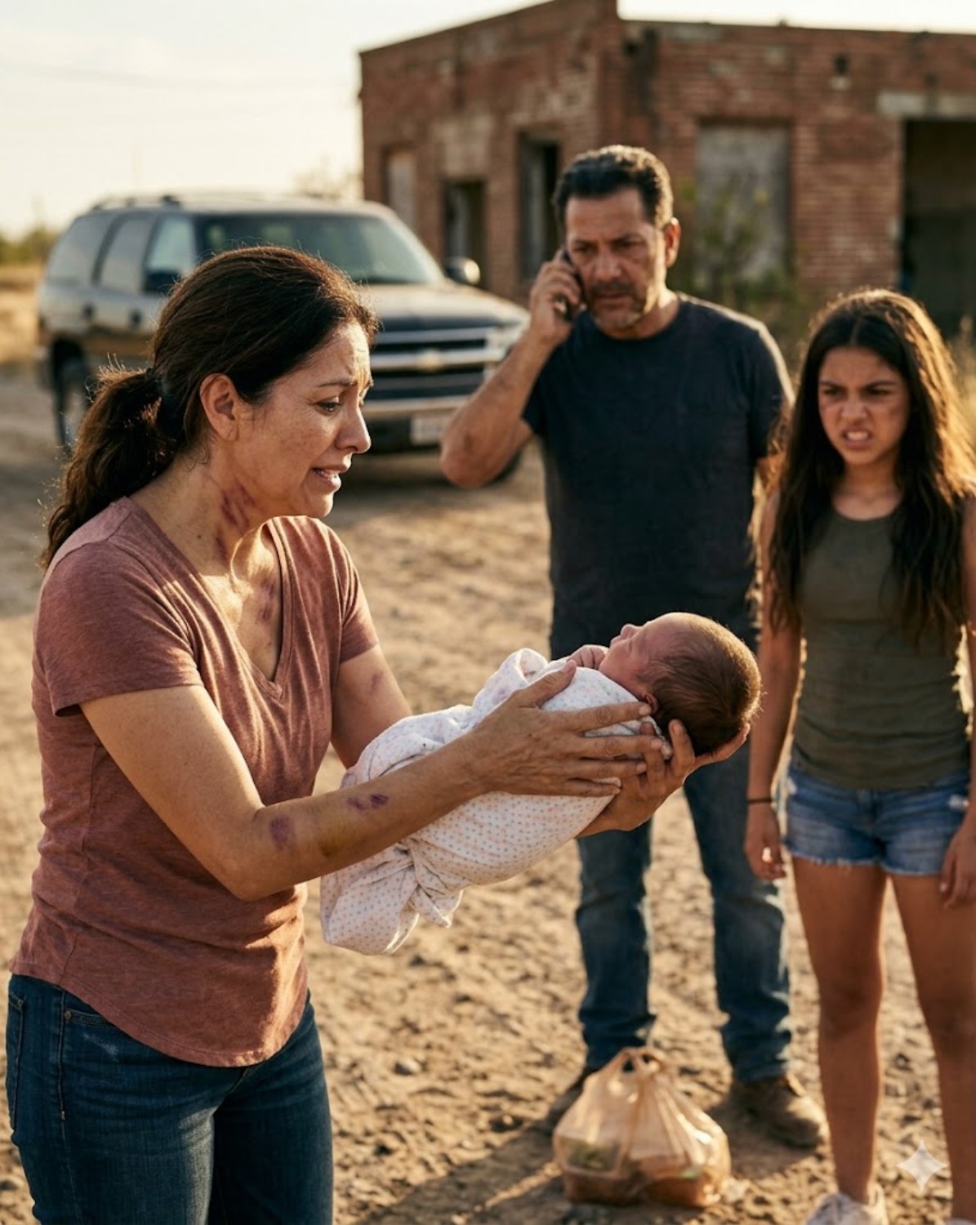
“Keep Isabela at home. I’ll take care of the rest.”
That was all Alejandro said.
Your father ended the call and finally started the SUV. Nobody spoke as the abandoned house disappeared behind you, its broken doorway shrinking in the rear window like a nightmare you had barely escaped.
You sat curled against Camila, shaking so hard your teeth clicked together.
Your mother kept whispering Mateo’s name, pressing her lips to his tiny forehead, praying under her breath because his skin was too hot and his cry was too weak.
When you reached your parents’ house, your father didn’t ask permission. He carried you inside like you were a child again, careful not to touch the bruises on your back. Your mother laid Mateo on the sofa and immediately called a doctor she trusted.
For the first time in weeks, someone brought you clean water.
Not insults.
Not threats.
Water.
The doctor arrived within twenty minutes. He examined Mateo first, then you. His face grew darker with every bruise, every swollen joint, every mark you tried to hide.
“This is not a fall,” he said quietly.
You looked away.
Your father answered for you.
“We know.”
The doctor photographed your injuries with your consent, wrote a medical report, and checked Mateo’s fever. Your baby was dehydrated, underfed, and dangerously weak, but still stable enough to avoid hospitalization if he was monitored closely overnight.
Your mother cried again when she heard that.
Camila did not cry anymore.
She sat beside you with her jaw clenched, holding your hand like she was afraid if she let go, you would disappear back into that street.
Then the front door opened.
Alejandro walked in.
Your brother had always been calm. Too calm sometimes. He was the kind of man who spoke little and noticed everything. But that night, when he saw your split lip, your swollen ankle, and Mateo wrapped in a thin blanket on the sofa, something in his face changed forever.
He didn’t shout.
He didn’t curse.
That was what made him terrifying.
He came to you slowly, knelt in front of your chair, and looked into your eyes.
“Tell me everything.”
You shook your head.
“Alejandro…”
“Everything, Isa.”
His voice broke on your name.
That broke you too.
You told him.
Not all at once. At first, the words came in pieces. Tomás taking your phone “so you wouldn’t bother people.” His mother, Graciela, throwing your postpartum medicine in the trash because “women gave birth in fields before and didn’t whine.” His sister laughing when Mateo cried from hunger.
You told them Tomás stopped giving you money after the baby was born.
You told them Graciela locked the pantry.
You told them she said formula was too expensive for “a weak baby who probably wouldn’t last anyway.”
Your mother made a sound like someone had struck her.
Your father stood by the window, hands clenched behind his back, staring into the night.
Alejandro listened without interrupting.
Then you told them the worst part.
Two days earlier, you had overheard Graciela telling Tomás that if you kept “acting unstable,” they should take Mateo from you and send you back to your parents empty-handed.
“She said I looked crazy,” you whispered. “She told him nobody would believe me because I had no phone, no money, and no proof.”
Alejandro stood.
“Good.”
You blinked.
“Good?”
He looked at you, and for the first time, you saw the fire under his calm.
“She thought you had no proof. That means she felt safe enough to make mistakes.”
He took out his phone and made three calls.
The first was to a lawyer.
The second was to a police commander he knew from work.
The third was to a woman named Laura, who ran a domestic violence response unit and had helped him on past cases.
Only then did you remember what your brother actually did for a living.
Alejandro was not a man who solved problems with fists.
He investigated corruption for a living.
And Tomás’ family had just become his case.
At nine that night, two police vehicles, a lawyer, and Laura arrived at your parents’ house. You gave a statement from the living room, wrapped in your mother’s robe, with Camila beside you and Mateo asleep in a clean blanket.
Every word felt like pulling glass from your throat.
But you kept speaking.
Because Mateo needed you alive.
Because the woman who had walked into that abandoned house was done protecting the people who had put her there.
At ten-thirty, Alejandro turned to your father.
“We’re going to get her documents.”
Your stomach dropped.
“No. Please. Don’t go there. They’ll say I abandoned Mateo. They’ll say I stole things. Graciela always twists everything.”
Alejandro looked at Laura.
Laura opened a folder.
“They already tried.”
The room went silent.
Your chest tightened.
“What?”
Laura placed a paper on the coffee table.
It was a complaint.
Filed that afternoon.
By Tomás.
He claimed you had “run away in an unstable emotional state” and taken the baby without permission. He claimed his family was worried you might harm yourself or the child.
You stared at the paper until the words blurred.
Even after everything, even after seeing how cruel they were, you had not imagined they would move that fast.
Your mother covered her mouth.
Camila stood so quickly the chair scraped backward.
“Those animals.”
Alejandro’s expression did not change.
“They filed too early,” he said.
Your father looked at him.
“What does that mean?”
“It means they filed while Isa was still in the abandoned house behind their property. If we prove they knew she was there, the complaint becomes evidence against them.”
Your pulse pounded.
“How do we prove that?”
Alejandro looked at you.
“Did anyone see you go there?”
You swallowed.
“The neighbors. A woman with a blue gate saw me yesterday. And Graciela’s nephew came by once and laughed. He said, ‘Still alive in there?’”
Camila’s face went white with rage.
Alejandro nodded.
“Names?”
You gave what you could.
Then your brother asked one more question.
“Where is your phone?”
“Graciela has it.”
“Did she turn it off?”
“I don’t know.”
He typed something quickly, then looked at Laura.
“If the phone is still on their Wi-Fi or near their house, we can show they had control of her communication.”
Laura nodded.
“We’ll request it.”
Your father picked up his keys.
“I’m going.”
Alejandro stopped him.
“No. You’re too angry.”
Your father’s face hardened.
“She is my daughter.”
“And that’s exactly why you stay here,” Alejandro said. “If you go, they’ll provoke you. If you touch Tomás, he becomes the victim. We are not giving them that gift.”
Your father looked like he might argue.
Then he looked at you.
At Mateo.
And he sat down.
That was the first time that night you understood what your brother was doing.
He was not going to attack them.
He was going to let the truth do it.
At eleven-fifteen, Alejandro left with Laura, two officers, and the lawyer. Camila wanted to go, but he refused. Your sister cursed him under her breath, then sat beside you again and fed Mateo tiny drops of milk under the doctor’s instructions.
You waited.
Every minute felt like an hour.
Your mother cleaned your wounds with shaking hands. Your father stood near the door like a guard. You kept seeing Graciela’s face in your mind, her mouth twisted in disgust, her voice saying you were useless.
Then, at midnight, Camila’s phone rang.
It was Alejandro.
She put him on speaker.
“We’re outside their house.”
Your breath stopped.
In the background, you heard dogs barking and someone shouting.
Then Graciela’s voice cut through the phone.
“You have no right to come here at this hour!”
Alejandro’s voice was calm.
“We’re here with police to retrieve my sister’s identification, medical records, personal belongings, and the child’s documents.”
“Your sister abandoned her marital home,” Graciela snapped. “She is unstable. She belongs in a clinic.”
Laura spoke next.
“Mrs. Graciela, we have medical documentation showing physical injuries, dehydration, and evidence consistent with neglect and abuse.”
There was a pause.
Then Tomás’ voice.
“She did it to herself.”
Your entire body went cold.
Camila whispered, “I’m going to kill him.”
Your father said, “No.”
But his voice shook.
Alejandro said, “Then you won’t mind letting us collect her things.”
Graciela laughed.
“She has nothing here. Everything in this house belongs to my son.”
That was when Alejandro did the thing that changed everything.
He said, “Then you won’t mind if we check the room you locked her in.”
Silence.
Not confusion.
Fear.
You heard it through the phone.
Your mother looked at you.
“What room?”
You closed your eyes.
You had not told them that part yet.
The small storage room behind the kitchen.
The one with no window.
The one where Graciela made you sleep whenever Tomás came home drunk and didn’t want “crying in the bedroom.”
Your father’s hand slammed against the wall.
But he stayed silent.
On the phone, Graciela shouted, “That room is for cleaning supplies.”
Alejandro answered, “Then why does the neighbor have video of my sister being pushed into it while holding a newborn?”
Your eyes opened.
Video?
Camila grabbed your hand.
“What video?”
Alejandro continued, louder now.
“Mrs. Hernández across the street has a security camera facing your back entrance. She gave us footage from three nights ago.”
Graciela said nothing.
Tomás said something low, but you couldn’t hear it.
Then Laura spoke.
“Officers, secure the hallway.”
That was when everything began to collapse.
The police found your phone in Graciela’s bedroom drawer.
They found your ID, Mateo’s birth certificate, and your clinic discharge papers inside a plastic bag hidden behind cleaning products.
They found your postpartum vitamins in the trash.
They found the baby formula donated by your mother unopened in a cabinet, while Graciela had been telling you there was none.
They found messages on your phone that Graciela had sent pretending to be you.
Your mother gasped when Alejandro read one aloud later.
Mom, stop bothering me. I need space from everyone.
Another to Camila:
I’m fine. Don’t come looking.
Another to your father:
Tomás is taking care of us. Please respect my marriage.
You had never sent any of them.
For days, your family had believed you were avoiding them because Graciela had turned your phone into a prison guard.
Your mother fell to her knees in the living room.
Not dramatically.
Broken.
“I believed the messages,” she sobbed. “My God, I believed them.”
You reached for her, even though your body hurt.
“Mamá…”
She crawled to your chair and took your hands.
“Forgive me. Forgive me, my daughter. I should have gone sooner.”
Your father came beside her, eyes red.
“I should have broken down the door days ago.”
You cried then.
Not because they had failed you on purpose.
Because you had needed them so badly and been trained to think asking for help would only make things worse.
“You came,” you whispered. “You came today.”
Camila wrapped her arms around all of you as carefully as she could.
But the night was not over.
At one in the morning, Alejandro returned.
He did not come alone.
Behind him were two officers carrying bags of your belongings, a sealed evidence box, and your documents. Your brother’s shirt was dusty, his jaw tight, and his eyes darker than you had ever seen them.
“What happened?” your father asked.
Alejandro placed your ID on the table first.
Then Mateo’s birth certificate.
Then your phone.
Then he looked at you.
“Tomás and Graciela were taken in for questioning.”
You covered your mouth.
Camila whispered, “Good.”
Alejandro shook his head.
“That’s not the biggest part.”
He opened the evidence box and took out a folder.
“This was in Tomás’ room.”
Your stomach twisted.
“What is it?”
Alejandro laid the papers out on the table.
A custody petition.
Already prepared.
A medical note describing you as “emotionally unstable postpartum.”
A statement supposedly signed by you, saying you wanted to leave Mateo with Tomás’ family while you recovered.
Your signature was forged.
Your mother began crying again.
Your father’s face turned gray.
You stared at the papers, unable to understand how deeply they had planned to erase you.
“They were going to take him,” you whispered.
Alejandro nodded.
“Tomorrow morning.”
The room went dead silent.
You looked at Mateo sleeping in your mother’s arms.
Tomorrow morning.
If your family had arrived one day later, Graciela might have claimed you abandoned your baby. Tomás might have walked into court pretending to be the responsible father. You might have been painted as sick, poor, unstable, and dangerous.
And your son could have been taken from your arms.
Your breath came too fast.
Camila grabbed your shoulders.
“Isa. Breathe. He’s here. Mateo is here.”
You tried.
You couldn’t.
Alejandro knelt in front of you.
“They didn’t win.”
You looked at him through tears.
“They almost did.”
“But they didn’t.”
His voice was steady.
“And now we make sure they never get close to you again.”
By sunrise, emergency protection measures were already moving.
Laura helped file a domestic violence report. The medical report was attached. The neighbor’s video was preserved. Your phone was submitted as evidence. The false messages, forged custody statement, hidden documents, and prepared petition became part of the case.
Tomás’ family tried to call.
No one answered.
Then they came.
At eight in the morning, Graciela, Tomás, and his sister arrived at your parents’ gate with swollen faces and ruined pride. They had been released pending further proceedings, but their confidence was gone.
You watched from the upstairs window.
Graciela wore the same floral blouse she had worn when she threw your shoes into the street. Tomás stood beside her, avoiding the security camera now installed above your father’s gate. His sister looked nervous.
Your father went outside first.
Alejandro followed.
Camila wanted to go too, but your mother held her back.
You stayed by the window, holding Mateo.
Graciela started crying the moment she saw your father.
Not because she was sorry.
Because she was afraid.
“Don Javier,” she said, hands raised. “This has gone too far. We are family. We can fix this privately.”
Your father looked at her with disgust.
“Family?”
Tomás stepped forward.
“I want to see my son.”
Alejandro moved in front of him.
“You don’t get to demand anything.”
“He’s my blood.”
Alejandro’s voice turned cold.
“He was your blood when he was hungry.”
Tomás looked away.
Graciela dropped to her knees.
You froze.
There it was.
The woman who had called you useless, who had locked food away, who had forced you into an abandoned house with a newborn, was kneeling on the pavement outside your parents’ home.
“Please,” she cried. “Tell Isabela to forgive us. If this goes to court, my son will lose his job. My family will be ruined.”
Camila whispered behind you, “Good.”
Tomás’ sister knelt too, shaking.
“We didn’t mean for it to get this bad.”
You almost laughed.
That was what cruel people always said when someone finally opened the curtains.
They never meant for it to get this bad.
They only meant for it to stay hidden.
Tomás did not kneel at first.
He stood with his fists clenched, humiliated.
Then Alejandro took out one more paper.
“Before you speak,” he said, “you should know we found the pharmacy receipts.”
Tomás paled.
Your father looked at Alejandro.
“What receipts?”
Alejandro kept his eyes on Tomás.
“He bought sedatives three times under his cousin’s name. Same week he claimed Isa was unstable. We’re checking whether he used anything in her food.”
Your knees almost gave out.
Your mother grabbed your arm.
Graciela screamed, “That’s a lie!”
But Tomás’ face betrayed him.
He sank to his knees.
Not from guilt.
From terror.
“Please,” he said. “Please don’t do this. I’ll sign anything. I’ll leave her alone. Just don’t ruin me.”
Your father’s voice shook with rage.
“You ruined yourself.”
Alejandro stepped closer.
“You will sign temporary custody and no-contact agreements through the court. You will return every belonging, every document, every peso taken from Isabela’s maternity gifts. You will not approach her, Mateo, this house, or her workplace. And you will tell the truth about the forged papers.”
Graciela sobbed harder.
Tomás stared at the ground.
“And if we don’t?” his sister whispered.
Alejandro looked at the security camera.
“Then the next time you kneel, it will be in front of a judge.”
That sentence ended them.
By noon, their lawyer called yours.
By evening, Tomás had signed emergency agreements giving you temporary full custody while the case moved forward. He agreed to return your belongings, your money, and your documents. He denied abuse, of course, but denial meant little when the evidence had already started speaking.
The following weeks were brutal.
Healing was not pretty.
Your ankle throbbed for days. Your back ached whenever you lifted Mateo. Loud footsteps made you flinch. A locked door could send you into panic before you even understood why.
But you were home.
Your real home.
Your mother slept on a mattress beside your bed for the first two weeks, just to help with Mateo’s fever and feedings. Camila handled paperwork, appointments, and all the phone calls that made your hands shake. Your father became quiet in a new way, softer with you, but harder with the world.
Alejandro built the case like he was constructing a wall around you.
Brick by brick.
The neighbor’s footage.
The forged messages.
The hidden phone.
The medical reports.
The abandoned house.
The custody petition.
The pharmacy receipts.
The statement from the market vendor who admitted he had given you leftovers three times because he saw you carrying the baby and limping.
That vendor cried when he gave his statement.
“I thought she had no family,” he said. “She looked so ashamed.”
You cried when you heard that.
Shame had been Graciela’s strongest weapon.
She made you believe hunger was your fault. Bruises were your fault. Being locked out was your fault. Mateo crying was your fault. Every humiliation became proof that you were failing as a wife and mother.
But evidence changed the shape of the story.
It did not say you were weak.
It said you survived.
Two months later, the first family court hearing arrived.
You were terrified.
Your hands shook so badly Camila had to button your blouse. Your mother packed Mateo’s diaper bag three times. Your father stood by the door, already holding the car keys an hour early.
Alejandro arrived last.
He looked at you carefully.
“You don’t have to be fearless today.”
You tried to smile.
“That’s good, because I’m not.”
“You only have to tell the truth.”
At court, Tomás arrived with Graciela and a lawyer who looked too expensive for a man who claimed he had no money for milk. Graciela wore black, like she was attending a funeral for her reputation. Tomás avoided your eyes.
When he saw Mateo in your arms, something crossed his face.
Not love.
Possession.
You held your son closer.
The hearing was not dramatic at first. Courts rarely are. There were forms, statements, questions, dates, procedures. But when Laura submitted the evidence, the air changed.
The judge watched the video of you being pushed toward the storage room.
She read the medical report.
She looked at the screenshots of fake messages sent from your phone.
Then she looked at Tomás.
“Did you send messages pretending to be your wife?”
His lawyer whispered to him.
Tomás said, “My mother did.”
Graciela gasped.
Just like that, the family bond cracked under pressure.
The judge turned to Graciela.
“Did you?”
Graciela’s lawyer leaned forward quickly.
“My client will not answer without counsel in the related criminal matter.”
The judge’s expression hardened.
That was enough.
Temporary full custody remained with you. Tomás received no visitation until a psychological evaluation and further review. Graciela was ordered to stay away from you and Mateo. Your documents and property had to be returned under supervision.
When the judge announced the order, your knees nearly gave out.
Your father caught you.
Mateo slept through the whole thing, one tiny fist pressed against your blouse.
Outside the courtroom, Tomás tried one last time.
“Isabela.”
You stopped but did not turn around.
His voice softened.
“I’m sorry.”
For months, you had dreamed of hearing those words.
Now they sounded cheap.
You turned slowly.
“Are you sorry because you hurt me, or because someone saw?”
He opened his mouth.
No answer.
You nodded.
“That’s what I thought.”
Then you walked away.
The criminal case took longer.
Justice, you learned, did not move like anger. Anger ran. Justice filled out paperwork, waited for dates, requested records, reviewed footage, and tested every fact until your trauma became a file thick enough for strangers to understand.
Some days, that made you furious.
Other days, it made you grateful.
Because slow justice was still more reliable than fast revenge.
Tomás eventually accepted responsibility for document concealment, impersonation through your phone, and coercive control connected to the custody scheme. The abuse charges moved separately, supported by medical records and testimony. Graciela fought everything, blamed everyone, and claimed you were ungrateful.
Then Alejandro found the final piece.
A recording.
Not from a phone.
From Graciela’s own kitchen camera.
She had installed it to watch employees and visitors, then forgotten it also recorded audio near the back door.
In the clip, she said clearly:
“Let her sleep in that abandoned dump another night. By tomorrow, we file that she ran away unstable. Then the baby stays with us.”
Tomás asked, “What if her family comes?”
Graciela laughed.
“She already told them not to come. I sent the messages myself.”
That recording ended the lies.
When their lawyer heard it, negotiation began within hours.
Graciela came to court three weeks later a different woman. No floral blouse. No sharp voice. No queen of the household. Just a frightened woman holding tissues and staring at the floor.
She pled guilty to charges connected to coercion, false statements, and document concealment. Her sentencing included restrictions, restitution, mandatory counseling, and a permanent protective order.
It was not enough for Camila.
It was not enough for your father.
Alejandro said nothing.
You were not sure what “enough” would even mean.
No sentence could give you back the nights in that abandoned house. No court order could erase Mateo’s weak cries in the heat. No apology could unbruise your body.
But when Graciela turned to you after the hearing and whispered, “Please forgive me,” you felt something unexpected.
Not forgiveness.
Freedom.
Because you realized you did not need her suffering to continue living.
You only needed her out of your life.
“No,” you said quietly.
Her face crumpled.
You continued.
“You don’t get forgiveness because you’re afraid. You get distance. That is all.”
And you walked away.
One year later, Mateo took his first steps in your parents’ living room.
Your mother screamed so loudly the neighbor knocked to check if everything was okay. Camila cried. Your father clapped like Mateo had won the Olympics. Alejandro stood in the doorway, smiling in that quiet way of his.
Mateo wobbled from the sofa toward you, laughing, arms lifted.
You knelt on the carpet and opened your arms.
He fell into you.
Strong.
Healthy.
Safe.
For a second, the abandoned house flashed in your mind. The dust. The heat. The rotten door. The bag of leftovers cutting into your fingers. The fear that your son would grow up thinking cruelty was normal.
Then Mateo laughed against your chest.
The memory faded.
Not gone.
But smaller.
That night, after everyone went to sleep, you sat alone in the kitchen with Alejandro. He poured tea for both of you, though neither of you drank it.
“I never thanked you,” you said.
He looked up.
“You don’t have to.”
“Yes, I do.”
He leaned back.
“I should have noticed sooner.”
You shook your head.
“They made sure nobody could.”
He stared at the table for a long moment.
“When Dad called me that night, I thought I was going to go there and break something.”
“You didn’t.”
“No,” he said. “I remembered what you needed. Not what my anger wanted.”
You reached across the table and took his hand.
“You saved us.”
His eyes filled, but he looked away before tears could fall.
“No, Isa. You kept Mateo alive until we found you. That was you.”
For a long time, you said nothing.
Then you let yourself believe him.
Years passed.
You rebuilt slowly.
You went back to work part-time, then full-time. You moved into a small apartment near your parents, with yellow curtains and a balcony where Mateo liked to line up toy cars. You learned to sleep with the lights off again.
Some scars remained.
You still panicked when someone knocked too hard. You still checked your phone battery obsessively. You still kept copies of every document in three different places because having your identity stolen by people who claimed to be family had changed something in you.
But you also laughed more.
You danced with Mateo in the kitchen.
You took him to the park.
You bought new shoes that fit.
On his third birthday, Mateo smashed cake on his own face and shouted, “I did it!”
Everyone laughed.
Your father whispered, “Yes, he did.”
You knew he was not just talking about cake.
Tomás tried to request visitation twice.
Both times, the court denied unsupervised contact. Eventually, he stopped. You heard through legal updates that he moved to another city after losing his job and most of his reputation.
You did not follow his life.
You had spent enough years being trapped inside his.
Graciela sent one letter after the protective order allowed written communication through lawyers.
You did not read it.
Alejandro did.
He told you it was exactly what you expected: excuses dressed as regret, blame dressed as motherhood, and one paragraph begging to see Mateo “before he forgot his blood.”
You told him to shred it.
He did.
The day Mateo started kindergarten, you walked him to the classroom with a backpack almost bigger than his body. He held your hand tightly until he saw the crayons. Then he let go without warning and ran inside.
You stood in the doorway, stunned.
His teacher smiled.
“He’ll be fine.”
You nodded.
But the words that rose in your throat were different.
He’ll be free.
That afternoon, he ran back to you with a drawing.
Three people stood in the picture: you, Mateo, and a tall figure with big arms.
“Is that Grandpa?” you asked.
Mateo shook his head.
“Tío Alejandro. He’s the one who fights monsters.”
Your heart squeezed.
At dinner, Mateo gave the drawing to Alejandro.
Your brother stared at it for so long that Camila nudged him.
“Say something, hero.”
Alejandro cleared his throat.
“I like the cape.”
Mateo giggled.
“You don’t have a cape.”
Alejandro smiled.
“Not where people can see it.”
Everyone laughed.
You looked around the table.
Your mother serving food. Your father pretending not to give Mateo extra dessert. Camila arguing with Alejandro over who got the last tortilla. Your son safe in the middle of all that noise.
This was family.
Not blood used as a chain.
Not marriage used as permission.
Not a house where doors locked you out.
Family was the hand that reached you on the road when you were too ashamed to call.
Family was the brother who chose evidence over violence.
Family was the mother who cried on her knees and then spent every day helping you stand.
Family was the father who said you would never lack a place to return to—and meant it.
Years later, people would still ask what really happened that night.
They wanted the dramatic version.
They wanted to hear that Alejandro stormed the house and destroyed everyone with one punch. They wanted rage because rage feels cleaner than paperwork, court orders, and long healing.
But that was not what happened.
Your brother did something more powerful.
He made the truth impossible to bury.
He found the phone. The documents. The camera footage. The forged petition. The proof that they had planned to steal your child after breaking you down.
He did not make them kneel with his fists.
He made them kneel with evidence.
And in the end, that was far more devastating.
Because bruises can be denied.
Tears can be mocked.
A desperate mother can be called unstable.
But proof has a way of standing upright even when everyone else tries to crawl away.
On the fifth anniversary of the night your family found you, you drove past the old road near Ecatepec.
Not alone.
Mateo sat in the backseat, singing to himself, kicking his feet against the booster seat. Camila sat beside you because she refused to let you go by yourself, even after all those years.
The abandoned house was gone.
In its place was an empty lot surrounded by weeds and a crooked sign advertising future construction.
You pulled over.
For a moment, you saw yourself again: swollen ankle, split lip, baby burning in your arms, leftover food in your hand, trying to disappear into a place nobody should have to call shelter.
Camila touched your arm.
“You okay?”
You looked at Mateo in the mirror.
He was laughing at something on his toy tablet, healthy and bright and completely unaware of how close the world had come to taking him from you.
You smiled.
“Yes.”
And this time, it was true.
You rolled down the window and let the hot wind enter the car.
Then you whispered goodbye to the woman who had walked that road.
Not because you were ashamed of her.
Because she had carried you as far as she could.
Then you drove home.