The notary walks into the hospital lobby carrying a black leather folder, and for the first time that night, Ernesto’s face loses its color.
You see it immediately.
That tiny flash of panic is so fast that most of your relatives miss it, but you do not. You have spent years learning Ernesto’s expressions the way a child learns warning signs before a storm. His anger is loud, his contempt is easy, but his fear is quiet.
And right now, he is afraid.
Notario Ramírez does not hurry. He walks with the calm of a man who knows paper can be sharper than a knife. His gray suit is neat, his silver hair combed back, and his eyes move once across the waiting room before landing on you.
“Sofía Morales?” he asks.
You stand carefully, shifting your sleeping son against your shoulder.
“Yes.”
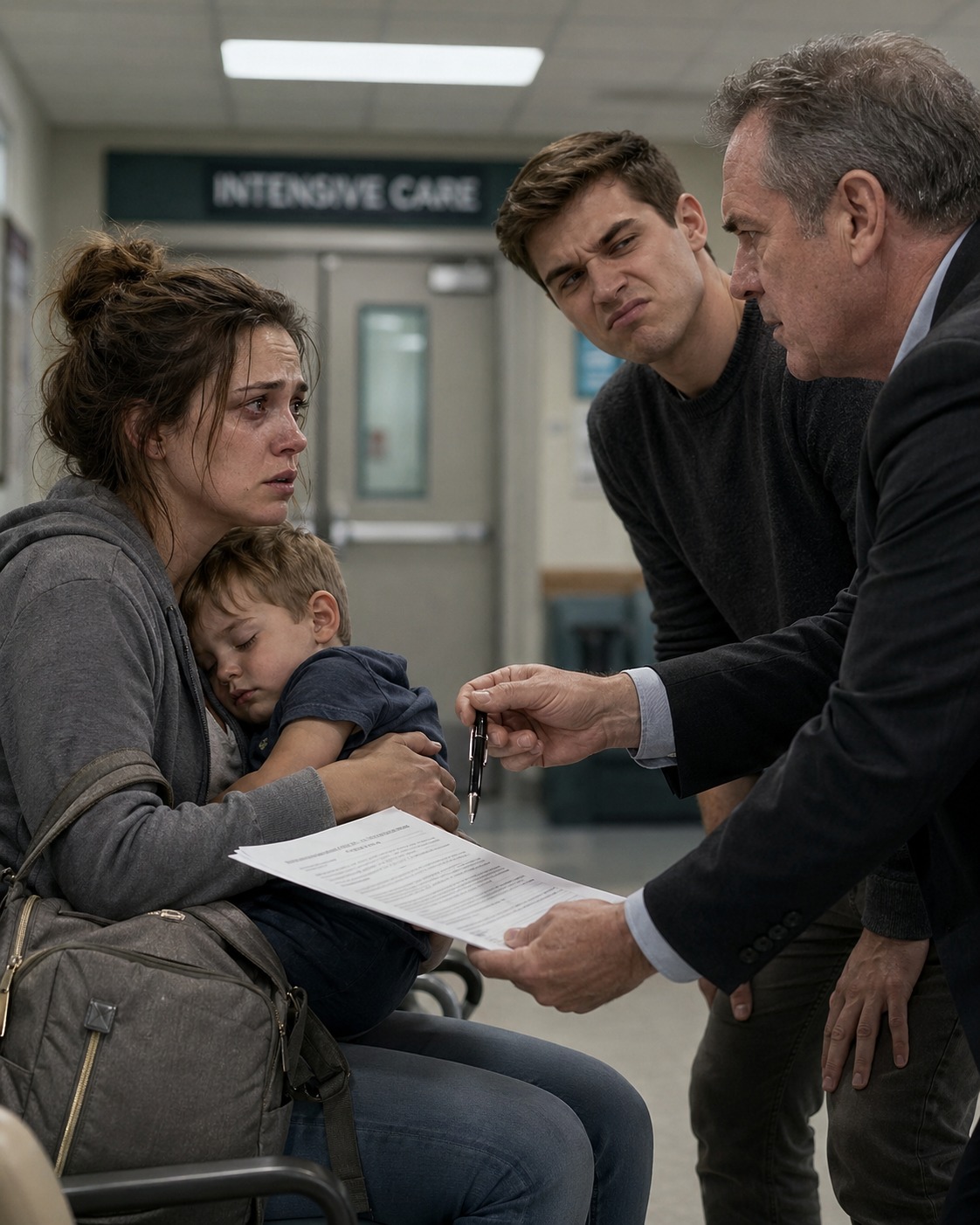
Iván steps in front of you before the notary can reach you.
“This is a private family matter,” he says.
Ramírez looks at him over the rim of his glasses.
“Then it is fortunate I was requested by a member of this family.”
Ernesto forces a laugh.
“Ramírez, this is not the time. My wife is in intensive care.”
“I am aware,” the notary says. “That is why I came.”
The room changes.
Your aunt stops pretending not to listen. A cousin lowers his phone. The neighbor who brought coffee freezes with one paper cup still in her hand. Everyone suddenly understands that the piece of paper on your lap may not be the only document in the hospital tonight.
Ernesto reaches for the paper Iván gave you.
You pull it away.
He smiles with his teeth.
“Sofía was just about to sign a family agreement.”
“No,” Ramírez says.
One word.
Clean. Final.
Ernesto’s jaw tightens.
“No?”
“No,” the notary repeats. “Any document signed in this room, under this pressure, while Mrs. Lucía Morales is medically incapacitated and while witnesses are intimidating her daughter, will be challenged immediately.”
A murmur moves through the waiting area.
Iván’s face burns red.
“Nobody is intimidating her.”
Ramírez turns toward him.
“You offered her money to renounce property in front of relatives while her mother is in intensive care. That is not negotiation. That is coercion with an audience.”
For the first time all night, you feel air enter your lungs properly.
Ernesto steps closer to the notary.
“You have no authority here.”
Ramírez opens his folder.
“I have exactly the authority your wife gave me.”
The word wife hits Ernesto like a slap. Not because it is affectionate, but because it reminds him of something he has forgotten all night. Lucía is not only a body behind hospital glass. She is a woman who signed papers, made decisions, and protected secrets before anyone could silence her.
Ramírez removes a sealed envelope.
Then a second one.
Then a third.
Your fingers tighten around the yellow envelope in your own backpack.
Ernesto sees the movement.
His eyes drop to your bag, and suddenly his fear has a direction.
“What is that?” he asks.
You do not answer.
Ramírez does.
“That is one of the reasons I am here.”
Iván laughs harshly.
“What, did she hire you to create some fake drama? She’s always been good at crying when she wants something.”
Your son stirs in your arms.
You press a kiss to his hair and whisper, “It’s okay, Matías.”
But it is not okay.
It has not been okay for years.
You were five when Ernesto entered your life carrying flowers for your mother and judgment for you. He smiled at Lucía, but looked at you like a stain on the couch. When he married her, everyone said you were lucky because now you had a father figure.
But Ernesto never became a father.
He became a landlord of affection.
Every hug in that house had a price. Every meal came with a reminder. Every birthday of yours was smaller than Iván’s, quieter than Iván’s, cheaper than Iván’s. Ernesto always said Iván was the future of the family, and you were something your mother brought from “before.”
Before him.
Before decency.
Before he decided which people counted.
Ramírez looks at you.
“Sofía, your mother asked me to find you before anyone forced you to sign anything. I tried for two days. Your phone was off yesterday.”
“It died at the hospital,” you say softly.
He nods, then turns toward the room.
“Mrs. Lucía Morales signed a medical directive, a property declaration, and a testamentary update before her hospitalization became critical.”
Ernesto explodes.
“That’s impossible.”
Ramírez does not blink.
“It is not.”
“My wife would never change anything without telling me.”
Your mouth opens before you can stop it.
“She changed plenty without telling you.”
The waiting room goes silent again.
Ernesto looks at you with pure hatred.
“You think because you carried a folder here, you’ve won something?”
“No,” you say. “I think because my mother was afraid of you, she prepared herself.”
That lands.
Your aunt covers her mouth.
Iván steps toward you.
“You ungrateful—”
Ramírez raises one hand.
“Careful.”
Iván stops, not because he respects the notary, but because everyone is watching.
Ernesto grabs the paper from the table and shoves it toward you again.
“Sign it. Now. Then you can see your mother.”
The cruelty is so naked that even the relatives who disliked you look uncomfortable.
You take the paper.
For one second, Ernesto relaxes.
Then you tear it in half.
The sound is small, but it travels through the lobby like thunder.
Iván lunges forward.
“You stupid—”
“Security,” Ramírez says sharply.
A nurse at the desk reaches for the phone.
Ernesto lifts his hands, suddenly dignified.
“No need. She is hysterical.”
You laugh once, bitter and low.
There is that word again.
Hysterical.
The favorite costume men throw over women when truth becomes inconvenient.
The intensive care doors open again. The nurse looks between Ernesto, you, and the notary.
“Only one family member may enter now.”
Ernesto straightens.
“I’m her husband.”
The nurse nods and starts to gesture him forward.
Ramírez removes a document from his folder.
“Mrs. Lucía Morales designated her daughter, Sofía Morales, as her medical decision representative in the event of incapacity.”
The nurse pauses.
Ernesto turns slowly.
“What?”
Ramírez hands the document to the nurse.
“It is notarized and dated three days before admission.”
Iván’s face twists.
“That’s fake.”
The nurse scans it, then looks at you.
“You may come in.”
Your knees almost give out.
Ernesto steps in front of the door.
“She is not going in before me.”
The nurse’s voice hardens.
“Sir, move.”
“I am her husband.”
“And this document names her daughter.”
Ernesto does not move.
Two security guards appear at the end of the hall.
That is when he finally steps aside, but his eyes stay fixed on you.
“This is not over,” he says.
You hold Matías out to your aunt, the only one who has not looked at you like an enemy.
“Please,” you whisper.
She takes him gently.
“Go,” she says.
You enter the ICU.
The world behind those doors is colder, quieter, filled with machines that breathe, beep, and measure what love cannot control. Your mother lies beneath white sheets, an oxygen mask covering half her face. Her skin looks too thin. Her hands, the same hands that sewed uniforms until dawn, rest limp beside her.
For a moment, you forget inheritance.
You forget Ernesto.
You forget everyone waiting outside to divide her life before it has even ended.
You go to her side and take her hand.
“Mamá,” you whisper. “I’m here.”
Her eyelids flutter.
You lean closer.
“It’s Sofía. I’m here.”
Her fingers move against yours.
Barely.
But enough.
You start crying silently.
Not the kind of tears you can control. The kind that slip out because the body recognizes its first home and sees it fighting to stay.
Your mother’s eyes open halfway.
“Sofi,” she breathes.
“I’m here. Don’t talk. Just rest.”
Her gaze shifts toward the door.
Even weak, even barely conscious, she is afraid.
You know who she is looking for.
“He can’t come in right now,” you say. “Ramírez is here.”
A tear slides from the corner of her eye.
Her fingers squeeze yours with surprising strength.
“Don’t sign.”
“I didn’t.”
Her eyes close with relief.
Then she whispers something you almost do not understand.
“The envelope.”
Your heart begins pounding.
“I have it.”
Her mouth trembles beneath the oxygen mask.
“You need to know.”
You lean closer.
“Mamá, later.”
“No,” she breathes. “Now.”
A nurse enters, checks a monitor, and looks at you with warning in her eyes.
“She shouldn’t speak much.”
Your mother ignores her.
Always stubborn.
Always yours.
“Ernesto,” she whispers. “He knew.”
Your blood turns cold.
“Knew what?”
Her eyes open again, full of apology so deep it frightens you.
“He is your father.”
The room tilts.
For a second, the monitor sounds far away. Your hand remains in hers, but you cannot feel your fingers. You stare at your mother, waiting for her to take it back, to say fever is confusing her, to say you misunderstood.
But she does not.
She cries.
And that is worse than any explanation.
“No,” you whisper.
“I’m sorry.”
You step back, then forward again, trapped between anger and terror.
“No. Ernesto is my stepfather.”
Your mother shakes her head weakly.
“I was young. Before him, before everything. He left when I told him I was pregnant. He said it wasn’t his. He called me a liar.”
The words enter you like broken glass.
“Then why did you marry him?”
Her face twists with shame.
“Because he came back. Because he begged. Because he said he wanted to fix it. Because I thought a bad father might become a good one if he had a second chance.”
Your throat closes.
“And he knew?”
Her silence answers.
You look toward the ICU door.
Ernesto, the man who called you “the burden,” “the package,” “the other,” was not only cruel to a child who was not his.
He was cruel to his own daughter.
Your mother’s hand tightens.
“I did the test,” she whispers. “For you. For Matías. For what comes next.”
“What comes next?”
She struggles to breathe.
“The inheritance.”
The nurse steps forward.
“That’s enough.”
Your mother’s eyes do not leave yours.
“Ramírez knows.”
Then the machine beside her begins beeping faster.
The nurse moves quickly, calling for help. Another nurse enters. Then a doctor. You are pushed back gently, then firmly, as the room fills with urgent voices.
You stand against the wall with your hands over your mouth.
The last thing your mother sees before they make you leave is your face.
And you pray it is enough.
Outside, Ernesto is waiting.
He knows something happened the moment he sees you.
“What did she say?” he demands.
You walk past him.
He grabs your arm.
“What did she say?”
You look down at his hand.
Then you look up at him.
For the first time in your life, you see him differently.
Not bigger.
Not stronger.
Not the man whose approval you were denied for so long that part of you confused the denial with power.
You see a coward who abandoned a pregnant woman, married her years later, punished the child he created, and then tried to steal from her at the hospital.
“Let go of me,” you say.
His grip tightens.
Security moves.
Ramírez steps between you.
“Remove your hand, Ernesto.”
The way the notary says his name tells you everything.
He knows too.
Ernesto lets go.
You pull the yellow envelope from your backpack.
Iván’s eyes narrow.
“What is that?”
You hold it against your chest.
“The truth.”
Ernesto lunges for it.
Security catches him before he reaches you.
The waiting room erupts.
Your aunt shouts. Elena screams that you are making a scene. Iván curses at the guards. Someone’s coffee spills across the floor. Through all of it, Ramírez remains still beside you.
“Not here,” he says quietly. “Not like this.”
You want to open the envelope in front of everyone. You want to shout the result so loudly that every relative who ever smirked at you has to swallow it whole. You want Ernesto humiliated exactly where he tried to humiliate you.
But then you hear the machines behind the ICU door.
Your mother is still fighting.
So you do the hardest thing.
You wait.
At 4:12 in the morning, Lucía Morales dies.
Not dramatically.
Not like in movies.
There is no final speech, no sudden miracle, no last grip of your hand. There is only a doctor with tired eyes, a hallway too bright for grief, and a sentence that cuts the world into before and after.
“We’re sorry.”
Your aunt is holding Matías when you collapse.
For a few seconds, you are not strong. You are not strategic. You are not the woman with documents and DNA results and a notary beside her. You are just a daughter whose mother is gone.
Your father was never in your life.
Or so you thought.
Your mother was everything.
And now everything has a death certificate.
Ernesto tries to enter the room first.
The nurse stops him.
He argues. He says he is the husband. He says he has rights. He says you are unstable and should be removed from the hospital.
The doctor looks at the medical directive.
Then at you.
“Ms. Morales, would you like a few minutes with your mother?”
You nod.
Ernesto is not allowed in.
That small mercy becomes the first justice of the morning.
You sit beside your mother’s body and hold her hand one last time. It is already cooling. You press your forehead to her knuckles and remember all the times those hands held you when fever took you, braided your hair for school, pushed coins into your palm when you pretended not to need them.
“I know,” you whisper.
You are not sure whether you mean the secret, the apology, or the love.
Maybe all of it.
The funeral happens two days later.
Ernesto tries to control that too.
He orders flowers in his name. He chooses the largest arrangement. He stands at the entrance shaking hands like a politician, accepting condolences with a tragic expression he probably practiced in the mirror.
Iván stands beside him in a black suit, looking wounded and important.
You arrive with Matías on your hip, wearing a simple black dress and your mother’s silver earrings.
The room quiets when you enter.
Grief has a strange way of revealing alliances. Some relatives look away, ashamed of what they saw at the hospital. Others stare openly, waiting for the next chapter. A few come to hug you, whispering that your mother loved you deeply, as if you needed witnesses for that.
Ernesto approaches you near the casket.
“You are not making a spectacle today,” he says under his breath.
You look at your mother’s face.
Peaceful.
Too peaceful for a woman who spent her last days preparing defenses against the man standing beside her coffin.
“No,” you say. “Today is hers.”
He leans closer.
“After the burial, we settle this.”
You turn your head slowly.
“Yes,” you say. “We do.”
The will reading is scheduled three days after the funeral.
Ernesto arrives first, of course. Iván sits beside him. Two of Ernesto’s cousins come as “support,” though everyone knows they are there to hear numbers. You arrive last with Ramírez, your son, and a calm so complete it almost scares you.
The office smells like leather, old paper, and rain.
Ramírez places a recorder on the table.
Ernesto scoffs.
“Is that necessary?”
“Yes,” Ramírez says.
Iván rolls his eyes.
“Let’s get this over with.”
You sit across from them.
Matías sleeps in his stroller, unaware that adults are about to fight over the bones of a woman who would have traded every property for one more morning with him.
Ramírez opens the file.
“Mrs. Lucía Morales executed this will while fully competent, in the presence of two witnesses and with medical certification attached.”
Ernesto interrupts.
“She was confused.”
Ramírez looks up.
“She was not.”
“She was medicated.”
“The document predates the intensive care admission.”
“She was manipulated.”
Ramírez pauses.
“By whom?”
Silence.
You almost smile.
Ernesto looks away.
The notary begins reading.
Your mother leaves the house in San Pedro to you.
The uniform business, including equipment, contracts, and accounts, to you.
The land in García to you, with instructions that a portion of its future profit be placed in an education fund for Matías.
A smaller bank account is left to Iván, but only if he does not contest the will or attempt to force transfer of assets.
Ernesto receives nothing from the assets your mother owned before marriage.
Nothing.
The word fills the room without being spoken.
Ernesto’s face becomes stone.
Iván slams his hand on the table.
“That’s impossible. I’m her son too.”
Ramírez continues.
“Mrs. Morales included a personal letter explaining her decision.”
“No,” Ernesto snaps.
Ramírez ignores him.
He unfolds the letter.
Your mother’s handwriting appears across the page, slanted and familiar, the same writing that labeled school supplies, grocery lists, and birthday cards.
Ramírez reads aloud.
“To my daughter Sofía: I failed you by allowing silence to protect a man who did not deserve protection. I let you grow up believing you were unwanted by your father, when the truth was worse. He knew. He denied you anyway.”
Your vision blurs.
Ernesto stands.
“Stop reading.”
Ramírez continues.
“I married Ernesto because I believed guilt could become love. I was wrong. He punished you for existing because your existence proved his cowardice.”
Iván turns to Ernesto.
“What is he talking about?”
Ernesto does not answer.
The notary lifts the second envelope.
“Attached to the will is a certified DNA report.”
Your heartbeat becomes loud in your ears.
Ramírez reads the result.
“Probability of paternity: 99.9998 percent. Ernesto Salazar is the biological father of Sofía Morales.”
The room dies.
Iván stares at you.
Then at Ernesto.
Then back at you.
“No,” he says.
Ernesto’s voice comes out hoarse.
“That test is fake.”
Ramírez slides copies across the table.
“It was conducted with chain-of-custody samples obtained during a prior legal consultation. Mrs. Morales preserved the report in my office and instructed me to release it if any attempt was made to dispossess Sofía.”
Ernesto’s hand shakes as he picks up the paper.
You watch his eyes move over the result.
He is not reading something new.
He is reading something confirmed.
That is when you know.
He knew.
Maybe not through a lab all those years, but he knew enough. He knew the dates. He knew your mother. He knew the possibility and chose cruelty anyway.
Iván stands so fast his chair scrapes the floor.
“You’re my sister?”
You look at him.
“I always was.”
He flinches.
It is the first honest pain you have ever seen on his face.
But pain does not erase what he did.
Ernesto throws the paper onto the table.
“Blood doesn’t change anything.”
Ramírez folds his hands.
“In this matter, it changes several things.”
Ernesto freezes.
The notary opens another file.
“Your father, Don Aurelio Salazar, established a family trust before his death. Its assets include rental properties, investment accounts, and two commercial lots. The trust language names all biological descendants of Ernesto Salazar as beneficiaries.”
Iván turns pale.
You do not move.
Ramírez continues.
“Until now, Iván was listed as Ernesto’s only child. The DNA result changes the beneficiary structure.”
Ernesto’s eyes go wild.
“No.”
“Yes,” Ramírez says. “Sofía has legal standing to claim her share.”
You almost cannot process it.
All your life, Ernesto called you extra.
A burden.
The child from before.
Now the same blood he denied opens the door to the inheritance he tried to reserve for the son he favored.
The irony is so sharp it feels unreal.
Iván points at you.
“She planned this.”
You finally speak.
“I planned to see my mother before she died.”
The room goes quiet.
Your voice stays steady.
“You planned to make me sign away her house while she was on oxygen.”
Iván looks down.
Ernesto does not.
He is too far gone in rage.
“You’ll never get a peso from my family.”
You lean forward.
“I don’t want your family. I want the truth, and I want what my mother protected.”
He laughs bitterly.
“You think court will believe you?”
Ramírez closes the file.
“They will believe certified documents.”
The legal fight begins the next morning.
Ernesto contests the will.
Iván joins him.
They claim your mother was unstable. They claim you manipulated her. They claim the DNA test is fraudulent. They claim you are greedy, bitter, and opportunistic. They use every word people use when a woman refuses to be robbed politely.
You answer with documents.
Medical certification.
Witness statements.
Business records.
Property deeds.
Bank trails.
The DNA report.
Then the court orders a second DNA test.
Ernesto refuses.
That refusal becomes its own confession.
When he is finally compelled, the result comes back the same.
99.9999 percent.
Your father is the man who spent your childhood pretending you were not his.
For three days after the official result, you cannot sleep.
Not because you feel joy.
There is no joy in discovering that the person who rejected you had no excuse. There is only grief wearing a new face. You mourn the father you never had, and then you mourn the stepfather excuse that had protected you from the worst truth.
He was not incapable of loving a child.
He loved Iván.
He simply decided you were the evidence of his shame.
One afternoon, Iván comes to your apartment.
You almost do not open the door.
He stands in the hallway wearing jeans and a wrinkled shirt, nothing like the polished son from the hospital. His eyes are red. His confidence is cracked.
“I didn’t know,” he says.
You hold the door halfway open.
“That he was my father?”
He nods.
You believe him.
Then you remember the paper he pushed into your lap while your mother was dying.
“But you knew you were hurting me.”
He swallows.
“Yes.”
That honesty surprises you.
He looks down.
“My whole life, he told me you wanted to take what was mine.”
“You had everything.”
“I know.”
“No,” you say quietly. “I don’t think you do.”
He looks at you.
“You had birthdays where he smiled. School events where he showed up. Photos in the living room. A room he didn’t enter only to criticize. A last name that opened doors in that house.”
His eyes fill.
“I’m sorry.”
You want to accept it.
Part of you does.
But apology is not a broom. It cannot sweep away years in one motion.
“You helped him corner me in the hospital.”
“I know.”
“You offered me money to disappear.”
His face breaks.
“I know.”
You look at him for a long moment.
“What do you want, Iván?”
He pulls an envelope from his jacket.
Inside is a signed statement.
He is withdrawing his challenge to your mother’s will.
“I can’t fight you for what she clearly wanted you to have,” he says.
You read it twice.
Your eyes sting.
“Why?”
He laughs once, empty.
“Because when the second DNA test came back, I asked him if he was sorry.”
You wait.
“He said he was sorry you found out.”
There it is.
Ernesto’s entire soul in one sentence.
You fold the paper.
“Thank you.”
Iván nods.
He turns to leave, then stops.
“She loved me, right?”
For the first time, he sounds like a child.
Your mother raised him. Fed him. Stayed up when he had fevers. Sewed his costumes. Saved his drawings. You know the answer, even if resentment wants to make it complicated.
“Yes,” you say.
He closes his eyes.
“Good.”
Then he leaves.
The case changes after that.
Without Iván, Ernesto looks less like a wronged widower and more like what he is: a man trying to control property that never belonged to him. His lawyers become colder. His relatives stop attending hearings. The people who once filled hospital chairs to watch your humiliation suddenly have appointments elsewhere.
Truth makes cowards busy.
The judge upholds your mother’s will.
The San Pedro house becomes yours.
The uniform business becomes yours.
The García land is transferred into your name with Matías’s education fund protected.
Then comes the Salazar trust.
That fight is uglier.
Ernesto argues that you may be biologically his daughter, but you were never publicly recognized. Your lawyer argues the trust does not require emotional recognition, only biological descent. The language is clear. Blood descendant.
The same blood Ernesto denied becomes the law’s answer.
The court orders the trust amended.
You receive a share equal to Iván’s.
Not because Ernesto wants it.
Because Don Aurelio’s own documents demand it.
When the ruling arrives, you sit alone in your kitchen with Matías asleep in the next room. The numbers on the page are larger than anything you expected. Rental income. Commercial lots. Investment distributions. Back payments from the date of your claim.
It is not just money.
It is the collapse of every lie Ernesto built.
You cry then.
Not from happiness.
From exhaustion.
Your mother should have been there. She should have seen the court say what she could not safely say for years. She should have seen the man who called you a burden forced to write your name beside his.
A week later, Ernesto asks to meet.
Your lawyer advises against it.
You agree anyway, but only in her office.
He arrives looking older. His suit is expensive but loose at the shoulders. His hair is still perfectly combed, but there are deep shadows under his eyes. Rage has aged him faster than grief ever did.
He does not sit at first.
He looks at you like he is searching for the little girl who used to lower her eyes.
She is gone.
Finally, he sits.
“You destroyed my life,” he says.
You almost smile.
“No. I inherited the truth.”
His jaw clenches.
“You turned my son against me.”
“You did that when you told him you were only sorry I found out.”
His eyes flicker.
So Iván told the truth.
Good.
Ernesto leans back.
“You think that money makes you my daughter?”
“No.”
“Then what do you want from me?”
You look at him carefully.
There was a time when you wanted an apology so badly you might have accepted a bad one. A rushed one. A fake one. Anything that sounded like proof you had not imagined the cruelty.
Now you realize something.
Some people are incapable of giving closure because they would have to enter the truth to hand it over.
“I don’t want anything from you,” you say.
He laughs.
“You took half my trust.”
“No,” you say. “Your father gave it to his descendants. You just forgot I was one.”
His face turns red.
“I never accepted you.”
That used to be the wound.
Now it is only information.
“You never had to,” you say. “The DNA did.”
For the first time, Ernesto has no answer.
You stand.
“This is the last time I will meet with you privately. Any future communication goes through lawyers.”
He stares up at you.
“You’re just like your mother.”
The words hit you differently than he intends.
You smile.
“Thank you.”
Then you leave him sitting there.
Six months later, the San Pedro house no longer feels haunted.
You move in slowly.
At first, every room hurts. The kitchen remembers your mother’s hands. The sewing room still smells faintly of fabric, steam, and lavender soap. The hallway holds echoes of arguments you were too young to understand.
But you change what needs changing.
Not to erase her.
To free the house from him.
You repaint the front room. You turn Ernesto’s old office into a playroom for Matías. You donate the heavy furniture he loved because it made the house look important and replace it with warm wood, soft chairs, and shelves filled with your mother’s photos.
In the sewing room, you keep one machine.
The oldest one.
The one your mother used when she had nothing but stubbornness and thread.
You place her silver thimble beside it in a small glass box.
The uniform business surprises everyone.
Especially you.
At first, you plan to sell it. You know contracts, not production. You are tired. You want simplicity. But then you visit the workshop and find twelve women who knew your mother not as Lucía the patient or Lucía the wife, but Lucía the boss.
They tell you stories.
How she paid advances when someone’s child needed medicine.
How she refused to cut corners on hospital fabric because “nurses deserve dignity too.”
How she kept working after Ernesto told people he was the one supporting the family.
So you keep it.
You hire an accountant.
You modernize orders.
You rename the company Lucía Medical Wear.
The first time you see your mother’s name printed on new packaging, you have to sit down.
Matías runs his little hand across the logo.
“Abuela,” he says.
“Yes,” you whisper. “Abuela.”
Iván comes by the workshop one afternoon.
You are cautious when you see him.
He does not ask for money. He does not ask to be part of the business. He only brings a box of your mother’s old recipe cards, school photos, and letters he found in Ernesto’s storage unit.
“I thought you should have these,” he says.
You open the box and see your childhood.
Not all of it.
Enough.
A drawing you made at seven. A photo of you missing two front teeth. A birthday card your mother kept even though Ernesto probably never noticed it existed.
Your throat tightens.
“Thank you.”
Iván nods.
“I’m leaving Monterrey for a while.”
“Where?”
“Querétaro. A job.”
You study him.
“Running away?”
He gives a small, sad smile.
“Maybe growing up.”
You can respect that.
Before he leaves, he looks around the workshop.
“She would like what you did.”
You touch the box.
“I hope so.”
“She would.”
For the first time, you believe he means it without trying to take anything.
You are not close after that.
But you are not enemies either.
Sometimes survival gives people separate roads instead of perfect reconciliation. That is still mercy.
A year after your mother’s death, you hold a small gathering at the San Pedro house.
Not a memorial full of black clothes and whispers.
A dinner.
Your mother loved feeding people, so you cook her recipes badly and let your aunt correct everything. Workers from the shop come. A few cousins who apologized properly are invited. Iván comes with flowers and stands awkwardly in the doorway until Matías grabs his hand and pulls him inside.
There is laughter in the house again.
Real laughter.
Not Ernesto’s sharp laugh.
Not Iván’s old cruel laugh.
Warm laughter that rises into the ceiling and makes the walls seem less tired.
After dinner, you stand in the patio alone.
The night air is cool. Somewhere nearby, a dog barks. The city glows beyond the garden wall, alive and indifferent.
Your lawyer calls.
The final transfer from the Salazar trust has cleared.
It is done.
All of it.
You look up at the dark sky.
For a moment, you imagine your mother sitting beside you, wiping her hands on an apron, pretending not to cry because she hated being seen as fragile.
“You did it,” you whisper.
Then you correct yourself.
“We did.”
A few weeks later, Ernesto dies of a heart attack.
The news comes through a formal message from a lawyer, not from family. You read it twice and feel something complicated move through you. Not grief exactly. Not relief exactly. More like the end of a noise you had heard for so long that silence feels strange.
There is another will.
Of course there is.
Ernesto tried to leave everything to Iván and specifically exclude you by name.
But most of what mattered was no longer his to control.
The trust had already been amended. Your mother’s property had already transferred. The business was thriving under her name. The house was full of life he could no longer enter.
His last attempt to erase you arrives too late.
At his funeral, you do not sit in the front.
You go because Iván asks you to, and because hatred is still a chain if you polish it too often.
The service is quiet.
Smaller than Ernesto would have wanted.
Iván looks broken, but not in the arrogant way he once performed grief at the hospital. This grief is private. Honest. Confused. He loved a man who lied to him too, and that is its own kind of wound.
After the burial, Iván stands beside you.
“He was your father,” he says.
You look at the grave.
“No,” you answer softly. “He was my biological fact.”
Iván exhales.
“That’s fair.”
You place one white flower on the grave.
Not for Ernesto.
For the little girl in you who waited years for a father to look at her and see his own eyes.
Then you walk away.
Life does not become perfect after truth wins.
That is something people do not tell you.
You still wake some mornings angry. You still wonder what your mother endured in silence. You still look at Matías and promise yourself he will never have to earn love from someone who owes it freely.
But life becomes yours.
That is better than perfect.
Two years after the hospital, Lucía Medical Wear wins a major contract with a private hospital network. The same kind of hospital where your mother spent her last days. The first delivery includes uniforms stitched with stronger seams, softer fabric, and your mother’s name printed on every box.
You attend the signing in a navy suit.
Matías is with your aunt for the afternoon.
The director shakes your hand and says, “Your mother built a strong foundation.”
You smile.
“She did.”
After the meeting, you drive past the hospital where everything changed.
For a moment, you see yourself there again.
Tired. Humiliated. Holding a sleeping child. A paper on your lap. A family watching to see whether you would break.
You wish you could go back and tell that woman what was coming.
That the paper would not win.
That the notary would arrive.
That the DNA result would not heal the wound, but it would name it.
That the inheritance would change, yes, but the real inheritance was not the house, the land, the business, or the trust.
The real inheritance was your mother’s final act of protection.
Her last gift was not money.
It was proof.
Proof that you were never the burden.
Proof that the man who rejected you was the one carrying shame.
Proof that your name belonged in every room where they tried to erase it.
That night, you return home to the San Pedro house.
Matías runs to you at the door, wearing pajamas with dinosaurs and holding one of your mother’s old measuring tapes like a toy.
“Mommy, look! Abuela’s snake!”
You laugh and scoop him up.
“That is not a snake, baby. That’s how Abuela measured things.”
He stretches it between his little hands.
“Can we measure me?”
So you do.
You stand him against the kitchen wall, the same wall where your mother once measured you with pencil marks Ernesto painted over because he said they made the house look messy.
You mark Matías’s height carefully.
Then, below it, you write the date.
You stare at the small pencil line.
A child’s growth recorded where no one can erase it.
Your eyes fill.
Matías looks up.
“Are you sad?”
You kiss his forehead.
“No,” you say. “I’m remembering.”
He accepts this with the wisdom of children and runs back to his toys.
You remain by the wall a moment longer.
Then you open a drawer and take out the silver thimble from your mother’s sewing box. You hold it in your palm, small and worn and stronger than it looks.
Just like her.
Just like you.
Outside, Monterrey glows beneath the night.
Inside, your son laughs.
The house is warm.
The business carries your mother’s name.
The land in García is being developed into a scholarship fund for children of working mothers.
And the inheritance Ernesto tried to steal has become something he never understood.
Not power.
Not revenge.
Not status.
Legacy.
You turn off the kitchen light and walk toward your son’s laughter.
Behind you, on the wall, the new pencil mark remains.
A small line.
A permanent truth.
Proof that this family will never again be measured by the men who refused to love it.