The rain that night was more than water; it fell like a curtain of liquid steel over the city, erasing the outlines of buildings and turning the roads into dark, dangerous rivers.

André drove his luxury sedan with the same mechanical precision that had defined his life for the past twenty years. The windshield wipers fought the downpour in a hypnotic rhythm, a metronome counting the seconds of a solitary, successful existence.
To the outside world, André had everything: a business empire, ever-growing bank accounts, properties in the most exclusive areas, and the wary respect of his competitors. Yet inside the silent, climate-controlled cabin of his car, the truth was a deafening emptiness. No one waited for him at home—only the echo of his own footsteps on cold marble.
That night, his mind drifted between corporate mergers and performance charts, his usual refuge from the loneliness waiting for him. But fate, sudden and unpredictable, was about to intervene. As he took a sharp turn on a dimly lit side road, something caught his peripheral vision. Just a shadow, a strange shape at the edge of the asphalt, battered by the storm’s fury. Anyone else might have sped past, dismissing it as a trash bag or a stray animal, staying safe inside their bubble. But André felt a chill that didn’t come from the air conditioning. An inexplicable urge—almost beyond his control—forced him to hit the brakes.
The car came to a smooth stop on the muddy shoulder. André glanced in the rearview mirror, torn between caution and that strange inner pull. In the end, curiosity and a spark of humanity won. He rolled down the window. The roar of the storm flooded in, carrying the scent of wet earth and ozone. Squinting through the rain lit by his taillights, what he saw froze his blood, stopping his heart for a suspended instant.
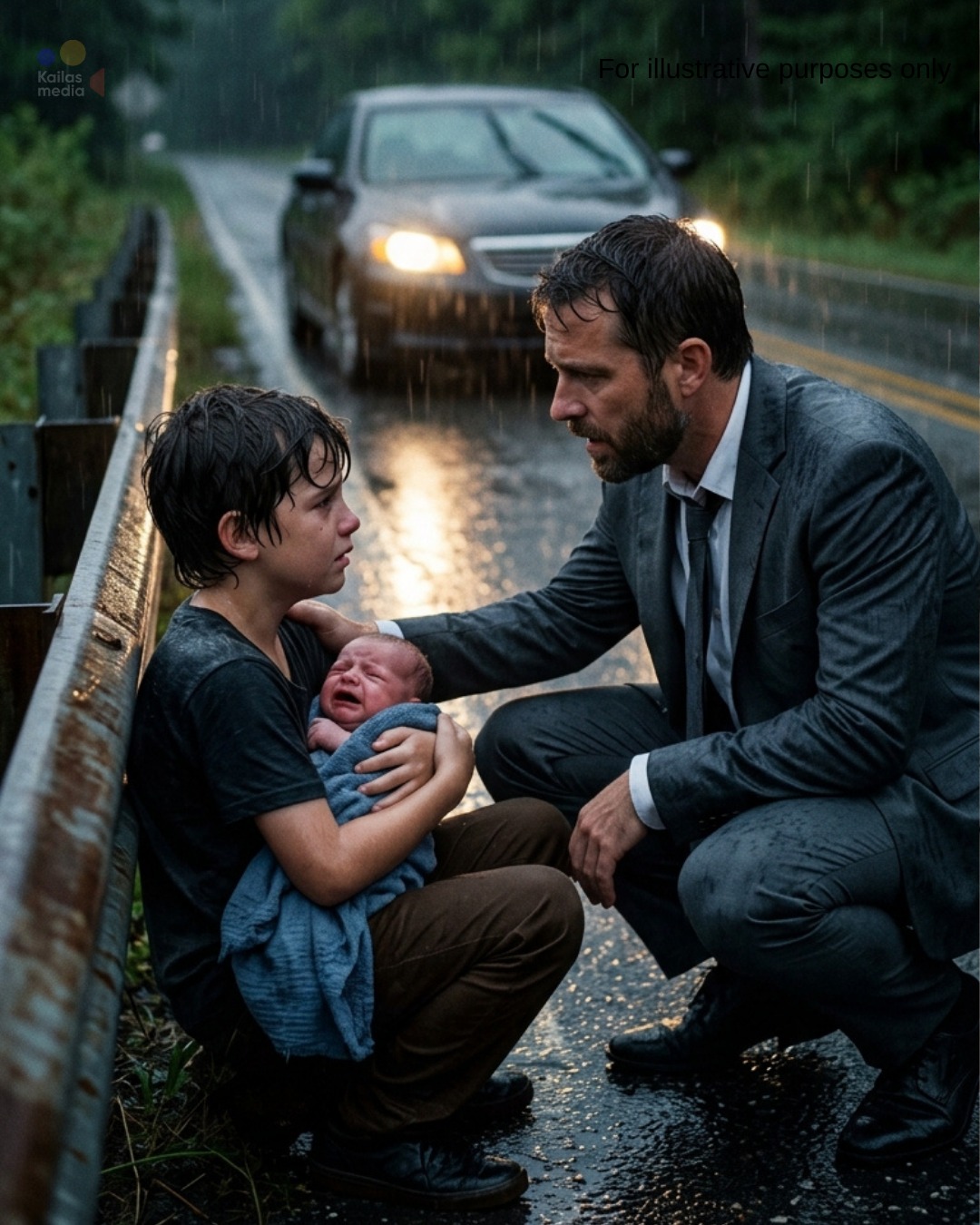
There, beneath the thin branch of a struggling tree that offered almost no shelter, was a child. No older than ten or eleven. Soaked to the bone, their clothes reduced to rags clinging to a skeletal body trembling in violent shivers. But what shattered André wasn’t the child’s condition—it was the posture. The child wasn’t hugging themselves for warmth. Their arms were stiff and protective, cradling a small bundle against their chest, curling their body into a shield against the freezing rain and wind.
André didn’t think. He forgot his Italian suit, forgot safety, forgot every warning about danger on dark roads. He opened the door and ran toward them, rain soaking through his shirt instantly. When he reached the tree, the child looked up. André expected fear, maybe pleading. Instead, he saw enormous dark eyes filled with fierce, untamed determination—the eyes of a soldier in a lost war, ready to die before surrendering.
“What are you doing here?” André shouted over the thunder, pulling off his jacket to cover the child.
The child stepped back, wary, clutching the bundle tighter. Then a faint cry—barely audible—rose from within their arms. André froze. It wasn’t a doll, food, or clothes the child was protecting.
“She’s my sister,” the child said, voice breaking from cold and desperation. “She’s hungry. Please, sir… she’s hungry.”
André looked at the tiny face peeking from the dirty cloth. A baby. Just a few months old, her skin pale, lips tinged purple. The truth hit him like a freight train. These children weren’t waiting for a bus. They were surviving. They were dying.
“Where are your parents?” André asked, though deep down he already knew.
The child lowered their gaze, and for a moment the mask cracked. “They left,” they whispered—two words carrying the weight of the world. “They said they couldn’t anymore. They’d come back, but… we’ve been walking for three days. They’re not coming back.”
Three days. Three days in the rain, without food, walking nowhere, carrying the weight of another life while still a child. André felt a deep nausea—anger at the world mixed with overwhelming compassion burning in his chest. He looked at his warm, gleaming car, then back at the abandoned children.
“Come on,” André said, his voice firm even to himself. “Get in the car. Now.”
The child hesitated. The streets had taught them that kindness often comes with a terrible price. But the baby’s cries grew sharper, more desperate. The child looked at her, then into André’s eyes, searching for any trace of harm. Finding none—only urgency—they nodded. André helped them into the back seat, wrapping them in a travel blanket from the trunk.
The drive back to the city was silent, broken only by the heater blasting and the children’s uneven breathing. André checked the rearview mirror constantly, making sure they were real. The boy, who said his name was Davi, stayed alert, watching everything. The baby, Sofia, had stopped crying, lulled by warmth.
When they arrived at the mansion, its grandeur felt absurd compared to the fragility of its new guests. Rita, the housekeeper who had been with André since before his first gray hair, came to greet him, ready to scold him for being late. The words died in her throat when she saw him—soaked, muddy, carrying a baby, with a boy clinging to his leg.
“Good heavens, Mr. André…” Rita whispered, hands covering her mouth.
“They need food, Rita. Hot. And a bath. And dry clothes. Now,” André ordered with urgency he never used in business.
That night, the mansion came alive in a way it never had. Rita moved like a storm, preparing soup, warm milk, and makeshift pajamas from André’s old shirts. André stood in the kitchen doorway, watching. Davi ate with painful hunger, yet paused to make sure Sofia drank first. That loyalty shattered the last wall around André’s heart.
Clean and fed, exhaustion finally claimed Davi. He fell asleep in a guest room, his hand dangling near the improvised crib where Sofia slept. André sat in a chair nearby, watching. He couldn’t sleep. If he closed his eyes, he feared this chance at redemption would vanish.
Morning brought reality. André called his lawyer.
“It’s complicated,” Marcelo said. “You must report it. They’ll search for family. If none are found, the children go to an orphanage. You’re a single older man with no relation—temporary custody is unlikely.”
“They’re not going to an orphanage,” André said firmly. “Find a way. I don’t care what it costs.”
Days became weeks. With influence and a generous “donation,” André secured temporary custody. During that time, something magical happened. The silence in the house disappeared, replaced by footsteps, laughter, and a baby’s cries for care—not survival.
André learned to change diapers, distinguish Sofia’s cries, and discovered Davi’s brilliant, curious mind. They studied together, and Davi slowly let his guard down. He stopped hiding food. He stopped flinching at noise. He began calling André “sir,” then “uncle,” and eventually, in quiet moments, simply looked to him for safety. A bond formed—not of blood, but of mutual rescue.
But happiness built on fragile ground cannot last untouched. Three months later, the call came. A relative had been found.
Their mother had vanished, but their grandmother, Helena, was located. She wanted the children.
The house fell silent again. Davi’s fear returned.
“Are they taking us?” he asked.
“I’ll do everything I can,” André promised.
“I don’t want to go. You’re my dad now,” Davi said, piercing André’s heart.
At the hearing, the courtroom felt cold and detached. Helena wasn’t cruel—just a grieving grandmother. The judge listened to both sides: blood versus stability.
Then he called Davi forward.
“My grandmother is good,” Davi said, voice steady. “But she wasn’t there.”
He paused, fighting tears. “When it rained and Sofia cried from hunger… no one stopped. Cars passed. We were invisible. I thought we would die. But he stopped.” He pointed at André. “He gave us his coat, his home, taught me not to fear the dark. A father isn’t who makes you—it’s who saves you. He saved me. He’s my father.”
Silence filled the room.
Then Helena stood, trembling. “I can’t break that bond,” she said. “I withdraw my request. I only ask to be their grandmother.”
The judge, moved, granted André permanent custody with open visitation.
Years passed like chapters in a story. The mansion became a home filled with laughter, photos, and love. Helena became a constant, healing her own wounds through her grandchildren.
Davi grew into a driven young man, studying medicine to save lives. Sofia became a confident young woman studying law. André aged, but gently, shifting from business to purpose, building foundations to help children like them.
At Davi’s graduation, he spoke: “I wouldn’t be here without one moment of compassion. Dad, this degree has my name—but it’s yours.”
Later, André’s heart began to fail. In poetic irony, Davi—now a doctor—oversaw his care.
“Don’t worry, Dad,” he whispered. “I’ll take care of you. Like you took care of me.”
The surgery succeeded.
Together, they founded the “Davi and Sofia Home,” a shelter for children—not an institution, but a place of warmth. André became a grandfather figure to all, reading stories and listening.
Years later, on a golden autumn evening, André sat on the porch watching Davi’s son run through the yard.
“Do you remember the rain?” André asked softly.
“Every time it rains,” Davi replied.
“I almost didn’t stop…” André whispered.
“But you did,” Davi said, placing his hand over his father’s. “And because you did, all of this exists.”
André looked at the horizon, peace settling in his soul. Life, he realized, is made of moments—and sometimes the most important one is born in darkness.
“It was worth it,” he whispered. “Every second.”
The sun set, giving way to stars. But on that porch, there was no darkness—only the enduring light of a family built not by blood, but by the brave choice to love without condition.